Strategic Negotiations in the Semiconductor Market
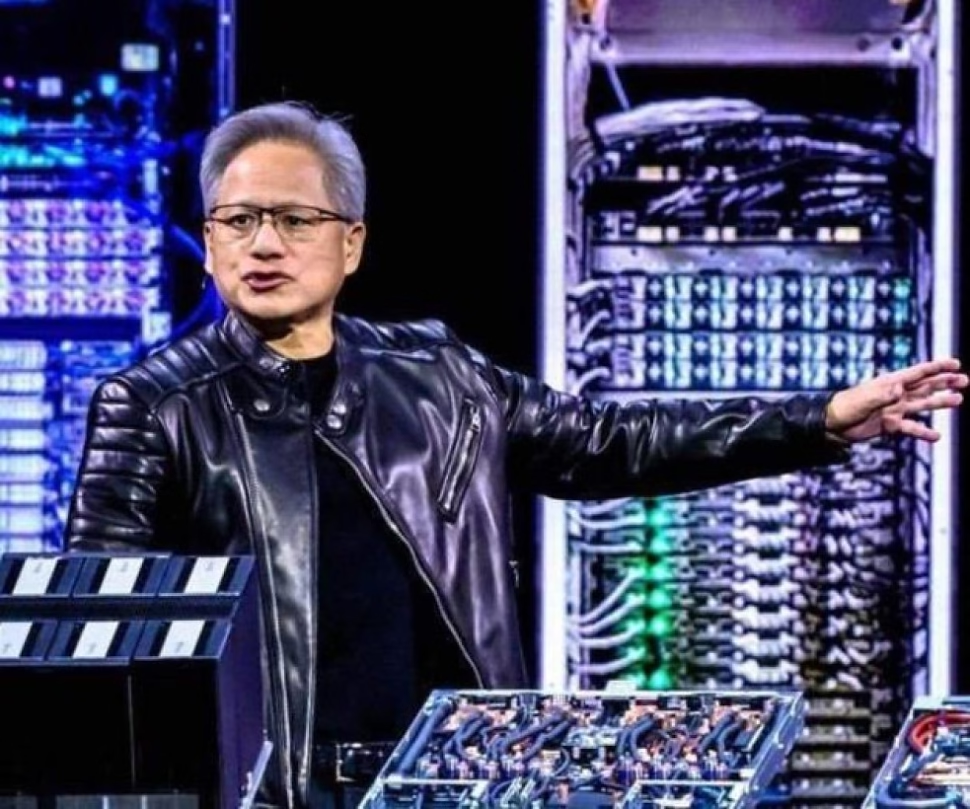
The technology giant Nvidia is immersed in high-level diplomatic and trade talks with the United States government. The central objective of these negotiations is to obtain the necessary authorization to market a new, significantly more advanced artificial intelligence chip in the Chinese market. This information was confirmed directly by the company’s CEO, Jensen Huang, during statements reported by CNBC.
This strategic development arises in response to the growing trade restrictions imposed by Washington, which severely limit the export of high-performance computing technologies to China. The current geopolitical context shows growing concern on the part of US authorities regarding the possible use of advanced US-made chips in military and artificial intelligence applications by China.
The New B30A Chip and the Regulatory Landscape
According to initial reports from the Reuters agency, the corporation based in Santa Clara, California, is in an advanced phase of development of a new processor specifically designed for the Chinese market. This semiconductor, identified under the name B30A, represents a technological evolution superior to the H20 model, which is currently the only device that Nvidia is allowed to export to China under current regulations.
During a recent visit to Taiwan, Jensen Huang directly addressed speculation about the new product. The executive stated: “Offering a new product to China for data centers, AI data centers, the continuation of the H20, is not our decision. It depends, of course, on the United States government. And we are in dialogue with them. But it is too early to know.” This statement underscores the complex and interdependent nature between corporate strategies and national security policies.
Nvidia’s position in the Chinese market has become a major operational and diplomatic challenge. The company had previously developed a specific and less powerful version of its processors, the H20, to comply with the initial restrictions. However, even this adapted chip faced additional obstacles when, this year, the US government implemented new limitations on its export.
Commercial and Geopolitical Implications
In a significant turn, during the month of July, US authorities granted Nvidia renewed permission to market the H20 chip in China. However, this authorization came with substantial financial conditions. As it was later revealed, the company agreed to cede 15% of its revenue from chip sales in China to the US government in exchange for the necessary export licenses.
Just when it seemed that Nvidia was beginning to stabilize its operation in the Chinese market, new challenges arose. Chinese regulatory authorities raised formal concerns this month about possible security vulnerabilities in Nvidia’s chip architecture. The company responded forcefully, ensuring that its products “do not incorporate safety switches or back doors” that compromise the integrity of the systems.
In parallel, several sector reports suggest that the Chinese government would be actively urging local technology companies to reduce their dependence on Nvidia semiconductors, favoring domestic alternatives such as Huawei. This move represents a significant risk to Nvidia’s business interests in a region that has historically accounted for a considerable portion of its global revenue.
Jensen Huang’s strategic stance has consistently been to advocate for the permissibility of selling its products in China. Its central argument is based on the fact that, by allowing Chinese artificial intelligence to be developed on American technology, national technology giants like Huawei are prevented from occupying that strategic vacuum, which in the long term could result in a greater technological disconnection between both powers.
This message seems to have found some echo in Washington. When the export of the H20 was approved again in July, US Secretary of Commerce Howard Lutnick told CNBC that the measure was allowed precisely because Nvidia would not share its most advanced technology: “We do not sell them our best product, nor our second best, nor even our third.”
However, these statements had unexpected negative repercussions. The Financial Times reported that Chinese officials considered these comments “insulting,” which would have accelerated local regulatory measures to discourage the acquisition of H20 by Chinese companies. In response to this complicated scenario, as published by The Information, Nvidia has asked some of its component suppliers to temporarily stop production of H20 graphics processing units, signaling a strategic reassessment of its market approach.
The impact on financial markets was immediate, with Nvidia shares registering a 1.34% drop during pre-market trading, reflecting investor uncertainty in the face of this constantly evolving geopolitical and regulatory landscape.
Did you find this analysis on the intersection between technology and geopolitics useful?Share this content on your social networks to keep your professional community informed and explore more articles related to the semiconductor and artificial intelligence industry on our platform.