El Bogueto joins México Canta 2026 with Sheinbaum

The Mexican reggaeton player participates honorably in the binational contest.

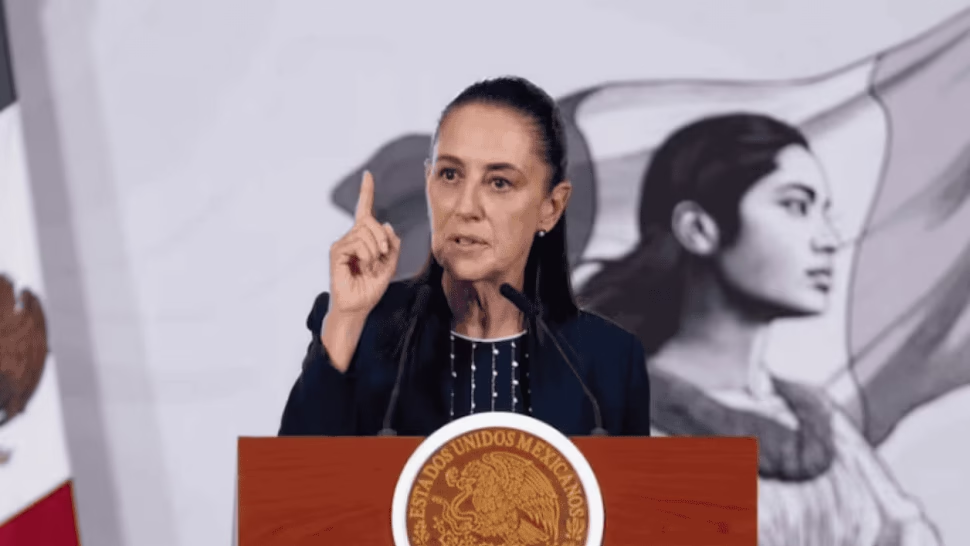
Reggaeton singer Armando Toledo, known as El Bogueto, accompanied President Claudia Sheinbaum in her morning conference this Thursday at the National Palace, within the framework of the México Canta contest.

Sheinbaum explained that the artist collaborates on an honorary basis in this binational initiative aimed at musicians from Mexico and the United States who seek to create new narratives away from violence and addictions.

“Voluntarily, honorably, you are helping this great program to promote music, with love lyrics, to keep away from hatred, to keep away from violence,” said the president.

Contest progress

The Secretary of Culture, Claudia Curiel, presented the results of the second edition of México Canta 2026. In total 16,289 young people participated: 10,528 from Mexico and 5,761 from the United States.

“This speaks of an extraordinary response and a generation that has a lot to say,” said Curiel.

The seven young people selected from the neighboring country were presented in the Treasury Room. Among them stood out Grecia Marín, 25 years old and originally from Perris, California.

RelatedMéxico Canta reveals the 24 American finalists to promote peace

Testimony of hope

Marín took the floor to thank the opportunity and pointed out that the contest represents much more than a musical competition for young Mexicans living in the United States.

She said that since she was little she discovered that music was “the language of her heart” and that she has worked to make her way in different scenarios. He shared that his birth was complicated and that the doctors predicted multiple difficulties, but thanks to the love and courage of his mother he managed to move forward.

“I am a miracle and every day I thank God for this second chance,” he expressed.

He assured that this experience marked his way of seeing life and his music. Although many of his compositions talk about love and heartbreak, his message always seeks to convey hope and demonstrate that music can heal and unite.

Finally, he thanked President Claudia Sheinbaum, the Secretary of Culture, Claudia Curiel, and the Mexican Music Council for promoting México Canta 2026 and opening spaces for new talents from both countries. He highlighted the support for the children of Mexicans who fight to keep their roots, dreams and identity alive.

“I promise to give you my best. Long live Mexico, long live good music, long live the band and long live the Mexican regional!”, he concluded.

Automation reduces jobs in maquiladoras; 100 thousand fewer places

Layoffs in maquiladoras due to robots, high wages and tariffs.

The impact of automation

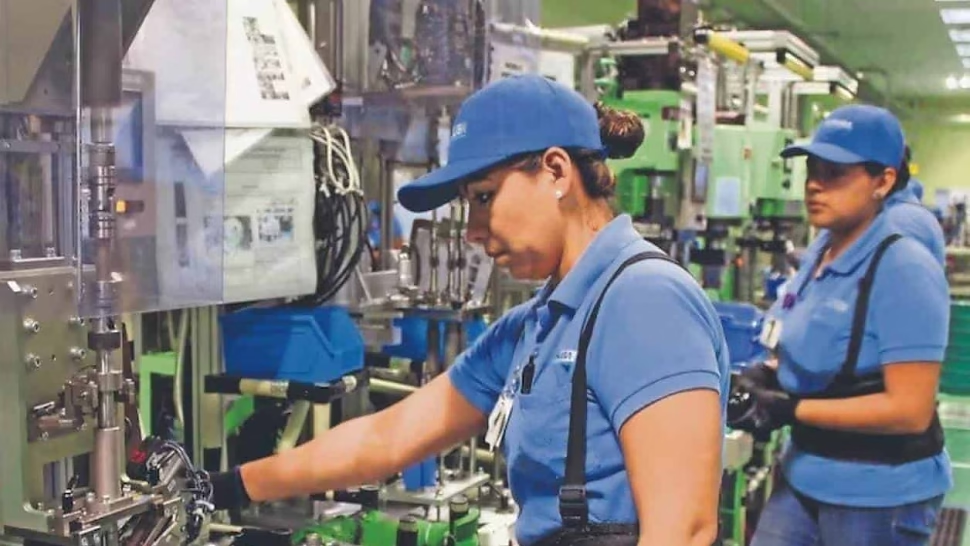
The wave of layoffs in the maquiladoras does not stop. The growing use of robots in production, especially at the border, has accelerated job losses. Added to this are higher minimum wages, increased vacation days, trade uncertainty and US tariffs.

According to data from Inegi, establishments with the Immex program had 3.19 million workers in May, 3% less than two years ago. That is equivalent to 100 thousand fewer places. Companies began laying off staff from the end of 2023.

Analysts consulted by EL UNIVERSAL point out that the combination of factors—automation, insecurity and tariffs—is behind this trend.

Humberto Martínez Cantú, president of the National Council of the Maquiladora and Export Manufacturing Industry (Index), explained that maquiladoras are being automated in the country. The process was accelerated by the increase in labor costs and external commercial pressure.

The northern border, a traditional bastion of the maquiladora industry, is the most affected area. There, robotization advances faster than in the rest of the country.

Official data reflect a sustained contraction. The sector is losing dynamism and with it, sources of formal employment for thousands of Mexicans.

Although the government has promoted incentives for investment, the reality is that technology replaces repetitive tasks. The least skilled workers are the most vulnerable.

Trade uncertainty with the United States and threats of additional tariffs complicate the outlook. Maquiladoras, which depend on global supply chains, adjust their workforces to remain competitive.

The immediate challenge is how to retrain the workforce. Without training and retraining policies, the loss of positions could worsen.

Continue reading

FGR rules out blocking Verónica Ruffo’s accounts

Authorities clarify that Ernesto Ruffo's daughter is not in the UIF's sights.

Security Cabinet denies blockade

After the dissemination of information about an alleged blocking of Verónica Ruffo’s accounts, the Security Cabinet clarified that the FGR has not requested such a measure.

The FGR’s request to the FIU only includes the natural and legal persons identified in the investigation, among which does not include Verónica Ruffo, daughter of the former governor of Baja California, Ernesto Ruffo Appel.

In an information card, the Cabinet detailed that the requests for the immobilization of resources are based on sufficient indications of founded and verifiable risk. The measures seek to prevent resources linked to people under investigation from being used for illicit activities or from being part of the financial circuits of organized crime.

The authorities reiterated that the actions are limited to those involved in the file, without affecting unrelated third parties.

Continue reading

Sheinbaum criticizes series that idealize organized crime

The president warned about the influence of fictions that present success linked to crime.

President Claudia Sheinbaum pointed out that some television series try to promote among young people the idea that joining criminal groups represents a path to success. He said it during the “México Canta” contest, in his morning conference this Thursday, July 23 at the National Palace.

Sheinbaum rejected the incursion of youth into organized crime and assured that these narratives distort reality.

“They try to promote to young people an idea that if you get involved with a criminal group you will be successful; you will have money; women, because that is what they unfortunately promote; a life of luxury, in short.”

The president highlighted the effect this has on young audiences: “So what happens to a young person? They turn a drug lord into a hero or a heroine and we are against that because that is not life for young people, that is death.”

Prevention actions

Sheinbaum described narrative as “very important” in the formation of youth. He assured that his administration works “dose every day to make that a reality.” He called on society, parents and the government to take care of young people collectively, with cultural actions such as the promotion of indigenous peoples.

Continue reading