Trump announces 100% tariff on computer chips made outside the US

A drastic measure that will shake the technology market and unleash an unprecedented commercial battle.

An Earthquake in the Technological World

In a turn that will shake the foundations of global industry, US President Donald Trump has unleashed an economic storm by announcing a 100% tariff on computer chips manufactured outside the United States. This decision, delivered with the solemnity of an ultimatum in the sacred Oval Office, threatens to raise the prices of electronic devices, automobiles and appliances, plunging consumers and companies into a sea of uncertainty.

The Battle for Technological Sovereignty

With his gaze fixed on Apple CEO Tim Cook, Trump declared in a booming voice: “We will impose a tariff of approximately 100% on chips and semiconductors… But if you are manufacturing in the United States, there is no charge.” These words, loaded with an epic challenge, are not only a commercial policy, but a manifesto of economic war. Companies that choose to produce on US soil will be forgiven, while others will face the burden of a tax that could break entire supply chains.

RelatedTrump proposes a 100% tariff on imported chips

The specter of the chip shortage during the pandemic, which inflated prices and fueled inflation, haunts again. Manufacturers like Nvidia and Intel remain stonily silent, while the world waits for their next move. Will this be the catalyst that redefines global technology production?

A Risky Bet

Trump not only challenges the industry, but bets the economic future of the US on a masterful or reckless move. Its “carrot and stick” strategy seeks to force corporations to establish factories in national territory, even if this means higher prices for phones, televisions and even refrigerators. Meanwhile, Biden’s CHIPS and Science law, with its 50 billion in incentives, now seems like a distant echo in the face of this new ironclad scenario.

Global demand for semiconductors, which grew by 19.6% in the last year, collides with this tariff wall. Will Trump manage to revitalize local production or will he trigger a crisis of Dantesque proportions?

Share this explosive news and discover how this tariff could change the technology game forever! #GlobalEconomy #Technology
Attack on Berlin Pride: one dead and 29 injured

A mass accident at the Berlin Pride parade leaves one dead and dozens injured.

The attack at the Pride parade

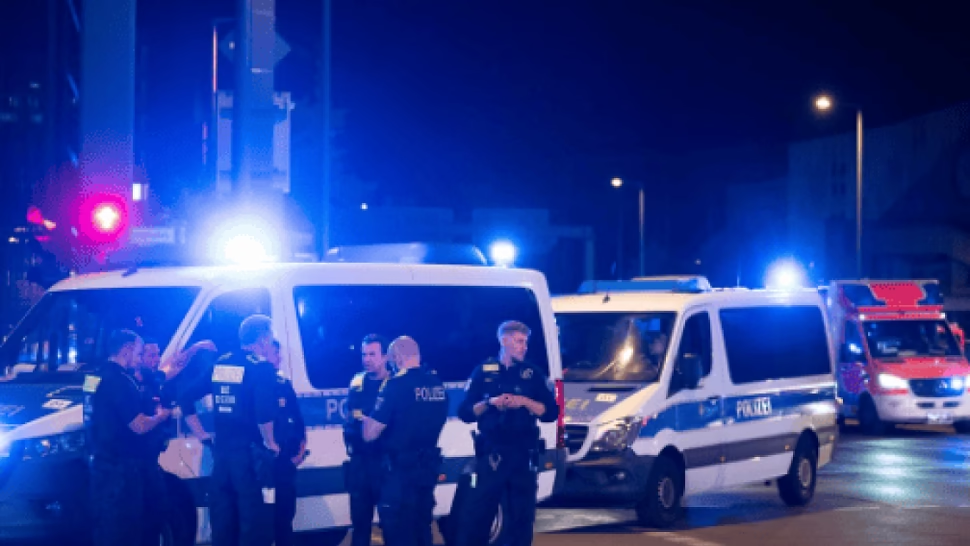
Germany faces new shock after the attack that occurred Saturday night during the Pride parade in Berlin. A white van broke into Tiergarten park around 10 p.m., running over dozens of people participating in Christopher Street Day (CSD), one of the busiest LGBTQ+ marches in Europe. The preliminary toll is one woman dead and 29 injured, none in critical condition. The vehicle ended up crashing into a tree.

The alleged perpetrator, Abdul Ballout, 21, a German citizen of Lebanese origin, was neutralized by special police forces in a shed in the Spandau district. According to the newspaper Bild, the agents opened fire after the man attacked them with a knife. Ballout died at the scene despite resuscitation attempts. The authorities identified him as a sympathizer of the Islamic State jihadist group and known for his links to extremist circles.

Witnesses indicated that, after getting out of the van, he attacked several passers-by with a machete. The search lasted more than a day with controls at borders, stations and airports. Police detained three people for questioning, although two were later released. The possible existence of accomplices is being investigated.

Investigation and political consequences

The site of the attack is a few meters from the end of the route and the main stage next to the Brandenburg Gate. On Sunday, citizens left flowers and messages such as:

“We must remain united”

Prayer services were held in St. Mary’s Church and a vigil in front of the Brandenburg Gate, where hundreds of people lit candles and displayed rainbow flags.

The German Chancellor, Friedrich Merz, went to the site accompanied by three ministers, laid a white rose and participated in a moment of prayer. This attack revives the debate on immigration and security two months before the regional elections in Saxony-Anhalt. The far-right party Alternative for Germany (AfD) leads the polls with more than 40% of voting intentions, promoting proposals for “remigration” and tightening border controls. International leaders expressed solidarity with the country.

Continue reading

UNESCO declares Landing Beaches as World Heritage

The 80-kilometer site that marked the end of the occupation in Europe gets maximum recognition.

Recognition by UNESCO

The beaches of Normandy, scene of the historic Allied landing on June 6, 1944, were inscribed as a UNESCO World Heritage Site. The decision was made during the 48th session of the World Heritage Committee in Busan, South Korea.

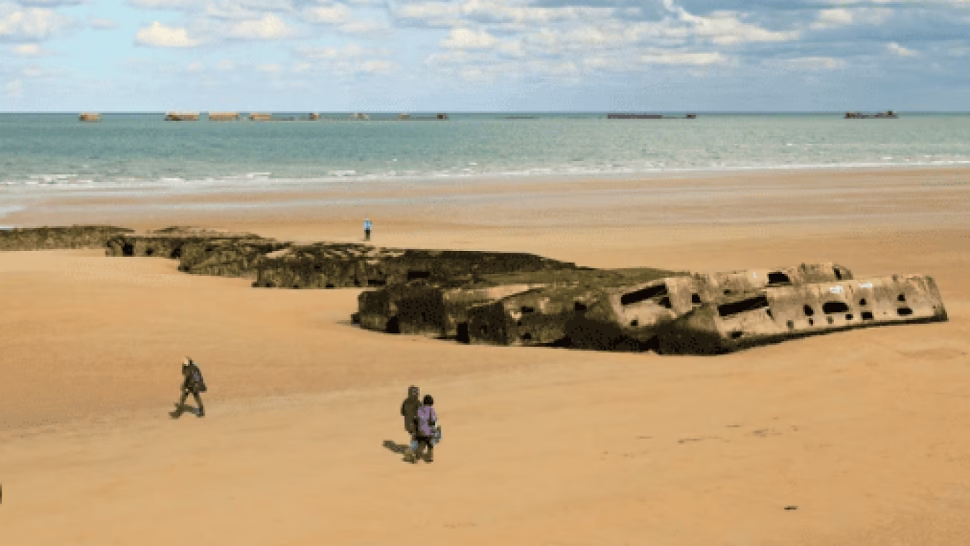
The coastal stretch of about 80 kilometers includes the five beaches known by their code names: Utah, Omaha, Gold, Juno and Sword. It also includes other key points such as Pointe du Hoc, the German artillery battery of Longues-sur-Mer and the artificial port of Arromanches-les-Bains.

The latter, designed by British engineers, was a system of submerged concrete caissons that allowed the creation of a temporary port. Thanks to him, nearly 2.5 million soldiers, more than 500,000 vehicles and four million tons of supplies landed.

A place of memory and reconciliation

The registration culminates a process started in 2008 by the Normandy Region, supported by more than 70,000 signatures. The file was paralyzed for five years due to a review of criteria and was reactivated in 2024.

UNESCO highlighted that the beaches represent not only a large-scale military operation, but also a site for transmitting the values of peace and reconciliation. He underlined his role in the rapprochement between France and Germany after the war, the basis of European integration.

French authorities hope the recognition will boost tourism and strengthen the preservation of this World War II memorial site.

Continue reading

Trump tariffs face new legal challenge

Two small business lawsuits challenge Trump's new tariffs in court.

Two lawsuits filed by small businesses challenge the tariffs Donald Trump announced Thursday. The levies, in the double digits, apply to 60 trading partners under Section 301 of the Trade Act of 1974.

The government argues that it seeks to stop imports linked to forced labor. Critics say the real goal is to replace global tariffs that the Supreme Court struck down in February. The new tariffs arrive just when the temporary 10% tariffs, also contested, expire.

Learning Resources, an educational toy company that already won a case in the Supreme Court, filed a new lawsuit before the International Trade Court. Other small companies join.

A second lawsuit was filed by Burlap and Barrel, a spice company, and Collective Horology, a watch retailer. They are represented by the Liberty Justice Center, a libertarian-oriented group.

Both lawsuits allege that the government failed to justify its actions against each country or explain how the tariffs will eliminate forced labor, as Section 301 requires.

“Forced labor is morally indefensible, but an important goal does not give the government permission to ignore the law,” said Sara Albrecht, president of the Liberty Justice Center. “The government let a global tariff expire and immediately replaced it with another under a different law. Changing the law does not change the right.”

The White House did not respond to requests for comment.

Experts warn that challenging these tariffs will be more difficult than on previous occasions. Trump used Section 301 in his first term against China and the tariffs survived the courts.

No short-term relief

Unlike the Section 122 levies that expired Friday, “these tariffs are going to be with us for a long time,” said Patrick Childress, a lawyer and former U.S. trade official.

Even if countries adopt the policies Washington demands, Childress explained that they will have to demonstrate compliance to the satisfaction of the United States before sanctions are removed. “This suggests that no short-term, country-level relief from the new Section 301 tariffs will be available.”

Continue reading