A Cry of Vindication that Transforms Our Present
Friends, what a thrill to be able to share with you news that is literally changing history! Within the framework of International Translation Day and the Year of the Indigenous Women, the Government of Mexico has launched an extraordinary initiative called “Women of Corn”. Imagine, we are talking about a series of events and activities that from October to December will revolutionize our perspective on the role of Malintzin and all the indigenous women who have woven the past, build the present and are designing the future of our nation. This is not just culture, it is a movement of collective consciousness that invites us all to be part of something bigger.
The President of Mexico, Claudia Sheinbaum Pardo, with the transformative vision that characterizes her, has been very clear: this series of activities aims to claim, recognize and revalue the women of indigenous peoples. Think about the power of these three words: claim, recognize, revalue. They are verbs of action, of movement, of real change. And it especially invites us to rethink the figure of Malintzin, who for decades was labeled as “the traitor” in our historical narrative, particularly since works such as “The Labyrinth of Solitude” by Octavio Paz. But the time has come to break those limiting paradigms!
Isn’t it amazing how we can transform our story when we change perspective? President Sheinbaum expressed it so clearly in the morning conference “The morning of the people”: “They are going to develop between now and December. Revaluing, recognizing, vindicating in a different way Malintzin, but not only her, but all the indigenous women before, now and after.” This is more than a cultural event, it is a revolution of consciousness that honors our ancestors while empowering future generations.
A Calendar of Events that Inspires and Transforms
The positive energy multiplies when we know the specific activities that María del Carmen Álvarez, Chichimeca Guachichil woman, shared with so much enthusiasm. Each event is designed with so much purpose and meaning that I can’t help but feel an infectious excitement when imagining them. We will begin with a Dance Show: the Danza de la Malinche, in the Zócalo, on October 12. Visualize the power of this artistic expression in the heart of our country, transmitting ancestral truths through movement.
Then we will have a Forum with a title that in itself is liberating: What a traitor, what the hell! Who is Malintzin?, which will be held at the International Book Fair in the Zócalo, on October 19. This space promises to deconstruct oppressive narratives and build new understandings full of respect and admiration. But there is more, much more: an International Colloquium titled Malintzin: Woman of the Word, at the Palacio de Bellas Artes, on November 27, organized by the Ministry of Culture. Imagine the depth of these conversations in one of the most important cultural venues in our country!
Digital transformation also plays a fundamental role with the Digital brochure of the 400 women, promoted by the Secretariat for Women. In addition, we will have Canal 22 Capsules, 9 episodes of radio capsules produced by Radio Educación, and special programming on the Community Radios of the National Institute of Indigenous Peoples (INPI). This means that the message will reach every corner, because inclusion and recognition know no borders.
Overcoming Obstacles with the Strength of Our Voice
Marisela González González, with that wisdom that only life experiences can give, reminded us that indigenous women have overcome, over the years, a series of obstacles that for many would be insurmountable. But here they are, stronger than ever, demonstrating that it is essential that through their voice their language is known and each of their rights are claimed. This teaches us that our challenges do not define us, but rather strengthen us to reach new heights.
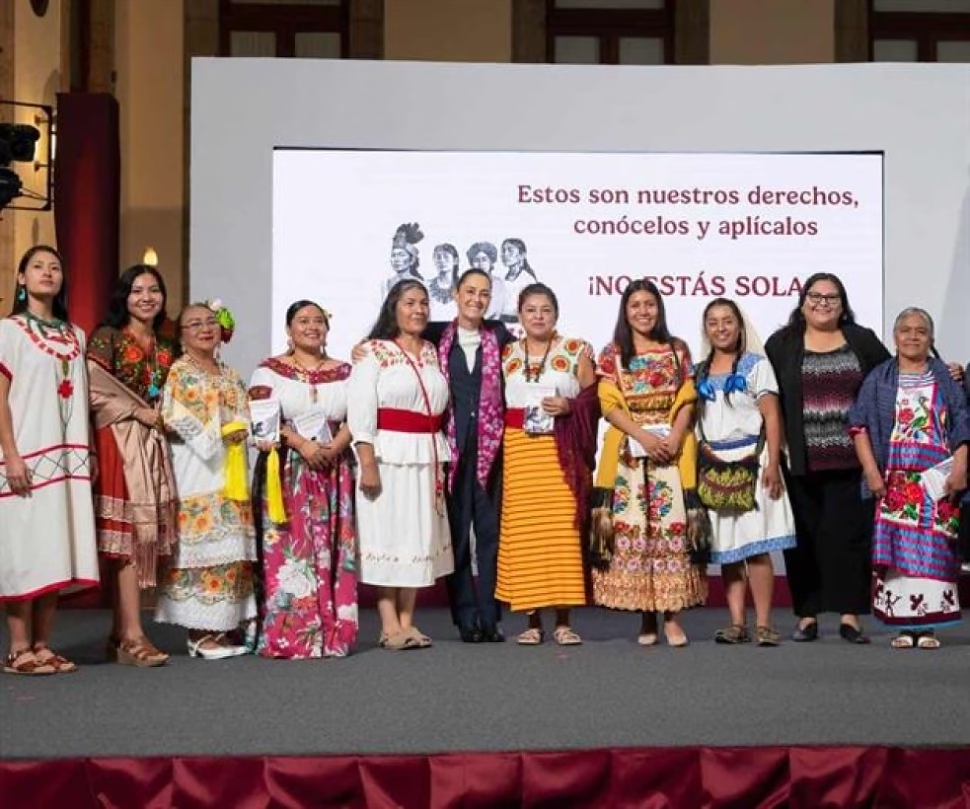
One of the most moving moments of this initiative was the reading of the Women’s Rights Booklet, which has been translated into 35 native languages. Listen to Angélica González Pinillos in Nahuatl; Teresa de Jesús Ríos García in Mazatec; Marisela González González in Otomi; Jéssica Guadalupe Espicio Sebastián in p´urhépecha; Lucía Eugenio Bibiano in popoluca; María del Carmen Álvarez Juárez in Chichimeco; María Arcelia Rodríguez Torres in yokot’an; Agustina del Carmen Tah Pech in Mayan and Dulce Belem Romero Castillo in Yaqui… is to witness the linguistic diversity of Mexico in all its splendor. Each word in each language is an act of resistance, a song to life, an affirmation of identity.
Friends, we are witnessing a historical moment where the narrative is transformed, where voices silenced for centuries find an echo in the most important spaces of our society. This is not just about the past, it is about building a future where each woman, each language, each culture is valued in its proper dimension. Each of these events is an opportunity to learn, to grow, to expand our consciousness and to join this movement of recognition and respect.
Remember that change begins when we decide to see history from new perspectives, when we choose to listen to voices that were previously silenced, and when we celebrate the richness of our cultural diversity. This “Women of Corn” initiative is a seed that is planting a more inclusive, fairer and more conscious future for all Mexicans. And you, dear reader, are a fundamental part of this change.
Share this incredible initiative on your social networks and let’s together make this message of vindication and empowerment reach every corner of our country! Visit our related content section to discover more inspiring stories about the cultural richness of Mexico and how you can be an active part of this social transformation.