From Red Queens to Translators: Paseo de la Reforma is filled with ancestral ‘girl power’
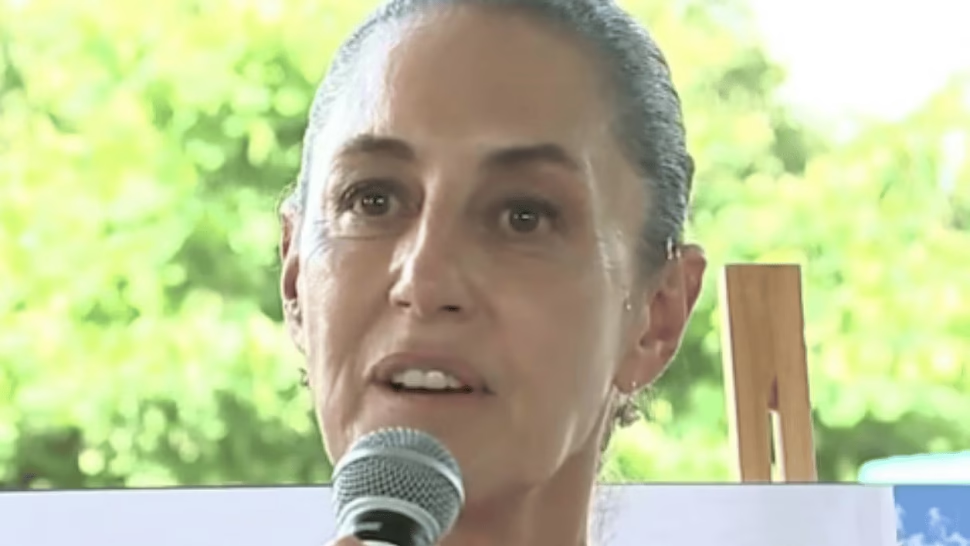
Well, while we were debating on Twitter about the latest Netflix series, the government decided to give a monumental (literal) glow-up to Paseo de la Reforma. President Claudia Sheinbaum didn’t come to play: she led the unveiling of six sculptures of ancestor women, in what could be the most Instagrammable act of historical justice of the year. Spoiler: they’re not just pretty statues; It is a direct message against racism, classism and machismo that, let’s be honest, are older than Chapultepec Castle itself.
The stellar cast of this new pre-Hispanic ‘walk of fame’ includes Tz´ak-b´u Aha (aka “the Red Queen”, it sounds like a drag queen’s name, but she is pure Mayan royalty), Tecuichpo-Ixcaxochitzin, Lady 6 Mono, Xiuhtzatzin, the always controversial Malintzin, and the Purépecha defender Eréndira. Basically, a squad of powerful indigenous women who finally leave the footnotes of textbooks to take their place on the most important avenue in the country. Sheinbaum made it clear: this is not just urban decoration, it is an explicit recognition of those who have sustained the cultural, social and spiritual life of Mexico for centuries, perhaps millennia, while the limelight was taken by others.
Malintzin in Reform: Betrayal or survival? The historical debate reaches marble
And let’s talk about the elephant in the room, or rather, the sculpture on the walk: Malintzin. For years, the official narrative painted her as the symbol of betrayal par excellence, a story loaded with more prejudices than a 9 o’clock soap opera. The President gave it a totally different spin: “she made use of her linguistic knowledge to survive in a context of violence.” In other words, she wasn’t the villain, she was a multilingual strategist in a historic predicament. Including it here, according to Sheinbaum, is not “opening old wounds, no. It is closing a historical debt.” A plot twist that official history did not see coming.
The message is forceful: placing these monuments is an act of historical vindication that seeks to break the historical silence that has made women invisible and relegated. The president of CONAPRED, Claudia Olivia Morales Reza, applauded the initiative, recalling that Sheinbaum promoted it from her time as Head of Government. Meanwhile, actress Jesusa Rodríguez asked to go further and promote science with a gender perspective, because in many historical monuments in the country women continue to be ghosts.
Marisela González González, representative of the Ñhäñhü people, hit the nail on the head: these figures will make women feel proud of their roots and see that they can reach important positions. He even ventured to hope that we would soon have the first indigenous woman as president. For her part, Valeria Valero Pie from the INAH, concluded that, with this action, the President asserts the commitment of her protest: she did not arrive alone, all generations of women arrived.
In summary, the Heroines Walk is no longer just a concept, it is a reality of concrete and meaning. It is a reminder that cultural transmission and ancestral wisdom are not a thing of the past, but pillars of the present and future. And that, sometimes, doing justice means taking away space from the usual bronze heroes to give it to the heroines of flesh and blood (or in this case, stone and marble) who were always there.
Do you like this new face of Mexico City? Share this note and help us make the story of these six powerful women viral. And if you want to explore more content on historical reclaiming and contemporary culture, stay browsing our site!