Binational cooperation against screwworm
The governments of Mexico and the United States launched a plant on Saturday in Chiapas to produce sterile flies, with the aim of stopping the advance of the screwworm. The plague has affected binational trade and raised alarms in both countries.
The complex is activated after the first case of the parasite was detected in the United States more than three weeks ago. So far, 20 infections have been confirmed in the United States, which motivated Donald Trump’s government to approve an additional $83.8 million to combat it.
The center is in Metapa de Domínguez, Chiapas. It represents the most recent effort in a collaboration that began last year. Mexico accumulates 1,907 active cases of screwworm.
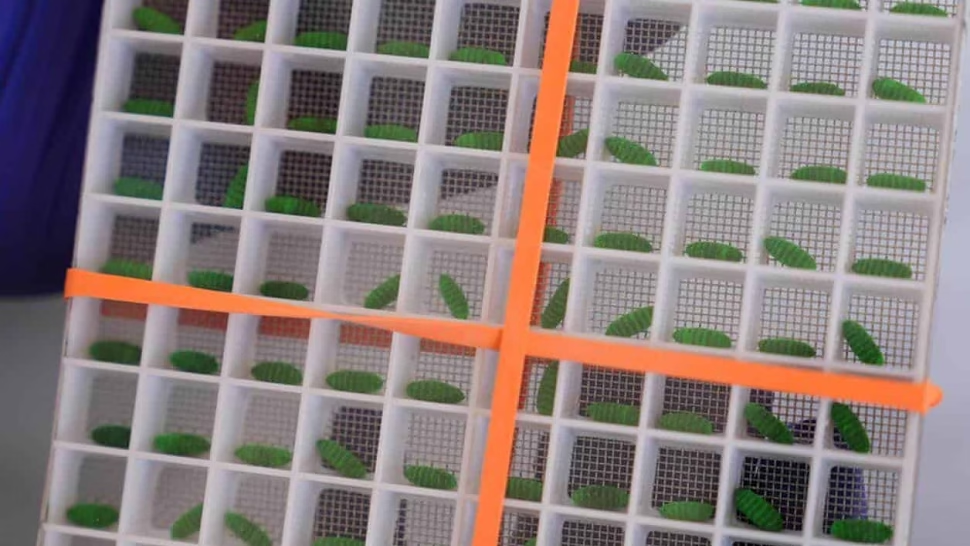
The plant replaces one that closed in 2013, when Mexico was declared free of the pest and a binational agreement in force since 1972 ended. It now produces sterile flies as a biological control: it interrupts the reproductive cycle of Cochliomyia hominivorax, whose larvae invade tissues of warm-blooded animals, including humans.
During the reopening, President Claudia Sheinbaum stated:
“It is the conviction that development cooperation produces results. Animal diseases, pests and food security challenges know no borders. The best response is to add capabilities, share experience and build solutions.”
Also present were the Secretary of Agriculture of the United States, Brooke Rollins, and Ambassador Ronald Johnson, who announced the additional $83.8 million to reproduce more sterile flies in Mexico and reinforce prevention.
The joint investment to convert the old plant was 61 million dollars. It will produce 100 million sterile flies weekly, according to Senasica. Currently, Mexico is supplied from Panama, and another plant is being built in Texas that will begin operating next year.
Livestock farmers consider that the reopening is late. The first outbreaks emerged almost two years ago and the estimated production could be insufficient. Omar Ornelas, a rancher from Tuxtla Chico—a neighboring municipality—has an infested animal:
“I hope that now with the inauguration of the plant there will be support for the livestock area, because we have closed the United States border for the export of livestock and it affects the price of beef.”
To treat his cattle he has used homemade recipes, from veterinary products to diesel and lime.
The commercial impact is severe. On June 9, after infections in Texas, Mexico suspended the import of cattle, horses, sheep, goats and other species from the United States. In the last 18 months, the US closed the passage to Mexican cattle on three occasions. The most recent closure occurred on July 9, after locating an infected cattle in Ixhuatlán de Madero, Veracruz.