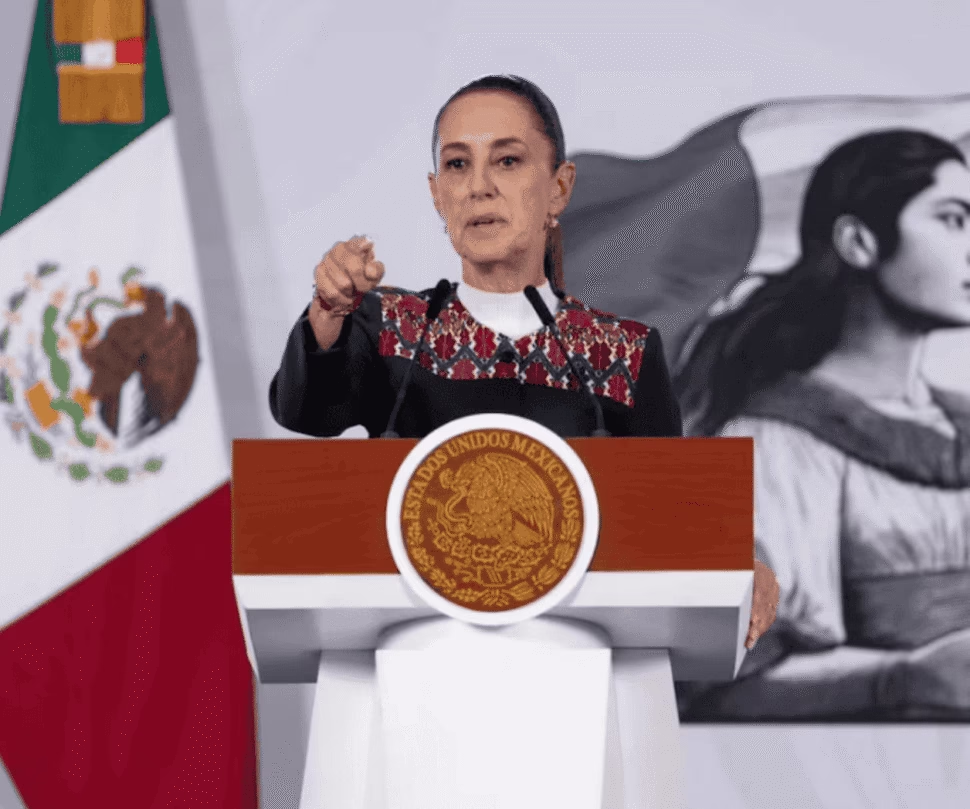
Mexico sends humanitarian support to Venezuela after earthquakes

Mexico sends rescue team to Venezuela after earthquakes that left dozens dead.

President Claudia Sheinbaum expressed the solidarity of the Government of Mexico with Venezuela after the earthquakes registered this Wednesday, which left dozens of people dead and injured.

During his conference, Sheinbaum reported that this same day a team from the Secretariat of National Defense (Defense), composed of rescuers and health personnel, will leave to collaborate in the emergency.

“Before continuing, our solidarity with the people of Venezuela. Today a team from the Secretariat of National Defense of rescuers and health personnel leaves to reach Venezuela,” he said.

Coordination with Venezuelan authorities

Sheinbaum explained that, once installed in the affected area and after coordinating with local authorities, the need for more support will be evaluated.

“And once we are installed there and having spoken with the authorities, tomorrow we will determine additional personnel that are required to always be able to help the towns that need it,” he added.

The president reiterated Mexico’s commitment to providing humanitarian aid in the face of natural disasters.

RelatedReport questions million-dollar expenses at the US embassy in Venezuela

No Mexicans affected

Sheinbaum reported that, so far, the Mexican Embassy in Venezuela does not report injured or deceased compatriots.

“At the moment we do not have any communication from the Mexican Embassy in Venezuela, no injured Mexican has been reported, unfortunately deceased, but we are under permanent review,” he indicated.

He explained that the sending of aid was decided after contact between Foreign Minister Roberto Velasco and Venezuelan authorities, who requested trained personnel, not food or supplies.

The federal government will send 250 soldiers, five dogs, four aircraft, a drone, search and rescue tools, as well as equipment and healing materials.

Seven injured after being run over in Cabo San Lucas during the World Cup celebration

A driver ran over several people during the World Cup celebrations in Cabo San Lucas.

Balance of the accident in Cabo San Lucas

The authorities confirmed that of the 17 people taken to hospitals after the accident in the center of Cabo San Lucas, only seven remain hospitalized. Three are in the IMSS clinic, two at Saint Luke’s and two at AMC. Ten people were discharged after treating minor injuries. Two victims are in serious condition, including the driver.

How the incident occurred

The event occurred on Lázaro Cárdenas Boulevard, during the celebrations for the Mexican National Team’s 3-0 victory over the Czech Republic in the 2026 World Cup. Hundreds of people gathered on the road. Videos show fans approaching moving vehicles, rocking them and throwing liquids at them. Some drivers moved slowly.

According to the images, the situation escalated when fans got into the black car involved. Surrounded by people, the vehicle accelerated and ran over several people. After hitting an object, the driver was pulled out and beaten. A woman and a minor also got out of the car, who appeared disconcerted.

Reactions

The incident generated statements from business chambers and local organizations, which asked to maintain civility during the World Cup days. They pointed out that such an event had not been recorded before in that tourist destination.

Continue reading

Train to AIFA adds 1.5 million users; Sheinbaum calls it successful

More than 1.5 million users on the Buenavista-AIFA train. Travel time improved to 46 minutes.

Buenavista-AIFA Train Operation: figures and challenges

President Claudia Sheinbaum assured that the Train from Buenavista to the Felipe Ángeles International Airport (AIFA) has operated “superbly” since its inauguration, weeks ago. The support was given during the morning conference on June 25, where the head of the Trains and Integrated Public Transport Agency, Andrés Lajous, presented details.

“Users have shown their satisfaction. And how have they shown it? By using it. Right now there are more than 1.5 million users who have used the service,” Lajous reported.

The official reported that a “peak of users” was recorded during the start of the World Cup, with national and international tourists arriving at the AIFA. He highlighted that the departure frequency is every 30 minutes from the terminals, and that the travel time dropped from 52 to 47-46 minutes.

Three stations concentrate the greatest influx: Prado Sur, Lechería and Jaltocan. Lajous also mentioned that walkways are pending at three stations, although he did not detail deadlines.

The official balance is positive, although complementary works persist. The route connects Buenavista with the AIFA and seeks to be an efficient alternative to vehicular traffic.

Continue reading

Mexico needs indicators beyond GDP, says Sheinbaum

President proposes measuring well-being with other indicators in addition to economic growth.

Sheinbaum questions GDP as the only measure

President Claudia Sheinbaum noted that her administration prefers to evaluate the economy with broader indicators than the Gross Domestic Product. During his morning conference on Thursday, he said:

“We prefer that it not only be the GDP, but that it be many other indicators that tell us about how Mexico is developing.”

Sheinbaum framed this position within Mexican humanism, in contrast to the neoliberal period. He recalled that in previous six-year terms, 2% growth did not translate into social well-being.

“Some six-year periods could grow at 2%, but poverty increased, inequality increased. So, who were the beneficiaries of 2% growth?”

The president clarified that economic growth continues to be relevant, but it is not enough. GDP, he said, is a very aggregate indicator that does not reflect the distribution of wealth or access to rights.

In addition, he highlighted that his government has promoted public works without resorting to debt. The strategy, as he explained, seeks to combine development with fiscal responsibility.

Sheinbaum insisted that measuring Mexico’s progress requires looking at inequality, poverty and other social factors. “That is a different vision from neoliberalism,” he concluded.

Continue reading