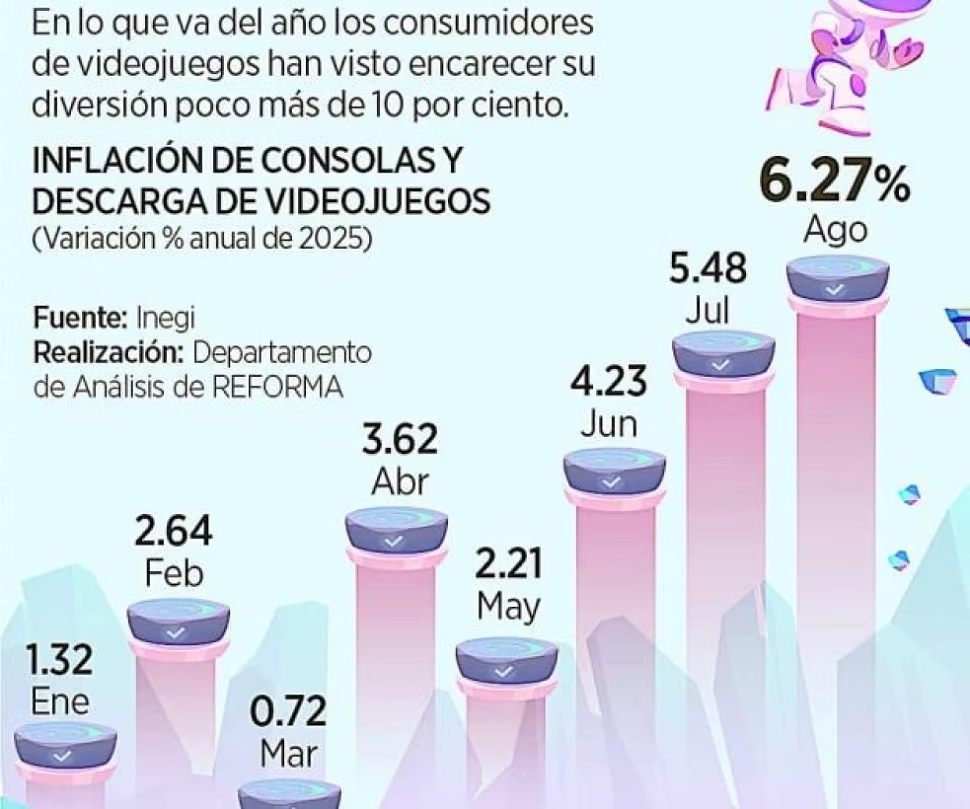
Analysis of the Tax Impact in the Video Game Industry
The inclusion of a specific 8 percent tax aimed at video games classified as violent within the Income Law has generated an intense debate among tax specialists, industry representatives and economic analysts. According to a meticulous investigation of the implications of this measure, this tax would not operate in isolation, but would be added to the current Value Added Tax (VAT), generating a compound increase in the final price for the consumer. Calculations made by experts indicate that the real premium could range between 22% and 24%, well above the nominal figure of 8% suggested by the initiative.
David Santiváñez, CEO of GameMetron Law Firm, and Miguel Ángel Villanueva, partner in charge of the tax, gaming and compliance area of the same firm, maintain that the measure would have a disproportionate regressive effect. Their analysis focuses on the fact that the tax would primarily affect the economically active young and adult population, which constitutes the main core of the consumer market. This demographic segment already faces significant barriers to economic access to digital entertainment products, and the imposition of a new tax would increase this gap, further limiting access to technologies and modern forms of cultural entertainment.
Demographic Breakdown and Justification of the Measure
Quantitative data is crucial to understanding the magnitude of the impact. Figures provided by the international consulting firm Newzoo, specialized in the video game market, reveal that between 80 and 89 percent of consumers in Mexico are between 18 and 68 years old. This statistic dismantles the fundamental premise that is usually used to justify taxes of this nature: the protection of minors.
In this regard, Santiváñez argues: “It is inappropriate to justify a tax under the argument of protection of minors, when the predominant consumer is an adult and economically active”. This position highlights how the initiative takes up obsolete political and social narratives from the 1990s, which simplistically and not scientifically proven to associate the consumption of violent video games with antisocial behavior, discourses that have been largely superseded by more recent and nuanced sociological research.
Villanueva delves into the practical mechanism of the tax: “The proposed tax is equivalent to an additional 8 percent on the base price of the video game, to which VAT is added”. To illustrate the effect precisely, provide a concrete example: a security with a list price of 100 Mexican pesos would experience a transformation in its final cost. After the application of the new tax (8 pesos) and the corresponding VAT (16 pesos on the new base of 108 pesos), the sale price would rise to 124 pesos, confirming the accumulated increase of 24%.
Official Position and Contrasting Perspectives
Faced with these warnings, the official position seems to minimize the potential consequences. When asked specifically about this issue, Sergio Fuentes Rodríguez, head of the Creative Industries Sector of the Ministry of Economy, categorically denied that this tax measure could have a significant impact on the consumption patterns of video games within Mexican territory. However, this statement is not accompanied by its own economic impact study or quantitative data that counteracts those presented by independent analysts, which generates an information vacuum on which the policy is based.
The discrepancy between the technical analysis and the government vision reveals a fracture in the assessment of risks associated with cultural taxation. While experts warn about a possible cooling of the market and a penalty to a dynamic and job-generating economic sector, the authority seems to prioritize a tax collection vision anchored in already outdated social perceptions. This tax, therefore, not only represents an additional financial burden, but acts as a thermometer of how the interactive entertainment industry is perceived and regulated by the spheres of power, with potential negative effects on innovation and cultural access.
Share this analysis on your social networks to encourage an informed conversation about tax policies and their impact on the digital economy. Explore more content related to the gaming industry and technology legislation on our portal.