Ebola in Congo: 80% of new cases are of unknown transmission

80% of new Ebola infections in the Congo come from untraced chains, warns the WHO.

The World Health Organization (WHO) warned that 80% of new Ebola infections in eastern Congo arise from transmission chains that have not been identified. It is the clearest sign that the outbreak is advancing faster than the ability of health teams to trace contacts.

“Perhaps the most alarming finding is that many of the recently reported deaths correspond to people who died in their communities, without ever reaching a health center,” said Chikwe Ihekweazu, WHO’s director for emergencies, after visiting Bunia, one of the most affected cities in Ituri province.

Ihekweazu explained that patients who die outside the hospital system cannot be isolated nor can their contacts be traced, which accelerates the spread. “As of today, 80% of new cases are not on our contact lists,” he added.

RelatedEbola alert: 87 deaths in Congo and cases in Uganda

Response exceeded

As of Monday, Congolese authorities reported at least 1,926 infections and 702 deaths in three provinces. Cases have also been confirmed in neighboring Uganda. The outbreak, caused by the Bundibugyo strain—for which there is no vaccine or approved treatment—began in May and was declared by the government on the 15th of that month, after weeks of silent spread.

The treatment capacity in Bunia is approaching 800 beds and the laboratories have increased from one to 14. However, Ihekweazu said: “Despite our best efforts, we have not managed to reach it in this race.”

Obstacles and strike

The response faces a funding gap, attacks on health facilities, armed conflict in eastern Congo and community distrust. On Monday, dozens of workers at a treatment center in the northeast went on strike over lack of pay. A day later they agreed to resume work on the condition of receiving payments within 72 hours.

“A single day of strike has already caused damage. Patients were unable to access the facility,” they said in a statement, warning that any loss of life would be the responsibility of the government if the facility closes.

Clinical trials of the treatment began last week. Additionally, the US Centers for Disease Control reported on July 11 that a US citizen working for a humanitarian organization in the Congo tested positive for the virus. No further details were given.

War in Iran threatens endangered species

Iranian veterinarians and conservationists assess the impact of airstrikes on threatened species.

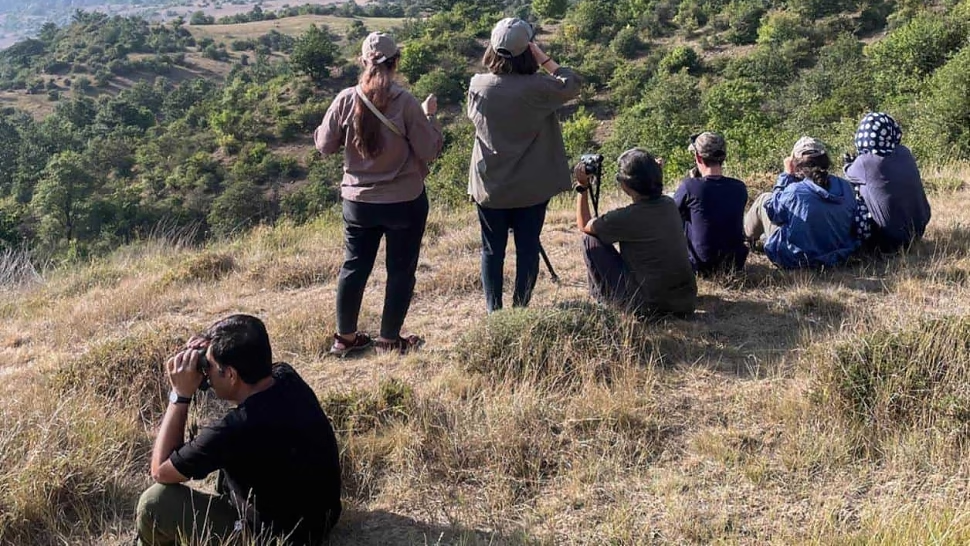
Just days after fighting between the United States, Israel and Iran began, veterinarian Reza Kiamarzi climbed cliffs near Isfahan. He was looking for nests of saker and peregrine falcons, threatened birds whose breeding season coincided with the bombings. “It’s a long climb. Then we climb rocks to get to the nests,” he said.

Iran is home to unique biodiversity: from humid Caspian forests to arid areas of the Persian Gulf. At least 86 species are at risk, according to the Department of the Environment: the Asiatic cheetah, the Persian fallow deer, the leopard, the brown bear and birds of prey, among others. The country is a key migratory stop between Eurasia and Africa.

Iman Ebrahimi, from the NGO AvayeBoom, warned: “It is a great unknown how much more we will be able to work. We are waiting.” The conflict worsens the economic crisis. The Iranian currency lost more than half its value in a year, fueling falcon smuggling into the Persian Gulf. Ironically, in peace the military zones served as a refuge from poachers.

Jamshid Parchizadeh, an expert on large carnivores, fears that airstrikes will damage cheetah and leopard habitats: “They degrade the soil, contaminate the water and destroy vegetation.” He added: “The bombing drives away the bears and leopards forever.”

Conservation despite everything

AvayeBoom has operated for a decade in mountains, deserts and wetlands. But sanctions prevent receiving international donations. “What worries us most is that the economic crisis will make environmental protection no longer a priority,” Ebrahimi said.

A wildlife photographer, who requested anonymity for safety reasons, has stopped taking images in the Persian Gulf. “One of the dangers is that people lose their connection with nature,” he said. He plans to resume his job if the tension does not escalate.

Despite everything, AvayeBoom made progress. In the Arjan protected area, a campaign with workshops and murals of the cinnamon shelduck—an orange-plumed water bird—raised local awareness. “Most people considered the environment and wetlands very important,” said Fateme Kazemi, director of the NGO.

“Our doors have not closed and we have continued with our work,” concluded Ebrahimi.

Continue reading

The invisible role of husbands behind the tradwife phenomenon

Behind the housewife ideal, husbands are the main beneficiaries but they remain in the background.

The tradwife phenomenon has found figures such as the Spanish Rocío López Bueno (RoRo) on digital platforms, who promotes an ideal of domesticity, elaborate cuisine and aesthetics of the sixties. Behind this trend, which generates debate about gender roles, husbands—the main direct beneficiaries of this dynamic—remain almost invisible to audiences.

The role of husbands

Specialists in cultural analysis and sociology warn that these digitalized representations are a mirage. Many female creators bill for advertising contracts for amounts much higher than the income of their husbands, whom they claim to serve. The figure of the trad husband is projected as a charitable accessory or secondary financial provider. This rigid script generates mutual dependence and perpetuates the absence of emotional and domestic co-responsibility.

At a global level, the disparity of interest is evident: the profiles of the creators accumulate tens of millions of followers, while the accounts of their partners register a much lower media impact, with speeches classified as flat or boring.

Sociologists and researchers regret that this type of content normalizes unequal relationships between young people and deepens the gender gap in the distribution of care tasks, in a context where the statistics of female job resignations after motherhood continue to rise.

Continue reading

Israel exempts ultra-Orthodox from military service in key law

The Israeli Parliament passes laws that de facto exempt the ultra-Orthodox from compulsory military service.

Exemptions for ultra-Orthodox in Israel: a political decision with military consequences

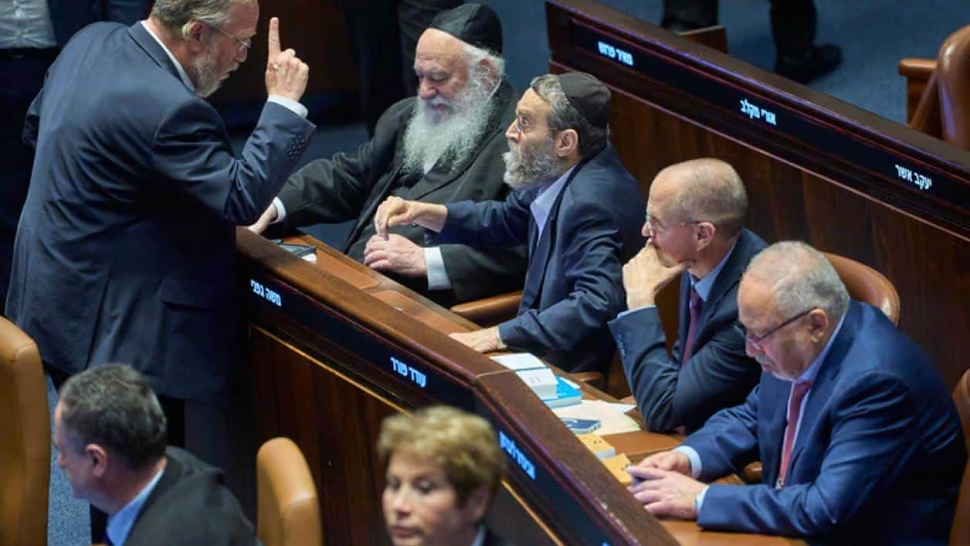
Israel’s Parliament (Knesset) passed two laws that, in practice, prevent ultra-Orthodox men from being recruited into the army. The measure, promoted by Prime Minister Benjamin Netanyahu, seeks to ensure the support of religious parties ahead of the October 27 elections.

One of the rules freezes the arrests of those who evade arrest. The other enshrines the study of the Torah as a “founding value” of the State, which provides a legal basis to oppose Supreme Court rulings that consider these exemptions illegal.

Rejection inside and outside the Government

The chief of the General Staff, Eyal Zamir, described the measures as “incompatible” with the needs of the Army. In a letter to Netanyahu and the defense minister, he wrote:

“It is inconceivable that the military system under my command, which demands unprecedented sacrifice from its personnel, would be party to granting mass exemptions from prosecution.”

Opposition leader Yair Lapid said the law is “an absolute desecration of the name of God” and “spits in the face” of soldiers.

Historical context and numbers

The exemptions have existed since Israel’s founding in 1948, but the Supreme Court declared them illegal. The debate resurfaces as the Army faces personnel shortages after almost three years of armed conflicts in Gaza, Lebanon and Iran.

Every year, about 13,000 ultra-Orthodox young people turn 18, but less than 10% enlist, according to a parliamentary committee. The prime minister seeks the support of the haredis for the next elections; Analysts point out that he is trying to get them to negotiate only with him after the elections.

For ultra-Orthodox legislator Moshe Gafni, the approval is historic. He stated:

“For thousands of years, the study of the Torah was the force that preserved the Jewish people. This law will be a compass for the values of the State.”

The decision generates tensions even within the ruling party and opens a debate about the balance between tradition and defense needs.

Continue reading