Congo reports more than 100 deaths from rare strain of Ebola

The WHO declared an international emergency due to the Bundibugyo virus outbreak in the east of the country.

The Democratic Republic of the Congo confirmed an Ebola outbreak caused by the Bundibugyo strain, a rare variant of the virus. As of Monday, more than 118 deaths and 300 suspected cases were recorded in the provinces of Ituri and North Kivu. Uganda reported one death and one case under study.

The World Health Organization declared a public health emergency of international concern on Sunday. Experts warn that the real number of infections could be higher, since the outbreak was not detected for several weeks.

RelatedAfrica reports new Ebola outbreak with 246 suspected cases

Late detection and criticism

Initial tests looked for the Zaire strain, the most common strain of Ebola, and came back negative. “Because the initial tests looked for the wrong strain of Ebola, we got false negatives and lost weeks of turnaround time,” said Matthew M. Kavanagh, director of the Center for Global Health Policy and Policy at Georgetown University. The specialist criticized the US government’s decision to withdraw from the WHO and cut foreign aid, “precisely the surveillance system designed to detect these viruses early.”

The first confirmed death occurred on April 24 in Bunia. The body was moved to the Mongbwalu mining area, which, according to Congolese Health Minister Samuel Roger Kamba, “made the Ebola outbreak worse.” The WHO was alerted on May 5 of about 50 deaths in that town, including four health workers.

Response and measures

The WHO will send a team of experts and the Congolese government has opened three treatment centers in Ituri. Doctors Without Borders noted that the situation “is quite worrying and is evolving quite rapidly.” Esther Sterk of the group said the outbreak “was detected quite late.”

Dr. Craig Spencer of Brown University and an Ebola survivor said: “I suspect the number of cases is going to rise quite dramatically in the coming weeks as we do better surveillance.”

Rwanda closed its land border with Congo on Sunday. Uganda intensified surveillance on its border. The United States will ban the entry of foreigners who have visited Congo, Uganda and South Sudan in the last three weeks. The UN ordered its staff in Bunia to work from home and avoid crowded areas.

The region is already facing a humanitarian crisis and the threat of armed groups that have displaced thousands. Although there have been more than 20 Ebola outbreaks in Congo and Uganda since 1976, this is only the third time that the Bundibugyo virus, which first appeared in 2007-2008 in Uganda, has been detected.
SRE rules out Mexicans affected after earthquakes in Venezuela

SRE reports that there are no Mexicans affected by earthquakes in Venezuela.

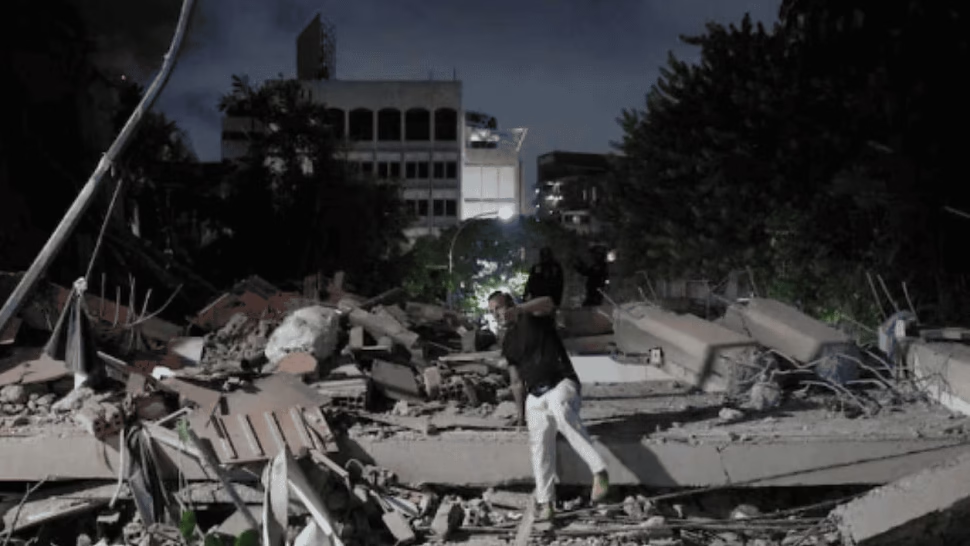
The Ministry of Foreign Affairs (SRE) reported that, as of this Wednesday afternoon, there were no reports of Mexican people affected by the earthquakes registered in Venezuela.

No effects reported

Through a statement, the Foreign Ministry expressed its solidarity with the Venezuelan people and regretted the damage that had occurred.

“The Ministry of Foreign Affairs expresses all its solidarity with the Venezuelan people and deeply regrets the damage and harm caused,” said the agency headed by Roberto Velasco.

The Mexican embassy in Venezuela remains attentive to the development of the situation. So far, there are no compatriots who have required assistance.

Support channels

For those who need consular protection, the Mexican representation has enabled the emergency number: +58 412 2524675. The authorities recommend staying calm and following local instructions.

The international organization continues to monitor possible aftershocks. For now, no changes are expected in travel recommendations for Mexicans in the region.

Continue reading

Colombia and the Amazon: a turn towards extractive development

De la Espriella's triumph in Colombia raises questions about the future of the Amazon rainforest in the region.

Abelardo de la Espriella’s victory in Colombia’s presidential elections marks a possible change in environmental policy in the region. The businessman, backed by Donald Trump, defeated Iván Cepeda by just 251,000 votes, according to official results.

What will happen to the Amazon?

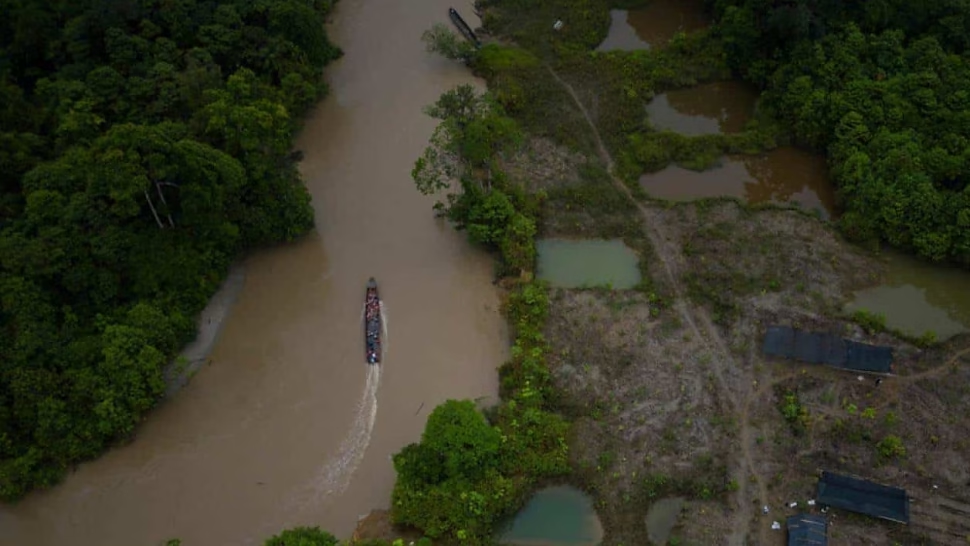
The Amazon rainforest, which absorbs carbon dioxide and slows climate change, faces a new scenario. Around 40% of Colombian territory is in the Amazon basin. During the government of Gustavo Petro, the country positioned itself as a defender of the jungle. De la Espriella promises to reactivate the oil sector, support fracking and further exploit natural resources.

Elizabeth Dickinson of the International Crisis Group noted that many governments now believe that economic development and conservation can move forward together. However, environmentalists warn that expanding fossil fuel production could increase pressure on sensitive ecosystems.

Peru and Brazil also join this trend. Keiko Fujimori, close to winning in Peru, supports mining. In Brazil, the election between Flávio Bolsonaro and Lula will define the direction of deforestation. Cristiane Mazzetti of Greenpeace Brazil said: “The elected administration sets budget priorities and regulates exploitation. The result is measurable, as shown by the rate of deforestation.”

Illegal gold mining is one of the biggest drivers of destruction in the Amazon. Dickinson added: “It’s very hard to disagree with going after illegal mining, one of the most damaging industries.” But he warned that governments often focus on seizing equipment, without dismantling criminal networks.

Julio Cusurichi, indigenous leader in Peru, stated: “Biodiversity and our territories can help climate change. In our territories we do governance for the planet.” Indigenous organizations denounce that governments do not adequately consult them before approving extractive projects.

Analysts such as Sergio Guzmán indicate that environmental concerns will compete with economic ones. “Many emissions concerns will take a backseat to energy self-sufficiency,” he said. He also mentioned that aerial fumigation of coca crops could resume, affecting Amazonian communities.

In Leticia, the Ticuna indigenous Arnaldo Rufino expressed his fear: “That means cutting down the trees that allow humanity to breathe.” The future of the Amazon will depend on the decisions made by the new governments in the region.

Continue reading

7.1 magnitude earthquake shakes Venezuela and raises alerts

7.1 tremor shakes Venezuela; tsunami warning in Puerto Rico.

7.1 tremor in Venezuela activates tsunami alert

A 7.1 magnitude earthquake was recorded this Wednesday in Venezuela, according to the United States National Oceanic and Atmospheric Administration (NOAA). The earthquake occurred at 22:04 GMT with the epicenter located 21 kilometers east of Morón, in the state of Carabobo.

The depth of the earthquake was 9.6 kilometers, which increased its perception on the surface. NOAA issued a tsunami warning for Puerto Rico and the Virgin Islands, although so far no major damage has been reported in those areas.

Aftershocks and affected areas

The tremor unleashed scenes of alarm in Caracas, where residents took to the streets after feeling the movement. It was also noticed in several cities in Colombia, such as Bogotá, Barranquilla and Bucaramanga, although without serious consequences.

Local authorities evaluate possible effects. Venezuela is located in an area of ​​moderate seismic activity, and events of this magnitude are rare. No casualties or significant structural damage have been reported as of press time.

Continue reading