The United States deploys massive military force in the Caribbean

An unprecedented war fleet and cutting-edge aircraft are concentrated in strategic waters, marking a new chapter in regional security policy.

An Unprecedented Strategic Deployment in the Caribbean

The United States military has established an unusually high concentration of military power in the Caribbean Sea basin and near the coast of Venezuela. This massive deployment began during the summer, as a direct action by President Donald Trump’s administration to move combat assets to the area. The operation is officially part of the government campaign against drug trafficking and narcoterrorism networks, a national security objective that justifies, according to Washington, the mobilization of a broad spectrum of war capabilities. This analysis examines the components, strategic potential and geopolitical implications of this force buildup, providing a detailed breakdown of deployed assets and their potential tactical employment.

Naval Capabilities: A Multifaceted Warfleet

The naval component of this operation is made up of eight warships of the US Navy, forming a combat group of notable versatility. The flotilla includes three destroyers, three amphibious assault ships, one cruiser and one littoral combat ship, the latter specifically designed for operations in coastal and shallow waters. The three amphibious assault ships are particularly significant, as they form an amphibious readiness group and transport a Marine expeditionary unit. This configuration gives them a double capacity: ground force projection and close air support. These ships act as light aircraft carriers, hosting a variety of Navy helicopters, tiltrotor aircraft MV-22 Osprey and attack fighters AV-8B Harrier, aerial vectors capable of transporting large contingents of marine infantry or attacking land and sea targets with precision.

RelatedThe United States carries out a military operation and captures Maduro in Venezuela

In addition, although US Southern Command authorities have not provided specific weapons data, it is standard operational practice for destroyers and cruisers to deploy equipped with Tomahawk cruise missiles. This long-range projectile, capable of hitting targets hundreds of kilometers away from its launch point, represents a first-rate deterrent and offensive element. To complete the underwater picture, the USS Newport News, a Los Angeles-class attack submarine, operates in the waters of South America. This underwater platform has the ability to transport and launch cruise missiles, adding a stealth and area denial layer to the military presence.

Air Domain: Fighter Aircraft and Unmanned Systems

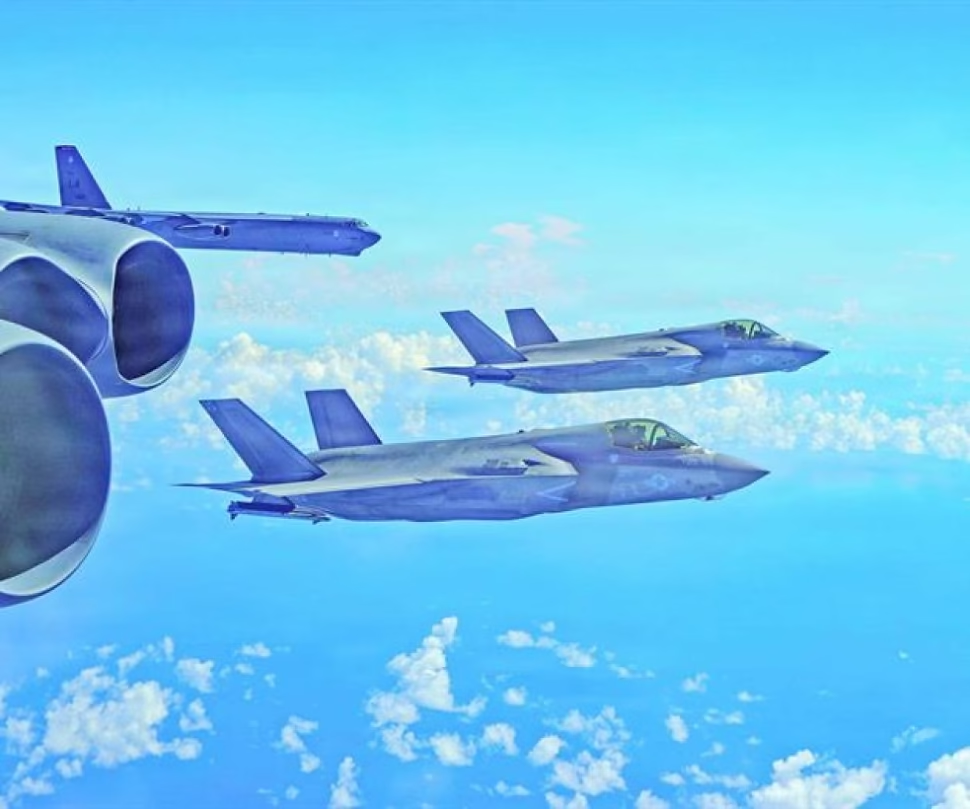
The deployed air power substantially reinforces naval capabilities. A squadron of next-generation stealth fighters, the Marine Corps’ F-35B Lightning II, was deployed to a landing strip in Puerto Rico. The arrival of these fifth-generation aircraft, observed for the first time in mid-September, represents a qualitative leap in surveillance and attack capabilities in the region. Almost simultaneously, commercial satellites and military observers documented the operation of Air Force MQ-9 Reaper drones from the same location. These unmanned aerial vehicles, known for their long flight autonomy and their ability to carry up to eight laser-guided missiles, are ideal instruments for intelligence, surveillance, reconnaissance and elimination of high-value target missions.

The US Navy has also deployed P-8 Poseidon maritime patrol aircraft from the region, aircraft specialized in anti-submarine and anti-ship warfare. An additional indicator of the seriousness of the deployment was the release, in early October, of an official image showing an Air Force AC-130J Ghostrider parked on the runway in Puerto Rico. This aircraft, essentially a flying artillery battery, is capable of providing overwhelmingly accurate suppressive fire on ground targets. To cap off this show of force, the Air Force executed a B-52 Stratofortress strategic bomber flight across the region last week, a mission the Pentagon explicitly labeled a “bomber strike demonstration.”

Strategic Implications and Conclusion

In terms of personnel, defense authorities have confirmed the presence of more than 6,000 sailors and marines operating in the region from identified naval platforms alone. The Department of Defense has refrained from offering specific figures on the ground personnel associated with the drones, aircraft and support units deployed in land bases, so the total number of troops is presumably higher. The combination of this naval, air and marine power sets up a scenario of maximum pressure on the government of Venezuela, transcending the declared framework of the anti-drug fight. This deployment can be interpreted as a mechanism of diplomatic coercion and a demonstration of Washington’s ability to project power quickly and overwhelmingly in its traditional sphere of influence. The accumulation of forces establishes a new and volatile status quo in hemispheric security, whose medium and long-term consequences require meticulous monitoring.

Do you consider that this level of military deployment is proportional to the threat of drug trafficking? Share this analysis on your social networks to expand the conversation and explore more content on geopolitics and global security on our site.

US without response to 233 extraditions requested by Mexico

Of 269 extradition requests from Mexico to the US, 233 remain unanswered. Sheinbaum and Blanche clash.

The Deputy Attorney General of the United States, Todd Blanche, seemed surprised when asked about the extradition requests from Mexico that Washington has not responded to. During the White House Correspondents’ Dinner, Blanche mentioned the “extradition agreement” and said those requests “should be reviewed.”

The most visible case is that of the former governor of Tamaulipas, Francisco García Cabeza de Vaca, who lives in the United States. President Claudia Sheinbaum has denounced the lack of American response.

“He has dual nationality. He is a Mexican citizen and an American citizen, he lives in the United States. Mexico has requested his extradition… and there has been no response from the United States Government,” Sheinbaum lamented in his morning conference.

According to data from the Mexican government, between 2018 and 2026, 269 requests were made for people accused of various crimes. Of that number, 233 have no resolution from the US authorities.

Accusations and politics

García Cabeza de Vaca faces charges from the Attorney General’s Office for alleged links to organized crime, money laundering and tax fraud. The former PAN president published a video on X accusing Sheinbaum of being “misinformed.”

Since his residence in the US, he has participated in events of the Conservative Political Action Conference (CPAC) along with other PAN politicians, including migrant congressman Raúl Torres Guerrero, where they called for US military actions in Mexico.

Contracts and a homicide

Between 2017 and 2019, companies linked to brothers Sergio and Julio César Carmona received contracts from the Tamaulipas government for about 335.8 million pesos. In August 2025, the state Ministry of Health revealed 70 complaints, 14 of them criminal, against García Cabeza de Vaca and former officials for these contracts.

Sergio Carmona was deprived of his life in November 2021 while being treated at a barbershop in San Pedro Garza García, Nuevo León, amid a claim of non-payment to the former governor.

The current governor of Tamaulipas, Américo Villarreal (Morena), has been linked by García Cabeza de Vaca’s political group with Carmona. A source from the Villarreal government declared: “From the American Union… I feel that they have been giving their versions, to which we have not had the consideration… to have a counter reply.”

Security cooperation between both countries continues, but the pending extradition file adds tension to the bilateral relationship.

Continue reading

Knife attack in Paris leaves three women injured

Three women attacked with a knife in Paris; none are in critical condition.

Attack on Porte de Clichy

None of the three women attacked this morning with a knife in the Porte de Clichy area, northwest of Paris, is in critical condition. This was reported by the Minister of the Interior, Laurent Núñez, after the meeting of the Council of Ministers.

Two of them suffered serious injuries: one in the back and another in the abdomen. The third suffered minor injuries caused by the blades of the two kitchen knives that the attacker was carrying. The victims are 19, 24 and 36 years old. The attack occurred around 11:30 in the morning.

Arrest and reactions

The attacker was intercepted by an off-duty police officer. Núñez thanked him for his bravery. Before the authorities, the suspect only gave general information and unconnected phrases. The minister asked for caution about the reasons for the act.

In a video circulating on social media, the alleged attacker is heard saying: “It was Allah who ordered it to me.” However, Núñez insisted that it will be the judicial process that determines the motive. According to the newspaper Le Parisien, the attacker is 31 years old and may not be of full use of his mental faculties. The authorities continue the investigation.

Continue reading

Colombia breaks diplomatic ties with Cuba and closes embassies

The Colombian president-elect breaks ties with Cuba and cuts his diplomatic presence.

The elected president of Colombia, Abelardo de la Espriella, confirmed in a message released this Sunday that he will break diplomatic relations with Cuba. The decision is aligned with what was previously done by Ecuador and Costa Rica.

In addition, it announced the closure of 14 embassies and 15 consulates in countries such as Nicaragua, Algeria, the Czech Republic, Ghana, Hungary, Senegal and South Africa. These nations will maintain concurrent representation upon coming to power.

A single ambassador for several countries

He explained that the same ambassador will attend multiple representations in the same country. He clarified: “These decisions do not mean breaking diplomatic relations with those countries or with multilateral organizations. The exception is Cuba and Nicaragua.”

The next president also reported that he will suspend the opening of the embassy in Palestine, but will authorize the reopening of the consulate in Israel.

Regional background

In early March, the government of Ecuador closed the Cuban diplomatic headquarters in Quito and declared its ambassador persona non grata. Days later, the then president of Costa Rica, Rodrigo Chaves, also ordered the closure of the island’s embassy in San José.

Continue reading