Venezuela deploys ships and drones in the Caribbean for drug trafficking

A strategic military and diplomatic response is activated in the midst of a scenario of high international tension in the region.

Analysis of the Venezuelan Military Deployment in the Caribbean

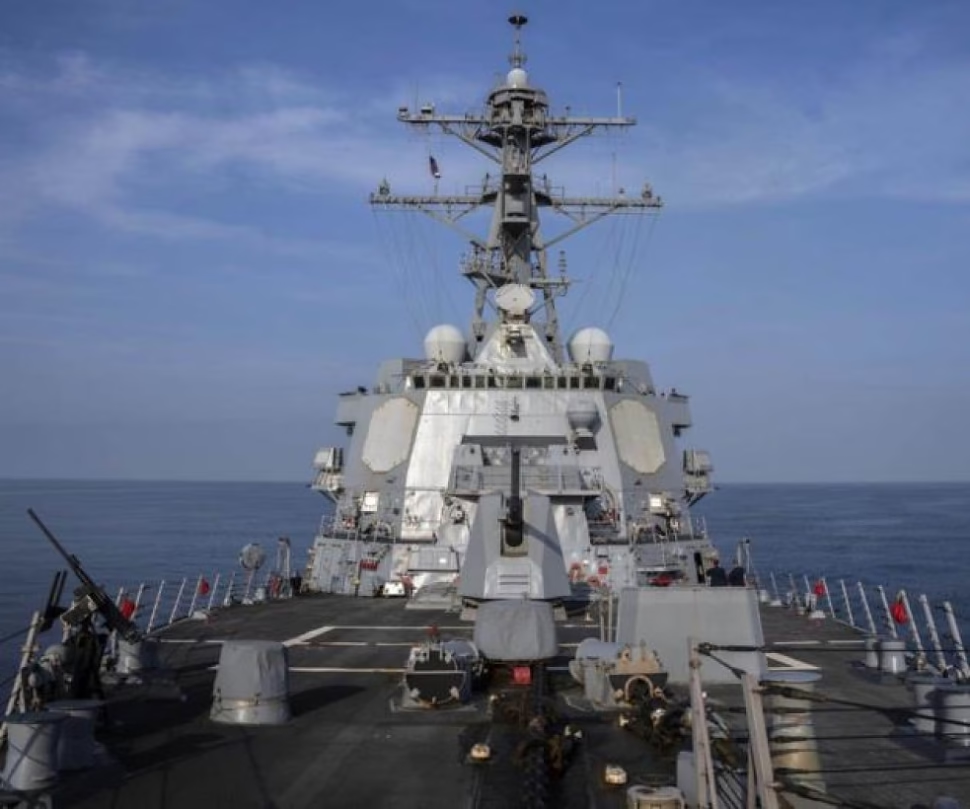
The government of the Bolivarian Republic of Venezuela formally announced this Tuesday the implementation of a large-scale security operation. The strategy includes the deployment of naval units, unmanned aircraft (drones) and the commitment of more than fifteen thousand troops from its regular forces. The stated objective of this mobilization is to significantly reinforce anti-narcotics military and police operations in two critical areas: the extensive land border it shares with the Republic of Colombia and the sovereign waters of the Caribbean Sea.

This significant announcement occurs in a particularly sensitive international context, characterized by a notable increase in diplomatic and strategic tension with the United States. This escalation began after the US government’s decision to order the deployment of three warships near the Venezuelan exclusive economic zone, a move described by Washington as part of its expanded efforts to combat threats associated with Latin American drug cartels.

RelatedThe United States carries out a military operation and captures Maduro in Venezuela

Strategic Components and Operational Context

The Minister of Popular Power for Defense, General in Chief Vladimir Padrino López, acted as the official spokesperson for this initiative. Through a video message broadcast by the state-owned Venezolana de Televisión (VTV), the senior official specified that the measure seeks to consolidate the presence of the security forces that are already carrying out work in the states of Táchira and Zulia, federal entities bordering Colombia. According to their statements, the troops involved are preparing to receive the specific operation order “soon.”

Padrino López justified the operation by referring to the “conditions and characteristics” of what the Venezuelan government identifies as “terrorist, armed and drug trafficking groups” that operate in the border area. The official discourse emphasizes the intention of these factions to try to infiltrate Venezuelan territory, so the dual mission consists of repelling these attempts and, simultaneously, “fighting all drug trafficking mafias.”

Parallel to the military mobilization, the Venezuelan executive began a diplomatic offensive. The Chancellor of the Republic, Yván Gil, held a meeting with Gianluca Rampolla, Resident Coordinator of the United Nations System in Venezuela. During the meeting, Gil formally requested the support and mediation of the multilateral organization to restore “sanity” and de-escalate what Caracas describes as “threats” from the United States. The head of Venezuelan diplomacy expressed his concerns regarding the deployment of US military units in the Caribbean region.

This request finds an immediate precedent in the public appeal made the previous week by the Secretary General of the UN, António Guterres, who urged both nations to “resolve their differences by peaceful means“, in line with the Charter of the United Nations and international law.

Background and Extension of the Conflict

The current situation cannot be separated from previous actions. In early August, the administration of then-President Donald Trump doubled, raising it to fifty million dollars, the reward offered for the capture of President Nicolás Maduro. This measure is part of a formal accusation presented before the US justice system, where the Venezuelan president is charged with charges of narcoterrorism, allegations that the government of Caracas categorically rejects, calling them unfounded and with a clear political motivation: the destabilization of his administration.

As a counterpart to these accusations, Foreign Minister Gil cited a report from the United Nations Office on Drugs and Crime (UNODC), which, according to his interpretation, “has ratified Venezuela as a territory free of illicit crops.” This point is used as a central pillar of the Venezuelan argument to defend its management in the fight against drug trafficking.

In the area of internal security, the Maduro government’s response has included the incorporation of approximately 4.5 million members of the Bolivarian militias—a body of civilian volunteers created during the mandate of President Hugo Chávez—to citizen security tasks in communities throughout the country. According to the president’s statements, this measure seeks to “strengthen the logistical and organizational capacity necessary to guarantee the security and defense of the national territory.” It is estimated that the Bolivarian National Armed Force has around 200,000 regular members, to which these millions of militiamen would be added as a reserve and support force.

Uncertainty over the timing of US naval deployment adds another layer of complexity. Although official US sources have suggested that the arrival of its warships to the region could take months, there is a widespread expectation, particularly in intelligence and geopolitical analysis circles, that their presence could materialize on a much more immediate time horizon, possibly in the coming days.

This intertwining of military movements, diplomatic statements and international legal actions forms a highly complex panorama for regional security. The Venezuelan deployment, therefore, can be analyzed as a multifaceted response that combines a demonstration of deterrent force, an internal security measure and a move within a broader geopolitical dispute, the outcome of which remains to be defined and which requires continuous and rigorous monitoring.

Do you consider this information to be relevant to understanding current geopolitics? Share this analysis on your social networks and explore more content on international security on our platform.
Bolivia keeps fuel prices frozen

Bolivia extends the fuel price freeze for six more months after the protests.

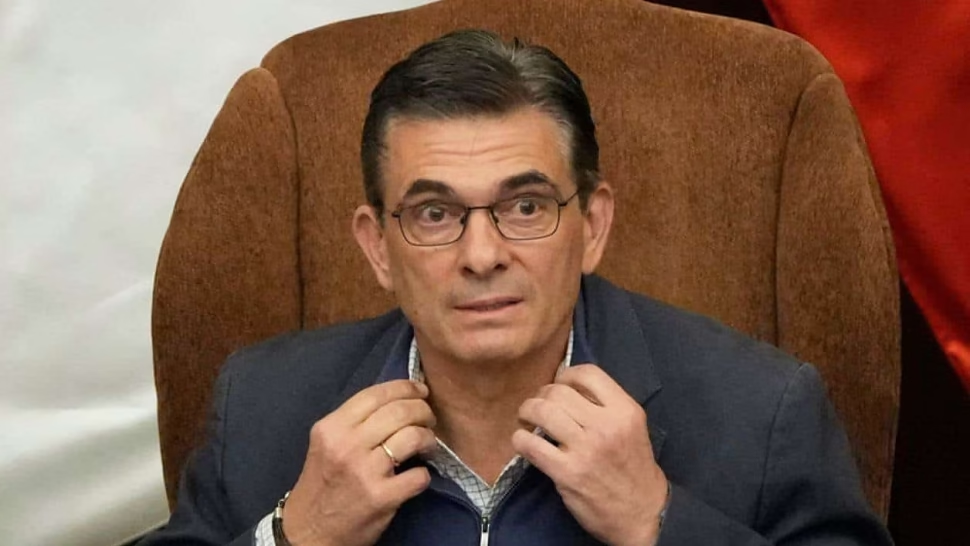
Bolivian President Rodrigo Paz decided to extend the fuel price freeze for six months. The measure responds to the prolonged protests and blockades in May and June that demanded his resignation.

Official measure

The decree was issued after a review of the subsidy scheme. Last December, the president withdrew almost all state support for fuel, as part of his anti-crisis plan, and established a mechanism for semiannual adjustments.

“We already had a previous decree that had frozen prices, what has been done is to modify it so that it is extended for another six months,” explained the presidential spokesperson, José Luis Gálvez.

A liter of gasoline remains at 6.96 bolivianos (0.71 dollars) and diesel at 9.80 bolivianos (more than a dollar). The price of gas also remains frozen.

Economic context

The government seeks to normalize supply after the blockades. The mobilizations aggravated the economic situation, with depleted international reserves. Bolivia depends on fuel imports, according to experts.

The country maintained a subsidy for about 20 years, which generated a strong outflow of foreign currency in a context of dollar illiquidity, according to the government.

Former Hydrocarbons Minister Álvaro Ríos criticized the decision as political: with it, the State would pay a higher price than what it sells to the final consumer.

Continue reading

Women fishermen in Kenya: from the sea to ecotourism due to the climate crisis

Kenyan women transform their relationship with the sea in the face of the fishing crisis.

Women fishermen in Kenya: from the sea to ecotourism due to the climate crisis

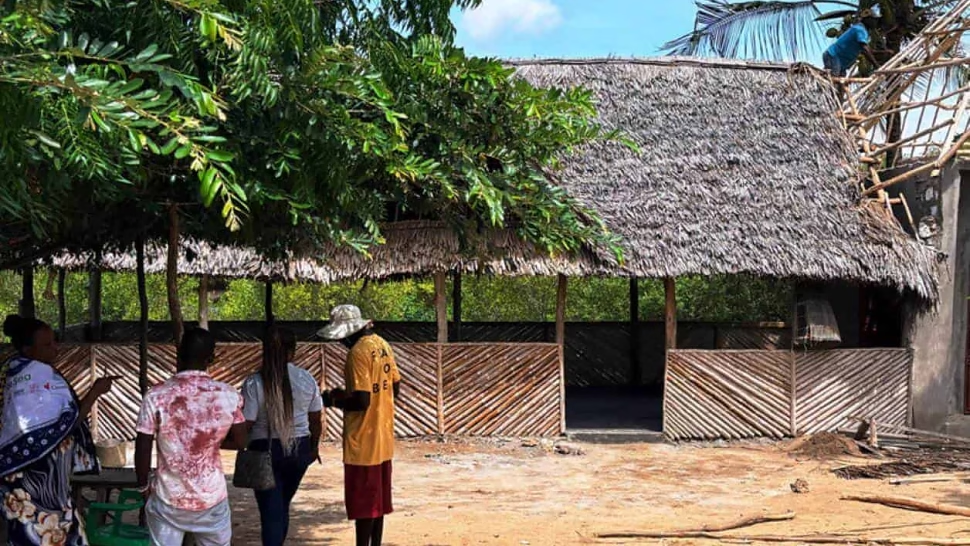
Nuru Mohammed, 54, leads a group of women hanging fishing nets as decorations at her new restaurant in Malindi, northeast of Mombasa. In a few days it will open its doors. “For us women, this is hope,” she says. “It will help support many families who have depended on the ocean for decades.”

Along the East African coast, fishermen are reinventing themselves. Climate change, overfishing and ocean deterioration threaten their livelihoods. In Kenya, women transform restored mangroves into sources of income through beekeeping and ecotourism. In Zanzibar, communities protect reefs with locally managed closures. In Mozambique, seagrass restoration creates jobs.

“Communities that depend on the ocean are also its best guardians,” says Andréanne Martel, project director of the ReSea conservation program. “When local people, especially women, lead in conservation, they protect biodiversity and create more resilient livelihoods.”

Mohammed says that his boats have been stolen and that it is difficult for him to compete with industrial trawlers. A nearby Chinese processing plant reflects the changes. “I can’t compete with that power,” he says. “It’s been hard. I fought to stay a fisherman, but I think it’s a battle I can’t win anymore.”

10 kilometers away, Beatrice Mwanyiro oversees a mangrove nursery and restaurant for Samahco, a self-help group of 30 women supported by the Canadian government. “We have to adapt. The number of fish decreases every year. Without another source of income we will not be able to feed our families,” he explains.

Mohamed Somo, a fishing leader in Lamu, says that they used to catch up to 100 kilos of fish per boat; now less than 30. Kenyan law prohibits trawling within 9 kilometers of the coast, but some vessels operate closer. Illegal, unreported and unregulated fishing costs $23 billion annually, according to the FAO.

“The trawlers fish on the high seas during the day, but at night they enter the shallow waters where we artisanal workers work. There is very little left in the morning,” adds Somo.

Jerry Mang’ena of Action for Ocean in Tanzania says: “Coastal communities are on the front lines of climate change, but they are also drivers of resilience. If we want to protect the ocean, we must invest in those who have cared for it.”

At the recent Our Ocean Conference in Mombasa, organizations called for ratifying the BBNJ (high seas) treaty, which came into force in January and has been signed by 145 countries and ratified by 81. Aliou Ba of Greenpeace Africa says: “The agreement offers a historic opportunity to protect the high seas and tackle illegal fishing that deprives communities of food and income. Governments cannot delay.”

Continue reading

Fujimori announces intention to resume ties with Mexico

The elected president of Peru seeks to reestablish dialogue with Mexico after statements by Sheinbaum.

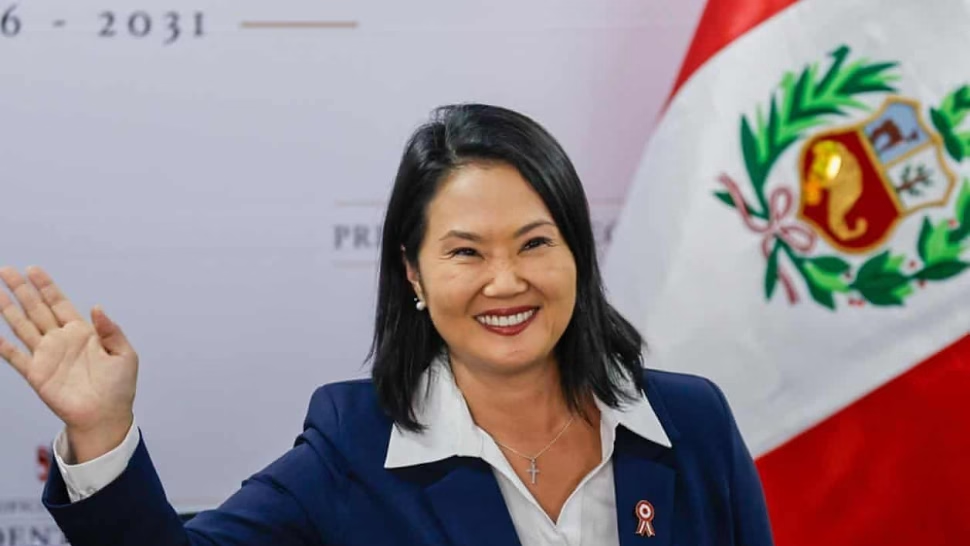
The elected president of Peru, Keiko Fujimori, stated on Thursday that she has “every intention” of resuming diplomatic relations with Mexico. The statement came a day after the Mexican president, Claudia Sheinbaum, indicated that she had not yet contacted Fujimori to congratulate her on her electoral victory.

“On my side there will be every intention to be able to resume relations between Peru and Mexico,” Fujimori briefly told the press during a public event in Lima.

Background of distancing

Sheinbaum had declared in his morning conference: “We are going to wait, remember that they broke off relations with us.” The break occurred in 2025, when Peru decided to break ties after the diplomatic asylum granted by Mexico to former Prime Minister Betssy Chávez, who took refuge in the Mexican embassy in Lima. Chávez is still waiting for safe passage to travel to Mexico, which Peru has not granted.

The conflict originated in December 2022, when the Peruvian Congress dismissed then-president Pedro Castillo, who was imprisoned after trying to dissolve the Legislature. In this context, Castillo’s wife and two minor children received asylum at the Mexican embassy and then moved to Mexico. Since then, both Andrés Manuel López Obrador and Sheinbaum requested Castillo’s release.

Castillo’s arrest sparked protests that left 50 dead during the repression by security forces under the government of Dina Boluarte. Later, Castillo and Chávez were sentenced to 11 years in prison for conspiracy to rebel. Castillo has appealed the sentence and faces other corruption investigations.

Asked if she considers Castillo’s detention illegal, as Sheinbaum claims, Fujimori responded: “I am very respectful of the institutions of my country.” However, before being proclaimed the winner, she had already pointed out that Peru and Mexico share the Pacific Alliance bloc and that there are “ties of friendship that must be prioritized beyond differences.”

Continue reading