Colombia breaks diplomatic ties with Cuba and closes embassies

The Colombian president-elect breaks ties with Cuba and cuts his diplomatic presence.

The elected president of Colombia, Abelardo de la Espriella, confirmed in a message released this Sunday that he will break diplomatic relations with Cuba. The decision is aligned with what was previously done by Ecuador and Costa Rica.

In addition, it announced the closure of 14 embassies and 15 consulates in countries such as Nicaragua, Algeria, the Czech Republic, Ghana, Hungary, Senegal and South Africa. These nations will maintain concurrent representation upon coming to power.

RelatedAbelardo de la Espriella is proclaimed president-elect of Colombia

A single ambassador for several countries

He explained that the same ambassador will attend multiple representations in the same country. He clarified: “These decisions do not mean breaking diplomatic relations with those countries or with multilateral organizations. The exception is Cuba and Nicaragua.”

The next president also reported that he will suspend the opening of the embassy in Palestine, but will authorize the reopening of the consulate in Israel.

Regional background

In early March, the government of Ecuador closed the Cuban diplomatic headquarters in Quito and declared its ambassador persona non grata. Days later, the then president of Costa Rica, Rodrigo Chaves, also ordered the closure of the island’s embassy in San José.

UN demands Israel stop demolitions in southern Lebanon

Volker Türk warns that Israeli actions could constitute war crimes.

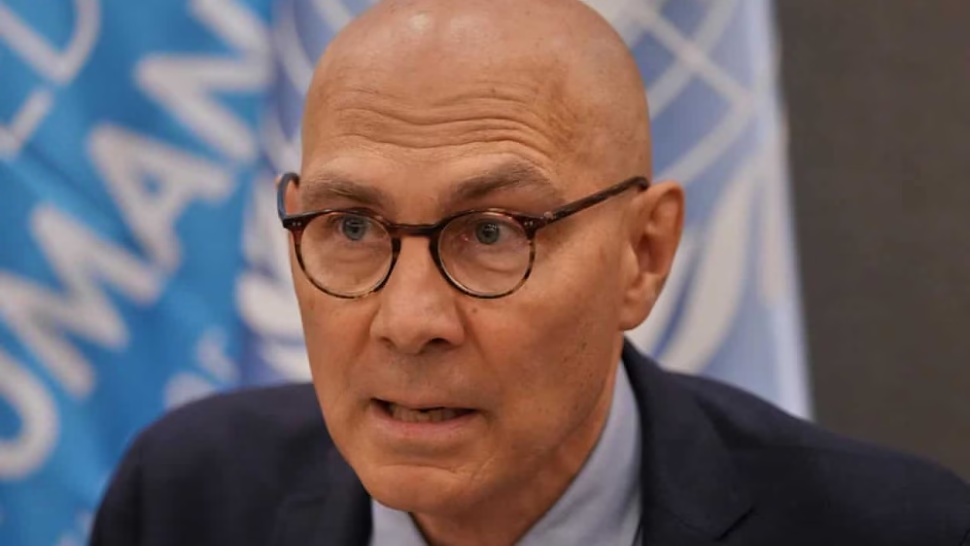
The UN High Commissioner for Human Rights, Volker Türk, urged Israel on Monday to end the occupation of large areas of southern Lebanon and stop the demolition of homes. The statement comes days before a new round of direct talks between Lebanese and Israeli officials in Rome.

Türk visited Lebanon for the second time in just over a year. He met with authorities, civil organizations and people displaced by the conflict between Israel and Hezbollah. The visit takes place in a critical context: since March 2, more than 4,000 people have died and 1.2 million have been displaced.

Actions that alarm

Türk noted that the mass demolition of towns and villages, along with the deaths of dozens of medical workers and journalists, could amount to war crimes. “Demolition of this type raises enormous alarms about adherence to international humanitarian law,” he said. He described what happened as a “total destruction” of civilian property.

Israel defends its attacks as directed against Hezbollah infrastructure, which it accuses of hiding among the civilian population. His forces still occupy dozens of towns in southern Lebanon.

Lebanese commitment and criticism of the agreement

President Joseph Aoun reaffirmed Lebanon’s commitment to the framework agreement reached on June 26, but warned that the Israeli military presence and demolitions “could undermine its effectiveness.” “We will not accept continued violations of its provisions,” he declared.

The agreement includes a controversial clause: both parties renounce legal action, a measure highly criticized in Lebanon.

Türk also condemned Hezbollah’s attacks on northern Israel and called for the safe return of the displaced. He recounted the case of a man who returned to his village and found it demolished by Israeli forces. Türk contacted the Israeli authorities to arrange a similar visit, but received no response. Israel voted against his re-election in the UN General Assembly.

Continue reading

Progress in mediation for a ceasefire between the US and Iran

Mediators from Qatar and Pakistan report significant progress in resuming dialogue.

Mediators led by Qatar and Pakistan made concrete progress toward getting Washington and Tehran back to the negotiating table, according to regional officials who requested anonymity. Both sides paused attacks for three consecutive days — a respite after two weeks of bombing that escalated after the closure of the Strait of Hormuz.

Saudi Arabia shot down drones from pro-Iran groups launched from Iraq against its oil facilities, while the Houthis in Yemen claimed responsibility for a similar attack. Jordan also reported two drones intercepted, with no casualties. In Iraq, two drone strikes hit an Iranian Kurdish dissident group.

President Donald Trump said Iran has asked to extend talks and that there is a “good chance” of an agreement. But Tehran denies direct negotiations. A spokesman for the Iranian Foreign Ministry, Esmail Baghaei, clarified that “mediators can transmit messages”, but there is no direct dialogue.

The trigger for the escalation: the Strait of Hormuz. Iran and Oman discussed a mechanism to manage maritime transit, respecting Iranian sovereignty and security. The Iranian spokesman stressed that the objective is to “guarantee safe navigation,” but the route remains closed to commercial traffic, which fell to its lowest level in three weeks, according to an organization supervised by the US Navy.

The United States imposed a naval blockade that has rerouted 17 ships, disabled two and boarded two others. The 60-day provisional agreement reached in June is already advanced but without progress on the Iranian nuclear program, the central point of tensions.

Analysts question the ability to maintain the attacks. Gen. Dan Caine, chairman of the Joint Chiefs of Staff, warned Trump that missile and interceptor stockpiles are under pressure, and that “air power has its limits.” Trump said the reserves are in “very good shape,” although he admitted he would like to have more.

In parallel, Israeli Prime Minister Benjamin Netanyahu is scheduled to meet with Trump in Washington. Hezbollah launched rockets into Israel at the start of the war, killing top Iranian leaders, including Ayatollah Ali Khamenei. Talks between Israel and Lebanon, mediated by the United States, will continue in Rome with a focus on pilot areas for the Israeli withdrawal.

The Houthis threaten to block Saudi traffic in Bab al-Mandeb, increasing pressure on global energy supplies and gasoline prices.

Continue reading

UK shares electronic warfare technology with Ukraine

Zelensky visits London and receives Stone Cloak technology to confront Russia.

Ukrainian President Volodymyr Zelensky made a whirlwind visit to London on Monday. There he met with the new British Prime Minister, Andy Burnham, the fifth tenant of Downing Street since the beginning of the conflict with Russia. Burnham ratified “unwavering” support for kyiv and announced the transfer of intellectual property for advanced electronic warfare technology.

The Stone Cloak System

The main agreement was to share Stone Cloak technology, a portable electronic jamming system designed to protect Ukrainian drones. London presented the device as a tool to increase the effectiveness of unmanned vehicles, not just as a defensive shield. The meeting took place at the Portsmouth naval base, where both leaders boarded the Queen Elizabeth aircraft carrier.

Zelensky also met with Ukrainian military personnel participating in the Sea Breeze exercises. The meeting occurs before another key meeting with Donald Trump, and in the midst of an escalation of attacks with Russia that has increased the number of civilian deaths in the last month.

British support seems solid despite changes in government. Zelensky highlighted that the strategic agreement signed last year made bilateral relations “the strongest in history.” For future cooperation, he mentioned three priorities: air defense, maritime security and joint weapons production.

Continue reading