Cuba denounces US campaign against its doctors

The Cuban ambassador reveals the intense US pressure to sabotage international humanitarian aid to the island and its consequences.

Havana vs. Washington: One more chapter in the geopolitical soap opera

Just when the UN is preparing for another vote on the eternal and controversial US blockade of Cuba, the Cuban ambassador to Mexico, Marcos Rodríguez Costa, came out with statements that sound more like a political thriller script than a boring press conference. Basically, he accused the US authorities of launching a “fierce” campaign, such as *bullying* at an international level, to pressure other countries to align with their position. Because, apparently, in the 21st century, diplomacy is exercised based on memes and pressure.

Rodríguez Costa did not bite his tongue and detailed how this economic fence affects practically everything on the island: from the economy and sports to education, tourism and, oh surprise, health. Their main complaint is that Washington now has its sights on Cuba’s international medical collaboration, one of the flags most waved by the Cuban government. According to the ambassador, this is a “coercive design” to prevent Cuba from obtaining income and, in the process, accuse them of human trafficking. An argument that, without a doubt, adds fuel to the fire of a dispute that seems to have no end.

RelatedCuba denounces US pressure on embargo vote at UN

The world without Cuban doctors? A drama in several acts

Imagine this: more than 50 countries and around 60 thousand Cuban health collaborators spread around the globe, turning the island into a kind of *startup* of solidarity medicine, but with decades of experience. The ambassador was clear: this campaign puts the health of thousands of people who depend on this aid at risk. And here, in Mexico, things are personal. With more than 3,300 Cuban doctors in Aztec territory, the possible departure of these professionals sounds like that awkward moment in a series when a key character announces that he is leaving.

The Mexican government, for its part, seems to have found in Cuban doctors the solution to the holes in a health system that, according to them, the “neoliberal model” left in a critical state. Both former president López Obrador and the current president, Claudia Sheinbaum

And speaking of topics that are close to us, the Abdalá vaccine against Covid-19 also came up. Rodríguez Costa mentioned that conversations with Mexico continue, highlighting the “global success” of the vaccine and remembering that thousands of Mexicans received it during the pandemic. A nod to those days of confinement where we were all experts in virology and we followed the trail of each vaccine as if it were a spoiler for our favorite series.

Oil, security and eternal gratitude: The complete combo
The bilateral relationship is not limited to white coats. The ambassador also spoke of sending Mexican oil to Cuba to alleviate the energy crisis, a measure that he described as “natural” and the result of a “close relationship” with institutions such as Pemex and the CFE. Basically, it’s the classic “neighbor who gives you a hand when the power goes out”, but on a geopolitical scale.

In a more serious tone, Rodríguez Costa warned about security threats in The Caribbean and Latin America, specifically pointing out the situation of Venezuela with the United States. He also strongly rejected the inclusion of Cuba on the list of countries sponsoring terrorism, a label that, according to him, has very real consequences, such as international banks fleeing the island as if it were a *spoiler* on Twitter.

In a rare (and refreshing) moment of self-criticism, the diplomat admitted that not all of Cuba’s problems are due to the blockade. He acknowledged that “we still have to improve things“, a statement that in the world of politics sounds almost *plot twist*. Even so, he trusts in unanimous support against the siege at the UN, despite what he describes as an intense United States campaign to bend wills.

The conclusion? This episode confirms that relations between Cuba and the United States continue to be as complicated as following the thread of a WhatsApp conversation full of deleted messages. Meanwhile, medical collaboration remains a point of pride for Havana and a topic of exciting debate for all.

Are you surprised by Cuba’s strategy? Share this analysis on your social networks and make your timeline also comment on this geopolitical pulse. Explore more content about international relations on our site.

Canada cancels ceremony with the US due to Trump’s tariff threats

Ottawa cancels joint event with Washington due to tariff tensions. The bridge opens on July 27.

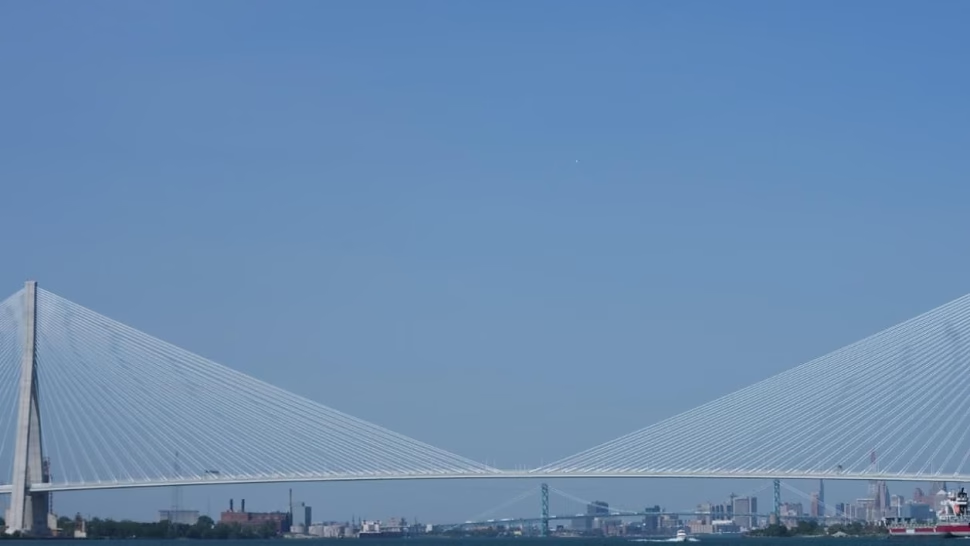
The Government of Canada decided to cancel the joint ceremony with the United States for the inauguration of the new Gordie Howe International Bridge, which connects Windsor with Detroit. The measure responds to recent tariff threats from President Donald Trump.

“In light of the trade actions threatened by the United States this week, it would be inappropriate to move forward with a celebratory event between the two countries,” said Jenna Ghassabeh, spokesperson for Canadian Infrastructure Minister Gregor Robertson.

The binational event was scheduled for July 24 with authorities from both countries. However, Ottawa will maintain the opening date to traffic on July 27, with an exclusively Canadian celebration.

Commercial tension and key work

The decision comes after Trump announced 50% tariffs on various Canadian imports, arguing alleged discriminatory treatment of American cars, alcoholic beverages and dairy products.

The Gordie Howe Bridge required an investment of $4.7 billion. It is one of the most relevant infrastructure works in North America and seeks to relieve the flow of the Ambassador Bridge, through which 126 billion dollars in merchandise circulated during 2023.

Despite the suspension of the joint event, the border crossing will begin operating as scheduled.

Continue reading

The official number of deaths from earthquakes in Venezuela rises to 5,346

5,346 dead and 16,740 injured: new official balance after the earthquakes of June 24 in Venezuela.

The Venezuelan authorities updated this Tuesday the official balance of the double earthquake registered on June 24. The death toll rises to 5,346 after adding 68 additional deaths in the last few hours.

Jorge Rodríguez, president of the National Assembly, reported that the injured remain at 16,740. A total of 17,265 people remain homeless, while 23,122 victims remain housed in 107 temporary camps. So far, authorities have provided care to 128,324 affected families.

Material damage and disappearances

The official report registers 856 buildings damaged and 190 collapsed. Civil society organizations estimate 29,460 people missing under the rubble, a figure that the government has not officially confirmed.

This new count is released 27 days after the earthquakes that generated a large-scale humanitarian emergency in the country. Rodríguez disseminated the data through his Telegram channel, where he detailed the progress in the care work for those affected.

The authorities maintain active search, rescue and humanitarian assistance tasks in the impacted areas. Thousands of people continue to depend on state aid and international cooperation to face the consequences of the tragedy.

Continue reading

The skeleton of a Triassic giant is restored in Poland

Volunteers restore a 6-meter-long prehistoric amphibian skeleton in Warsaw.

Volunteers restore the fossil of a prehistoric colossus in Warsaw

At the Copernicus Science Center in Warsaw, a team of more than 2,000 volunteers is working on restoring the skeleton of a Mastodonsaurus, a giant amphibian that lived 240 million years ago. With chisels, brushes and protective glasses, they remove the rock that covers the bones millimeter by millimeter.

Visitors watch through a window as the work progresses. The skeleton measures almost 6 meters and weighs 1,300 kilograms. It will be the largest of its kind displayed in a museum in the world, according to Tomasz Sulej, a paleontologist at the Polish Academy of Sciences.

An experience open to citizens

The volunteers are not scientists, but managers, cleaning staff and tattoo artists, among others. They receive training and protective equipment before supervised two-hour sessions. “I imagine that those bones were underground for 240 million years and I am the first human being to touch them,” commented Tatyana Kozyk, team coordinator.

The specimen was discovered in southern Poland in 2023 by Sulej and Wojciech Pawlak. Unlike other finds in Germany and Russia, which measure 2 to 3 meters, this specimen offers new information about the species. “The structure of the body is different from what we knew,” Sulej said.

A message of natural resilience

Dorota Serafín, a 51-year-old manager, described the experience as “relaxing and philosophical, even mystical.” The Mastodonsaurus lived after the largest mass extinction on the planet, just before the rise of the dinosaurs. For Sulej, his story sends a message of hope in the face of climate change: “Nature and life always find ways to survive.”

The restoration will be completed in October or November. The skeleton will then be displayed to the public at the same center.

Continue reading