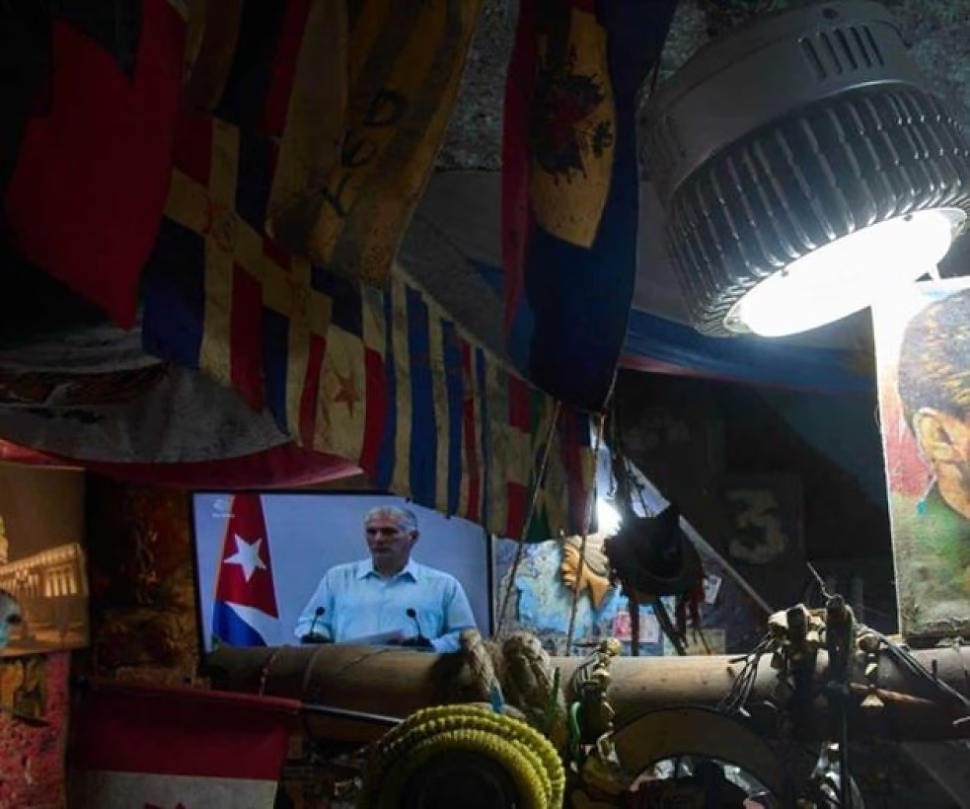
Cuba admits secret dialogue with the US in the midst of crisis

Cuba confirms secret talks with the US while facing a severe energy crisis that paralyzes the country.

Cuba breaks silence: there was secret dialogue with Washington

President Miguel Díaz-Canel confirmed what many suspected: Cuba and the United States have been talking. In the midst of an energy crisis that has the island on the verge of collapse, the Cuban president admitted this Friday that there were conversations “to seek solutions through dialogue.”

But he did not give details. He only mentioned “international factors” that facilitated these exchanges. An information gap that others immediately began to fill.

RelatedCuba talks with Washington amid massive blackouts

The secret meeting in the Caribbean

Two US officials revealed to the AP what really happened: Marco Rubio, the hard-line senator towards Cuba, met secretly with Raúl Guillermo Rodríguez Castro. Yes, Raúl Castro’s grandson.

“Rubio met secretly with Raúl Guillermo Rodríguez Castro on the sidelines of a meeting of CARICOM leaders”

The meeting was in February, during a Caribbean summit in Saint Kitts and Nevis. At the time, Rubio declined to say who he was speaking to. Now we know.

The White House, for its part, noted that the discussions seek to “press important changes” in Cuba. Trump has been clear: Cuban leaders would do well to avoid the fate of Nicolás Maduro.

The real crisis: no light, no water, no hope

While diplomacy advances in secret, Cubans face a brutal reality. Díaz-Canel admitted it bluntly:

“The impact is tremendous”

Three months without oil shipments. Paralyzed thermoelectric plants. Surgeries postponed for “tens of miles of people.” Transportation, communications, education—all affected.

“The Cuban is desperate,” says Elvis Hernández, 62 years old. “Without light, without water, you cannot live.”

The temporary solution has been surreal: more than 115 bakeries converted to run on firewood or coal. A throwback to another century.

And now what?

The US State Department is considering reducing staff at its embassy in Havana because… there is not enough fuel to operate. Ironic: the blockade affects even those who implement it.

Brian Fonseca, an expert at Florida International University, warns:

“Diplomatic staff are your eyes and ears on the ground. A degradation scenario could complicate the United States’ understanding of what is happening”

Meanwhile, Trump continues to send public messages: Cuba is “on the edge” and expects a “big change.” Díaz-Canel responds by seeking areas of cooperation to “guarantee security and peace.”

Cubans like Miguel García only want concrete results: “If agreements are reached that improve our situation, the better.”

The real question is whether these secret talks are a prelude to real change or just another chapter in six decades of tensions. With Cuba on the brink of energy collapse and Washington pushing for drastic changes, time is running out for both.
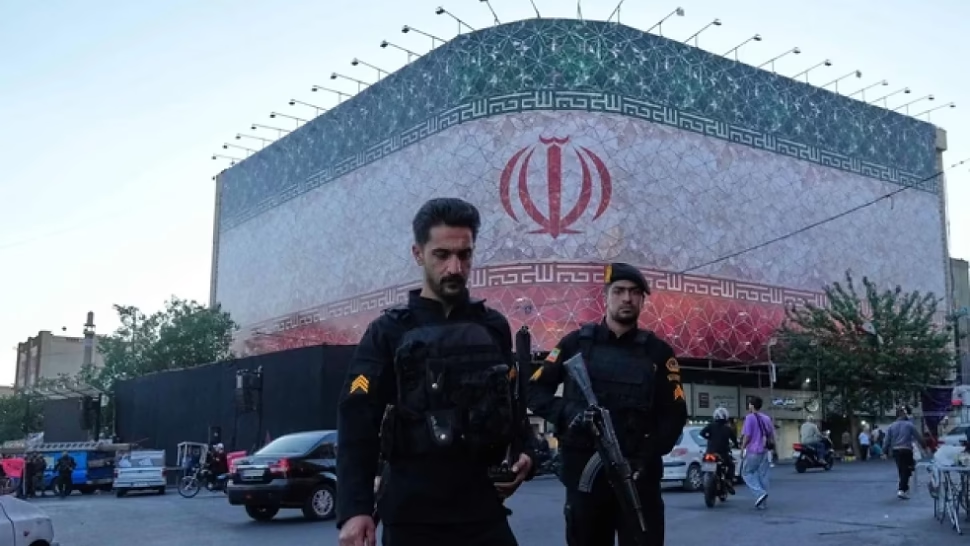
US and Iran reach provisional agreement to reopen Hormuz

The US and Iran agree to reopen the Strait of Hormuz and extend the truce.

The United States and Iran closed a provisional agreement that seeks to end the armed conflict and reopen the Strait of Hormuz, one of the most strategic maritime routes on the planet. The understanding also contemplates extending the fragile ceasefire in force in the region, amid years of military and political tension.

What does the pact contemplate?

The announcement opens the door to a formal signing next Friday in Switzerland, although authorities acknowledge that previous similar attempts have failed. As of Monday, the final content remained in dispute, especially on issues of regional security, nuclear verification and conditions for the lifting of sanctions.

The crisis between both nations has deep roots, from the Iranian nuclear program initiated with international cooperation to the Islamic Revolution of 1979. Since then, relations have been marked by diplomatic ruptures, economic sanctions and indirect clashes in the Middle East. The new agreement could mark a turning point, but doubts remain over its implementation.

Continue reading

Israel criticizes Netanyahu over US-Iran deal

The provisional pact between the US and Iran sparks internal criticism against Netanyahu for possible loss of influence.

Reactions in Israel

Israel is experiencing an intense internal debate after the provisional agreement between the United States and Iran. The pact has generated widespread criticism across the political spectrum, who consider it a strategic setback.

Prime Minister Benjamin Netanyahu has not yet issued an official position. Meanwhile, opposition figures, former officials and analysts react harshly. They point out that the Israeli government overestimated its ability to influence Washington’s strategy during the conflict with Tehran.

Another point of complaint is that the agreement could limit Israel’s freedom of military action, especially on the Lebanon front, where tensions with Hezbollah persist. Government sectors warn that resuming attacks could complicate the relationship with the United States.

International analysts point out that the pact alters the power dynamics in the Middle East. Israel would come under greater strategic pressure. Furthermore, the eventual partial lifting of sanctions on Iran would strengthen its economic and military capacity in the medium term.

Continue reading

Russian attack leaves 11 dead and damages cathedral in Ukraine

The massive bombing of kyiv and Kharkiv affected an 11th century temple.

A cathedral located in one of the oldest religious complexes in Eastern Orthodox Christianity was burned during a wide-ranging Russian attack on Ukraine. The Ukrainian government reported at least 11 people dead and dozens injured.

Details of the bombing

The attack occurred early Monday morning. Russia launched hundreds of drones and dozens of missiles against major Ukrainian cities, including kyiv and Kharkiv. Local authorities reported damage to residential buildings, markets and civil infrastructure.

Emergency teams work to rescue survivors from the rubble. President Volodymyr Zelenskyy condemned the bombing, calling it a new aggression against the civilian population and the country’s cultural heritage.

Continue reading