The physical price of going to the Moon: the human body under siege in Artemis II

The Artemis II mission not only broke records, it subjected astronauts to an extreme experiment on the limits of the human body.

The human body in the danger zone: what Artemis II did to its astronauts

The Artemis II mission was historic. It broke the distance record for a manned flight and returned us to lunar orbit after more than 50 years. But behind the technological achievement there is a less told story: that of four human bodies subjected to a hostile environment for which they were not designed.

“Artemis II is a historic mission, but it is undoubtedly also a physiological challenge,” says Carol Perelman, Mexican Pharmaceutical Chemistry Biologist and scientific communicator, in an interview with EL UNIVERSAL.

A terrestrial organism in deep space

Our body is perfectly adapted to the Earth. Gravity, atmosphere, magnetic protection. Coming out of that bubble is a brutal shock. “These four astronauts came out of the magnetosphere… they are receiving cosmic radiation all the time,” explains Perelman.

RelatedMexican engineer in NASA tests for Artemis lunar mission

That radiation is the silent enemy. Unlike the crew of the Space Station, those of Artemis II ventured beyond our planet’s natural protective shield.

“This radiation can be very harmful… it can have an acute impact, but also in the long term,” warns the scientist.

The data is worrying. Previous studies show that the mortality rate from cardiovascular disease is four to five times higher in astronauts who traveled to the Moon. Compared to the 9% of those who did not travel into space or the 11% of those who stayed in low orbits, it is an abysmal difference.

Microgravity plays its own game. Body fluids are redistributed. The face swells, intracranial pressure increases, and there may be changes in vision. None of this is trivial.

Experiments that seek answers (and cures)

The Orion capsule was also a floating laboratory. Key experiments were on board:

  • AVATAR: Bone marrow samples to study changes due to radiation and microgravity.
  • Immune Biomarkers: How the immune system reacts (special attention to viruses such as herpes).
  • ARCHeR: Evaluation of the physical and mental performance of the crew.

“What we understand better about immunosuppression and aging of cells due to radiation… will also help us understand what happens to our body here on Earth,” says Perelman.

Terrestrial applications are promising: personalized medicine, rapid virus diagnosis, osteoporosis treatments and better understanding of the cardiovascular system.

Stress: that invisible companion

Imagine living for weeks in a space the size of a van with three people. No escape. “Literally having nowhere to go,” says Perelman.

Constant stress increases cortisol, can reactivate latent viruses and generate immunosuppression. That is why training is not only physical, but also mental and emotional. Psychological health is critical in long-duration missions.

The final lesson: turn to see the Earth

Amid the current geopolitical chaos, Artemis II offers a humble perspective. Photographs of Earth from deep space are overwhelmingly beautiful.

Perelman takes up the words of Christina Koch, astronaut on the mission: “we can do explorations, we can reach the Moon, but in the end, ‘we choose Earth'”.

“We are changing these conditions with climate change… perhaps it is a time for reflection,” Perelman concludes. “Let’s take care of our planet.”.

In the end, the greatest discovery might not be on the Moon, but in realizing the fragile and perfect balance we have here.


Olivia Rodrigo joins Fortnite Festival with new collaboration

Olivia Rodrigo comes to Fortnite with outfits and emotes inspired by her albums.

Singer Olivia Rodrigo lands in Fortnite

The Epic Games platform incorporates Olivia Rodrigo’s Y2K and grunge aesthetic. The collaboration includes outfits, gestures and songs from the American artist within the Fortnite Festival.

The announcement was made this Thursday through social networks. The three-time Grammy winner shared the news alongside the game’s official accounts.

Collaboration details

Two main outfits are available:

  • Olivia Rodrigo SOUR: inspired by the cheerleader outfit from the “good 4 you” video. Includes a LEGO minifigure version.
  • Olivia Rodrigo Lover Girl: based on her new musical stage with the album “You Seem Pretty Sad For A Girl So In Love”, released on June 12. Also includes LEGO minifigure.

The thematic gestures reflect the different eras of the singer. “good 4 u” incorporates broken mirror and flame effects. “maggots for brains” uses hearts and fairy dust.

Additional articles

  • Olivia Butterfly Wings Backpack.
  • Retro backpack Collection of Stickers on Fire.
  • Three improvisation tracks: “drop dead”, “maggots for brains” and “deja vu”.

The collaboration seeks to unite digital fashion, modern music and new experiences within the Fortnite Festival.

Continue reading

AI becomes a dating coach, but divides opinions

Users turn to chatbots to start romantic conversations, but doubts persist about authenticity.

The role of AI in modern romance

Marie Lansley recently arrived in San Francisco and, while looking for a partner, decided to try artificial intelligence. “I’ve tried everything,” says the 36-year-old engineer, who consults chatbots like ChatGPT and Claude to help her start conversations on dating apps. “I’m open to AI finding the love of my life, but I’m not totally convinced,” she says. “Chemistry is always going to be analog.”

More and more people are using chatbots to compose messages or interpret responses. Dating coach Carey Gaynes compares him to Cyrano de Bergerac: “You’re using a voice that’s not your own.” He worries about overdependence, although he recognizes that it can be useful.

Mason Naung, a 25-year-old student in Los Angeles, only turns to AI to break the initial ice. “If the messages go further, it would be a small warning sign,” he says. San Diego businesswoman Dani Cohen prefers an AI-written farewell message to being ghosted. “Anything that gets people to communicate in a friendly way is great,” he says.

Other voices are more critical. Clara Sullivan, a 22-year-old student, would not respond to a profile that uses AI. “It’s scary how dependent people are. It’s taken away the ability to think creatively,” he says. A Pew Research Center survey reveals that 53% of US adults believe AI will worsen creativity, and half think it will affect meaningful relationships.

Dating apps already integrate AI. Tinder has Chemistry, Hinge uses AI launchers, and Bumble plans to eliminate swipe to prioritize automated matching. Its CEO, Whitney Wolfe Herd, says that technology “should make love feel more human, not less.”

Mohammed Nizami, 23, does not use AI for dating. “We all crave authentic connection. If there’s a filter, it’s not a good way to start,” he says. Jake Clay, a content creator in New York, calls the situation a “vicious cycle” that bypasses sacred processes of life. “It’s sad to delegate something so fundamental to an AI that doesn’t understand emotions,” he laments.

Despite reservations, the merger between AI and dating seems inevitable. Efficiency gains ground, but authenticity remains the challenge.

Continue reading

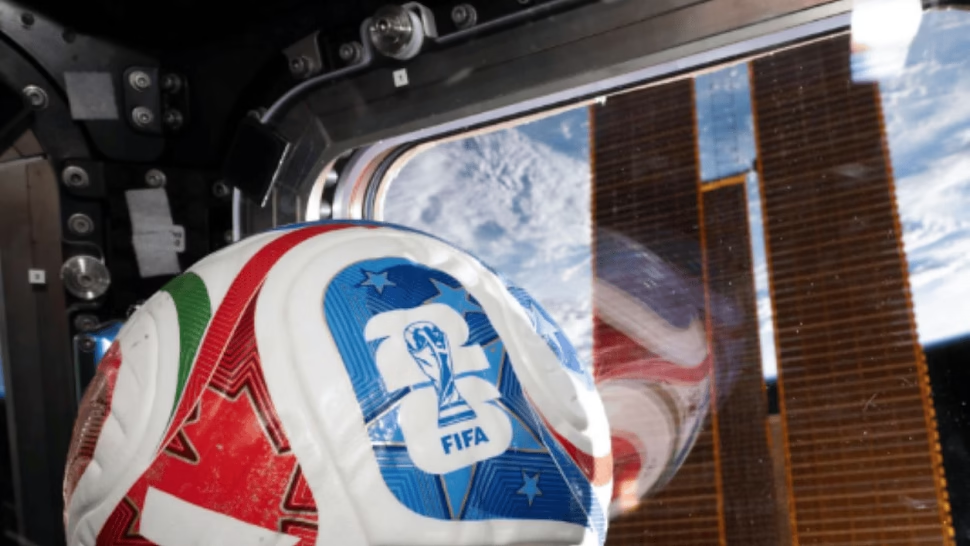
NASA takes the 2026 World Cup ball into space and plays it on the ISS

NASA sent an official 2026 World Cup ball into space and opened an exhibition in Houston.

World Cup ball arrives at the International Space Station

The fever of the 2026 World Cup permeated the atmosphere. NASA sent an official World Cup ball to the International Space Station (ISS). In a video shared on social networks, four astronauts are seen playing with the ball in microgravity. The message: “We work to inspire the next generation by showing how space exploration drives innovation in sports science.”

The agency seeks to disseminate how research on the ISS generates advances in science, technology and human health. Benefits that even reach the soccer field.

Exhibition at the FIFA Fan Fest in Houston

NASA set up an exhibit at the FIFA Fan Fest in Houston, Texas. It opened on June 11 at the start of the World Cup and will be available until July 19. Visitors can discover how space research improves life on Earth and learn about the Artemis program missions.

The exhibition explains how more than 25 years of studies on the ISS have helped understand the aerodynamics of the ball. According to a statement from the Johnson Space Center, previous research analyzed how internal mass, sensors and seam texture affect stability and rotation under real-play conditions.

Science applied to sports

As part of the project, NASA and Adidas present the “STEMonstration” demo. They compare how balls spin with different balance in microgravity. The objective: to show that space discoveries benefit athletes and fans of the most popular sport in the world.

Continue reading