


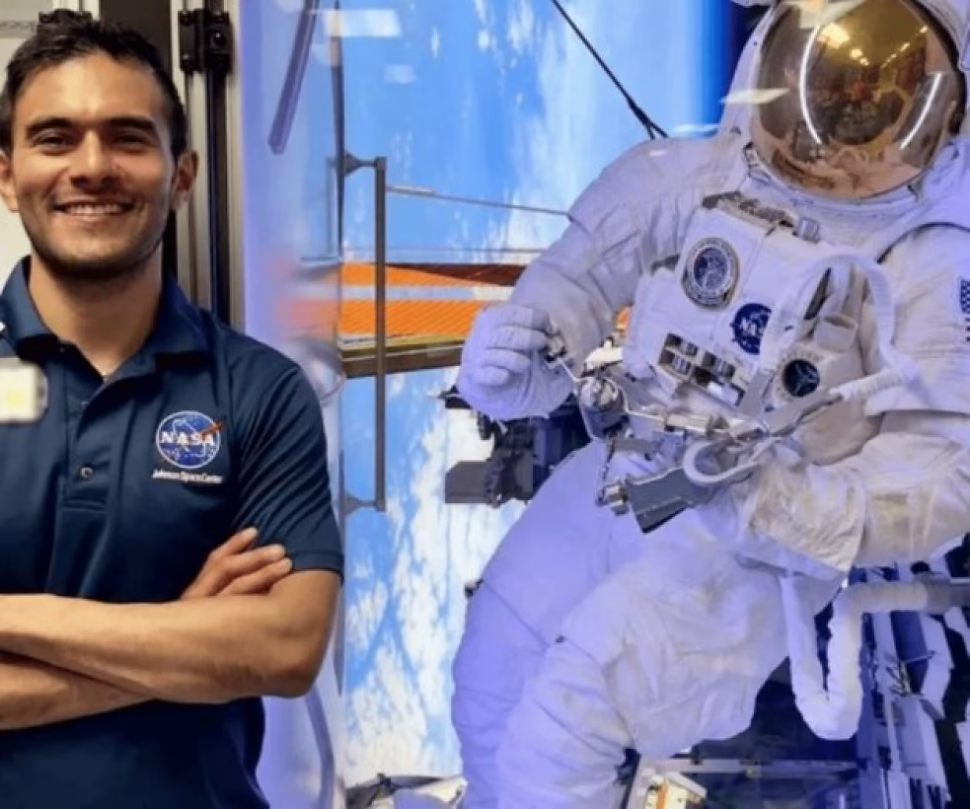
Guadalupe Espinoza: A Sinaloan Engineer at the Vanguard of Lunar Exploration
With an exceptional academic career and unwavering dedication, Guadalupe Espinoza Gastélum, originally from Guamúchil, Sinaloa, has established herself as one of the Mexican professionals with the greatest potential to be part of a manned mission to the Moon. His story, which began with the contemplation of the firmament during his childhood in the fields of Angostura, is a testimony of perseverance, discipline and a deep passion for the conquest of space.
Espinoza’s fascination with cosmology and astronautical engineering was forged in those childhood nights, laying the foundations for a career that has led him to accumulate multidisciplinary training. Its academic profile includes qualifications in Mechatronics Engineering, Mechanical Engineering, Renewable Energy Engineering, Space Operations Engineering and, crucially, a specialization in Aerospace Engineering. This solid technical base has allowed it to integrate into high-level projects within the international space industry.
Key Contribution to NASA’s Artemis Program
Currently, Espinoza works at NASA’s Johnson Space Center, where his work is fundamental to the success of the Artemis program. Its primary responsibility focuses on validating the exploration atmosphere designed for humanity’s return to the lunar surface. This role involves establishing the base parameters of the entire mission profile, a meticulous process that will lay the foundations for learning to work and inhabit another celestial body.
Espinoza acts as a test subject in experiments exploring the use of an atmosphere with a higher percentage of oxygen and a lower overall pressure. The technical objective of this research is to significantly reduce the pre-breathing time required when astronauts must perform extravehicular activities, commonly known as spacewalks, on the lunar surface. Optimizing this procedure is vital for the efficiency and safety of operations on the Moon.
Recently, NASA selected Guadalupe Espinoza to command a simulated analog mission to the Moon. The purpose of this simulation, carried out in July, was to test and refine operating procedures, safety protocols and the atmospheric configuration necessary for the imminent Artemis III Mission. The data collected in this analog mission will be a fundamental pillar for the design of the next lunar expeditions, directly contributing to the advancement of knowledge and the expansion of human capabilities in deep space.
Astronaut Candidate and Space Technology Development
Beyond his work at NASA, Espinoza holds the position of scientific astronaut candidate for the International Institute for Astronautical Sciences (IIAS). This scientific initiative is dedicated to training civilian astronauts for future space missions, with an initial focus on low Earth orbit and a projection toward deep space missions. These expeditions not only seek to return to the Moon, but also facilitate researchers to carry out advanced studies on the lunar environment.
In parallel, Guadalupe Espinoza actively participates in the design and evaluation of new generation space suits. These tests are carried out in environments that simulate microgravity conditions, with underwater work being a predominant technique to replicate the weightlessness of outer space and rehearse critical procedures. His contributions in the field of bioastronautics—the science that studies the impact of space flights on the human organism—position him as one of the technical profiles with the greatest projection in Latin America.
His professional goal is clear and ambitious: to become the first Sinaloa native to set foot on the Moon and, from there, conduct pioneering research on human physiology in extreme environments. Complementing his technical merits, Espinoza has demonstrated a strong civic commitment. On June 1, 2025, he participated in the climb of One World Trade Center in New York, the tallest building in the Western Hemisphere. This activity, organized by the Tunnel to Towers foundation, served as a tribute to the victims and heroes of the September 11 attacks.
With a career on the rise, Guadalupe Espinoza is not only an example of individual improvement, but a symbol of Mexico’s growing scientific and technological capacity. As you advance your applications and prepare for the next phases of the Artemis program, the possibility of seeing the Mexican flag fly in space is increasingly perceived as an achievable reality. The engineer who once looked at the Moon from the fields of the Évora Valley could soon be observing it from its surface, materializing a personal dream and making history for his country.
Does the story of Guadalupe inspire you? Share this achievement of Mexican science on your social networks and explore more content about Mexico’s advances in space exploration.


