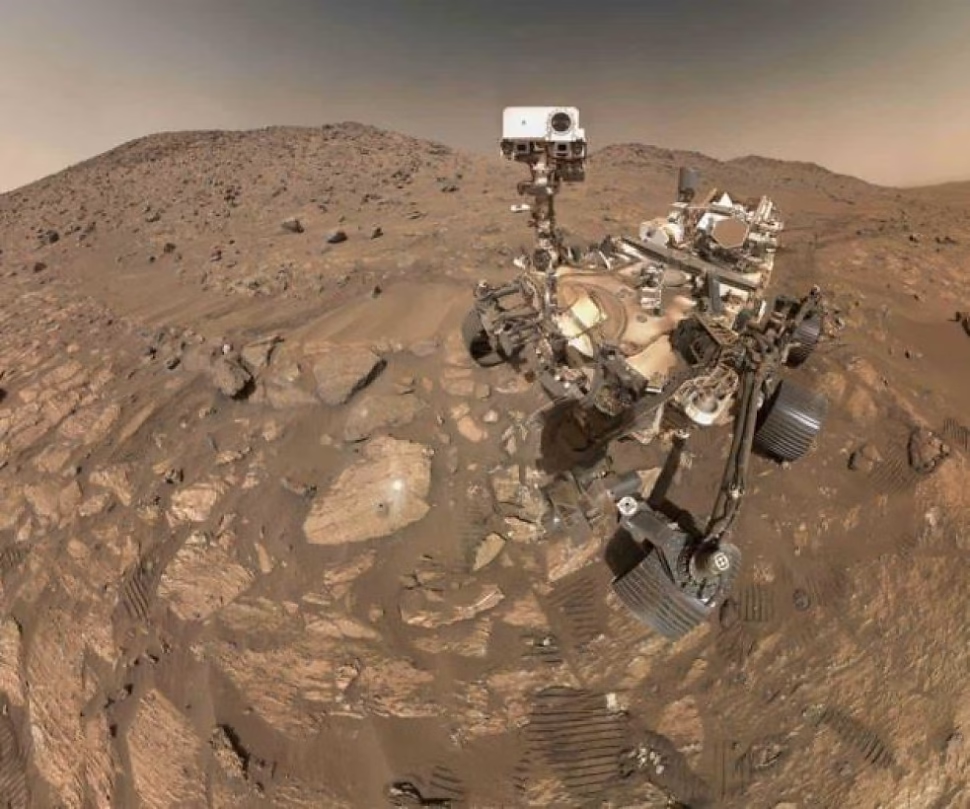
Perseverance finds what we all expected: more questions
CABE CANAVERAL, Florida, USA – Because what would space exploration be without a little interplanetary drama? NASA’s Perseverance explorer on Mars, that robotic tourist that has been traveling around the red planet since 2021, has done what it does best: collect stones. But not just any stone, oh no! These are special rocks, found in a dry river channel, that could contain potential signs of ancient microscopic life. Or they could just be particularly interesting stones. The scientists, in their eternal prudence, announced Wednesday that they need to further analyze the sample – ideally in laboratories on Earth – before throwing the bells into the air. How boring.
Nicky Fox, the space agency’s science mission chief, admitted that the latest analysis is “certainly not the final answer.” But, in a burst of contained emotion, he added that it is “the closest we have come to discovering ancient life on Mars.” Wow, finally a statement that doesn’t sound like it was written by a lawyer! Although, of course, we are still a few billion dollars and a decade away from knowing for sure.
The great mission of collecting tubes and waiting
The rover, which lacks the direct ability to detect life, past or present (a pretty major omission, if you ask us), carries a drill to penetrate rocks and tubes to hold samples. Their strategy is basically to pick up things from places that look promising and wait for someone else to deal with the problem. The samples are waiting to be sent back to Earth in an ambitious plan that is currently on hold because, surprise, it turned out to be too expensive. NASA is now looking for cheaper and faster options, which in bureaucratic language means “we’ll get back to it in 2040 or so.”
Calling it an “exciting discovery,” a pair of scientists not involved in the study—Janice Bishop of the SETI Institute and Mario Parente of the University of Massachusetts—were quick to point out that nonbiological processes could be responsible. Come on, you can’t let your colleagues have too much fun. “That’s part of the reason we can’t go as far as to say, ‘Aha, this is positive proof of life!'” lead researcher Joel Hurowitz told The Associated Press. “All we can say is that one of the possible explanations is microbial life, but there could be other ways to create this set of features that we see.” In other words: it could be alien life, or it could be that Mars simply has rocks with very good taste for chemical composition.
Hurowitz, however, declared it the best and most compelling candidate yet in the rover’s search for possible signs of life from long ago. It was sample number 25 of the 30 that have been collected so far. The findings were published in the journal Nature, because where else would you publish something that could revolutionize our understanding of the universe or turn out to be a funny anecdote?
“It would be amazing to be able to conclusively prove that these features were formed by something that was alive on another planet billions of years ago, right?” Hurowitz said. But even if that’s not the case, it’s “a valuable lesson in all the ways nature can conspire to deceive us.” What a nice way of saying “we could be completely wrong.”
The analysis that excites and confuses in equal parts
Collected last summer, the sample comes from clay-rich reddish mudstones in Neretva Vallis, a river channel that once carried water to Jezero Crater. This outcrop of sedimentary rock, known as the Bright Angel Formation, was examined by Perseverance’s scientific instruments before the drill went out. Because even robots have to follow protocols.
Along with organic carbon, a foundation of life, Hurowitz and his team found tiny specks, nicknamed poppy seeds and leopard spots, that were enriched in iron phosphate and iron sulfide. On Earth, these chemicals are the byproducts when microorganisms devour organic matter. So either we’re finding evidence that Mars once had its own gluttonous microbes, or we’re seeing a very, very compelling geological process. The eternal dilemma.
“There is no evidence of microbes on Mars today,” Bishop and Parente wrote in an accompanying editorial, throwing a bucket of reality (and cold water) on the party. “But if any had been present on ancient Mars, they too could have reduced sulfate minerals to form sulfides in a lake like that in Jezero Crater.” Wow, thanks for clarifying that we are not being invaded… for now.
NASA has for decades sent spacecraft to Mars in search of past aquatic environments that could have supported life. And now that we have possible clues, the plan to bring back the samples has run into the harsh reality: money. When Perseverance launched in 2020, NASA expected samples to return to Earth in the early 2030s. But that date was pushed back to the 2040s as costs rose to $11 billion, halting recovery efforts. Because, apparently, even the discovery of extraterrestrial life has to fit a budget.
Until spacecraft, whether robotic or carrying astronauts, take samples from Mars, scientists will have to rely on terrestrial surrogates and laboratory experiments to evaluate the viability of ancient Martian life, according to Hurowitz. That is, we will continue playing guessing with second-hand clues.
Acting NASA Administrator Sean Duffy said budgets and time will dictate the best way to proceed, and even raised the possibility of sending sophisticated equipment to Mars to analyze samples directly on the red planet. “All options are on the table,” he said. Translation: “We have no idea how we are going to pay for this, but it sounds good to say.”
Meanwhile, ten of the titanium sample tubes were placed on the Martian surface a few years ago as backup for the rest on board the rover. Just in case the main rover has a bad day and decides to become luxury scrap metal. The primary objective in NASA’s still-uncertain return mission remains…uncertain.
So there you have it: we could be on the verge of the most important discovery in human history, or simply watching Martian rocks play a cosmic joke on us. Science, like life itself, is full of suspense… and budget cuts.
Did you like this irreverent look at space exploration? Share it on your social networks and spark a conversation! And be sure to explore our site for more content on the absurdities and wonders of science.