Analysis of the Astronomical Event of September 7, 2025
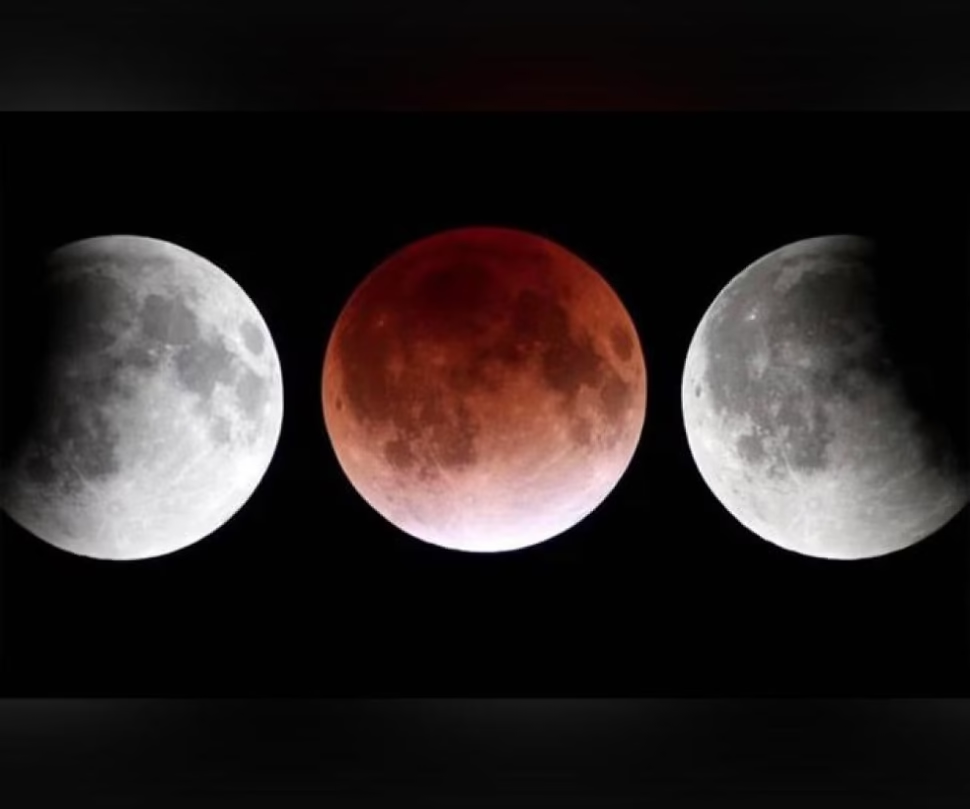
On September 7, 2025, a significant astronomical phenomenon will take place that will capture the attention of amateurs and experts around the world. This is a total lunar eclipse, colloquially called Blood Moon, whose development will last for an estimated period of one hour and twenty-two minutes. This meticulous analysis examines the characteristics, causes, and observational implications of this celestial event.
Formation Mechanism and Main Characteristics
According to the National Aeronautics and Space Administration (NASA), lunar eclipses are events that occur between four and seven times annually. Its genesis lies in the precise alignment of the Earth, the Moon and the Sun. When our planet comes directly between its natural satellite and the star, it projects its shadow on the lunar surface, generating a spectacle of shadows on a cosmic scale. It is crucial to understand that, due to orbital mechanics, each event of this nature is visible only from one half of the globe. This geometric restriction explains why the next event cannot be witnessed from Mexican territory.
The information provided by the astronomy platform Star Walk confirms that the visibility of the eclipse on September 7 will be limited to specific regions of the planet. Privileged viewers will be found in parts of Europe, Russia, Australia, Africa and Antarctica. This geographical distribution is determined by the relative position of the Moon with respect to the Earth’s shadow during the hours of the event.
Classification of Lunar Eclipses
Lunar occulting events are categorized into three main types, each with distinctive observational characteristics:
The total lunar eclipse occurs when the natural satellite moves completely into the inner region of the Earth’s shadow, known as the umbra. During this phase, a portion of the sunlight manages to filter through the Earth’s atmosphere, projecting itself onto the lunar surface and giving it that characteristic reddish or orange hue that is popularly called the Blood Moon. This chromatic effect results from Rayleigh scattering, the same phenomenon that colors our sunsets.
The partial lunar eclipse occurs when there is an imperfect alignment between the Sun, Earth and Moon. In this scenario, our satellite only partially passes through the Earth’s umbra. Observers can see how the dark shadow gradually grows over the lunar disk and then recedes, without completely covering it.
Finally, the penumbral eclipse represents the most subtle type. It occurs when the Moon transits exclusively through the penumbra, the outer and tenuous region of the Earth’s shadow. The dimming of the lunar brightness is so slight that it is often imperceptible to the untrained eye, requiring specialized instrumentation for reliable detection.
Considerations for Astronomical Observation
Unlike solar eclipses, which require specialized eye protection, observing lunar phenomena does not represent any risk to human vision. No optical instrument is required to witness the spectacle, although the experience is considerably enriched by the use of astronomical binoculars or medium-power telescopes.
To optimize observation conditions, experts recommend moving to locations away from urban light pollution. In addition, it is essential to allow the visual system to fully adapt to the darkness for a period of fifteen to twenty minutes prior to the event. Monitoring weather conditions is also essential, since the presence of cloudiness can significantly hinder the visibility of the phenomenon.
Although Mexico will not witness this particular event, understanding its mechanics and meaning enriches our astronomical knowledge. The periodicity of these phenomena guarantees that new observational opportunities will arise in the future, reminding us of our dynamic position within the solar system.
Share this analysis with other astronomy enthusiasts on your social networks and explore more content related to celestial events in our science section.