The longest solar eclipse in history will occur in 2186

An unprecedented cosmic event will occur in 2186, breaking duration records and capturing global scientific attention.

An unprecedented astronomical phenomenon

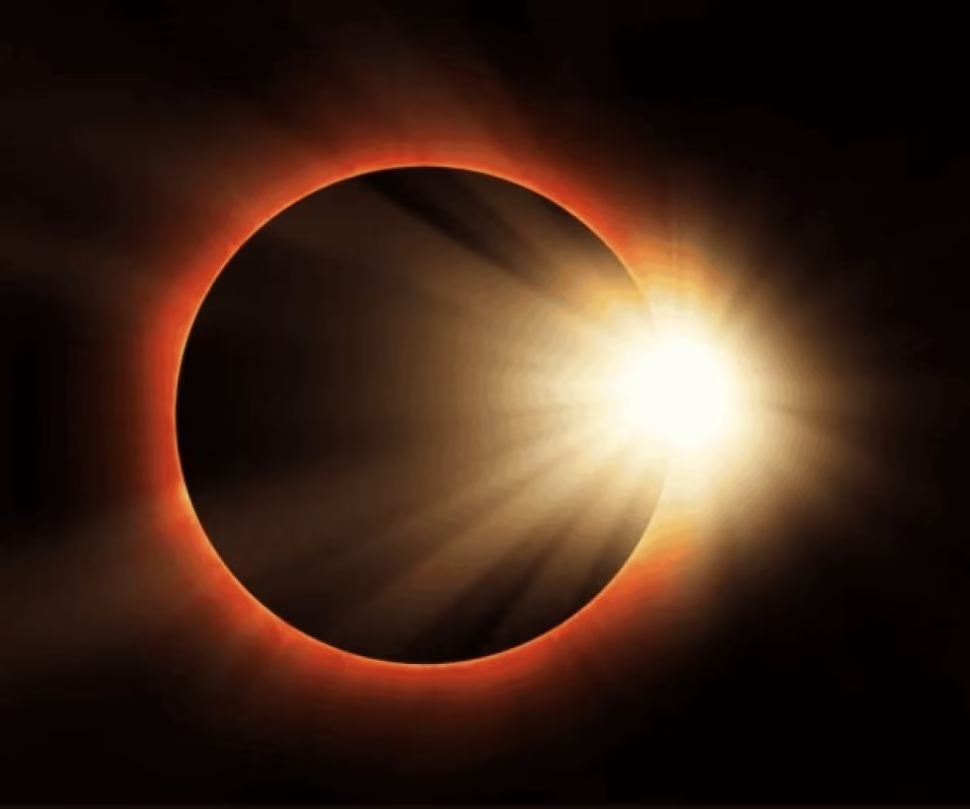
Solar eclipses are usually fleeting events, lasting an average of a few minutes. However, on rare occasions, the universe surprises us with an exceptional spectacle. According to NASA data, on July 8, 2186 the longest solar eclipse ever recorded will take place, lasting 7 minutes and 29 seconds, surpassing the previous record of 6 minutes and 39 seconds set in 2009.

The science behind exceptional durability

This phenomenon will occur thanks to an almost perfect planetary alignment between the Earth, the Moon and the Sun. Three key factors influence it:

RelatedPartial Solar Eclipse of September 2025 Details and Visibility
  • Lunar distance: The Moon will be close to its perigee (closest point to Earth), increasing its apparent size.
  • Earth position: The Earth will be located near aphelion (maximum distance from the Sun), reducing the visible solar disk.
  • Orbital speed: The combination of planetary movements will slow down the movement of the lunar shadow.

Visibility and geographical limitations

The path of the shadow will begin in the Atlantic Ocean, near French Guyana, crossing areas of Venezuela and Colombia. Unfortunately, as astronomers point out, Mexico and much of America will be outside the area of ​​total visibility. However, scientific institutions are already planning multidisciplinary studies to analyze atmospheric effects and animal behavior during the event.

Eclipse classification: more than shadows

This event belongs to the category of total solar eclipses, but there are other variants:

Solar eclipses

  • Total: The Moon completely hides the Sun, revealing the solar corona.
  • Partial: Only a fraction of the solar disk is covered.
  • Annular: The Moon, further away, leaves a “ring of fire” visible.
  • Hybrid: Combination of ring and total according to geographic location.

Lunar eclipses

  • Total: The Moon completely enters the Earth’s umbra.
  • Partial: Only a portion passes through the main shadow.
  • Penumbral: The Moon crosses the zone of secondary shadow, almost imperceptible.

This record-breaking eclipse will not only be a visual milestone, but a unique opportunity to advance the study of solar physics, atmospheric optics and orbital dynamics. Although 162 years away, projects like NASA’s Solar Dynamics Observatory are already collecting data to accurately model the event.

Are you fascinated by astronomy? Share this article to spread scientific knowledge and continue exploring our content on celestial events. The next generation of astronomers will appreciate your curiosity.

How artificial intelligence transforms global security

Motorola Solutions is committed to hybrid models and agentic AI in the transformation of the sector.

Security industry: cloud migration and artificial intelligence

Security is undergoing a profound transformation. The cloud, generative artificial intelligence and video surveillance systems as decision tools are redefining the sector. This was stated by Pedro Simoes, global vice president of video security and analytics at Motorola Solutions.

“The cloud is a very strong trend, but it is not a solution for all sectors,” he explained. Prison facilities, airports and nuclear plants require hybrid models that combine local infrastructure with cloud services. Motorola Solutions is committed to unified platforms.

One of the key advances is agentic artificial intelligence. The company introduced Operator, a platform that integrates video, access controls and sensors in a single interface. The objective: reduce the time between detection and response. “It’s not just identifying. It’s being collaborative in decisions,” said Simoes.

The role of sensors in smart cities

Cameras no longer just record: they are sensors. “Today a camera produces data that can be used to optimize logistics, mobility or business decisions,” he added. Security information extends to multiple applications.

However, the growth of AI poses privacy challenges. Motorola Solutions developed “AI nutrition labels,” documents that detail capabilities and limitations of its models. “We are the first company in the sector to create and use this type of labels,” said Simoes.

Mexico and the 2026 World Cup

Mexico is experiencing a key moment for the 2026 FIFA World Cup. The arrival of millions of visitors is driving investments in technological infrastructure and security in airports, hotels and stadiums. Simoes confirmed collaboration with governments, without revealing details. “Safety is a priority; our responsibility is to develop technology that protects people and infrastructure.”

He recommended organizations think long term: “The decision should not be based only on current problems, but on the challenges of three or five years.” The combination of cloud, generative AI and unified platforms will define the next stage of the sector.

Continue reading

Strawberry Moon: the June full moon will arrive on the 29th

The Strawberry Moon will light up the night sky on June 29. Know its origin and other names.

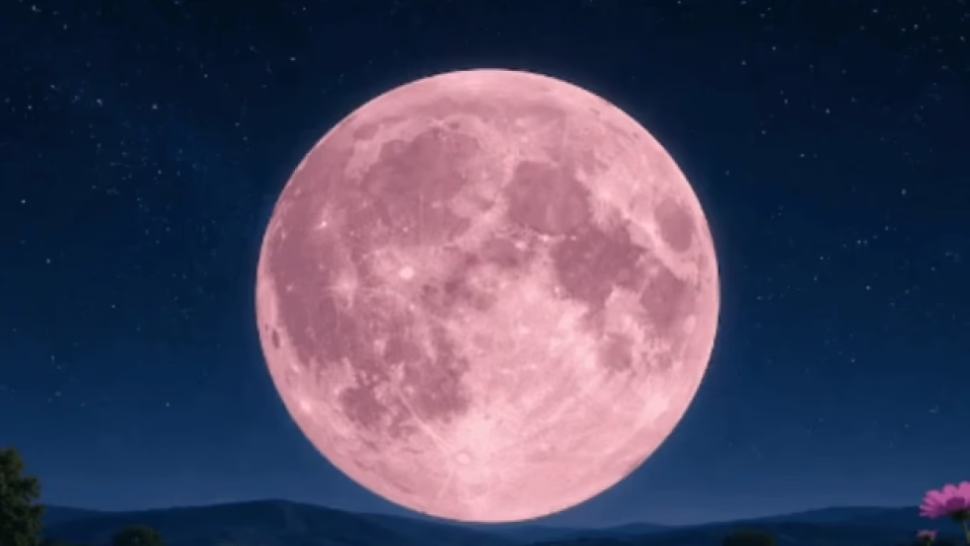
The night sky will offer a notable astronomical event at the end of June. That month’s Full Moon, known as the Strawberry Moon, will reach its maximum splendor on Monday, June 29, according to the specialized portal Star Walk.

When and how to see it?

The full moon will occur exactly at 5:57 in the afternoon, central Mexico time. It will be the first full Moon after the summer solstice, which according to the same source will happen on Sunday, May 21. The satellite will be fully illuminated from June 28 to 30.

The origin of the name

Despite what its nickname suggests, the Moon does not take on a pinkish or reddish hue. The name “Strawberry Moon” comes from the native North American peoples, who named it that way because it coincided with the harvest season for this fruit in various regions of the continent.

In other cultures, this same full moon receives names such as:

  • Moon of Moras
  • Honeymoon
  • Rose Moon
  • Moon of Ripening Berries
  • Garden Moon
  • Green Corn Moon
  • Windy Moon
  • Birth Moon
  • Moon When the Buffalo Bellows

All of these nicknames are linked to natural phenomena typical of the same time of year.

Continue reading

The oldest plague: remains from 5,500 years ago in Siberia

Traces of plague from 5,500 years ago found in teeth of Siberian hunter-gatherers.

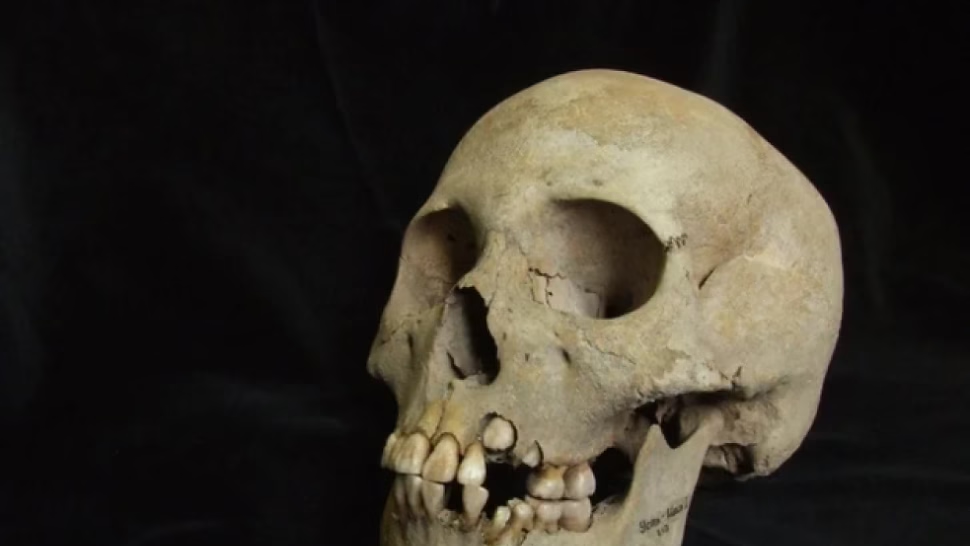
Scientists have identified the earliest evidence of plague known so far: traces of bacterial DNA in the teeth of hunter-gatherers buried near Lake Baikal in Siberia. Carbon dating indicates that the disease caused outbreaks about 5,500 years ago, about 200 years earlier than previously thought.

Finding in Siberia

A team led by geneticist Eske Willerslev of the University of Copenhagen analyzed remains from four cemeteries. They found traces of Yersinia pestis in the teeth of 18 individuals. The dating revealed two episodes of infection.

“To understand our own history, understanding the history of the plague is extremely important,” Willerslev said.

The prehistoric plague spread in stages. According to the authors, it was probably transmitted from marmots—native rodents—when people consumed their raw organs or handled infected skins. It also spread from person to person through coughing or sneezing.

Many of the deceased were children between 8 and 11 years old. Three girls were buried together; two were cousins. An aunt and her nephew were found in another mass grave. “There were people who buried the dead and who knew who they were. It’s a very human element,” said co-author Ruairidh Macleod, an expert in ancient DNA at the University of Oxford.

Implications of the study

The researchers note that children may be at greater risk due to still developing immune systems. The presence of multiple victims suggests that the prehistoric plague caused both isolated cases and outbreaks, said geneticist Aida Andrades Valtueña, from the Max Planck Institute for Evolutionary Anthropology, who was not involved in the study.

This ancient strain evolved long before the bubonic plague responsible for the medieval Black Death. However, there is evidence that earlier plagues were just as serious. The disease not only affected populous cities, but also small nomadic groups.

“Understanding the steps the bacteria took to become the deadly pathogen we know today can provide clues about how pathogens could emerge in the future,” wrote Andrades Valtueña.

The study was published Wednesday in the journal Nature.

Continue reading