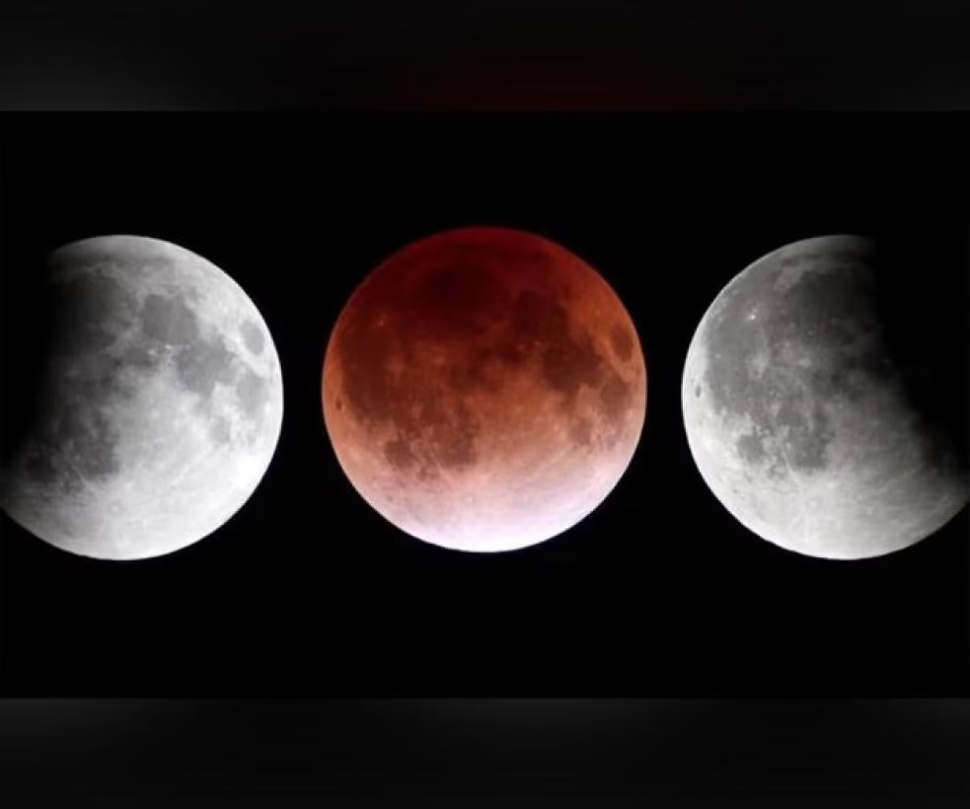
Lunar eclipse of 2025 will not be visible in Mexico

Discover why Mexico will miss this cosmic spectacle and how this unique phenomenon occurs.

The next lunar eclipse: an astronomical event with limited visibility

On September 7, 2025, a total lunar eclipse will occur, also known as a Blood Moon, a phenomenon that will last approximately 1 hour and 22 minutes. However, according to data from Star Walk and NASA, this event cannot be observed from Mexico. Its visibility will be limited to specific regions such as Europe, Russia, Australia, Africa and Antarctica.

Why will it not be visible in Mexico?

Lunar eclipses occur between four and seven times a year, but their observation depends on geographical position. During these events, the Earth comes between the Sun and the Moon, casting a shadow that obscures our natural satellite. However, only half of the planet can witness each eclipse, and on this occasion, Mexico will be outside the visibility zone.

RelatedLunar eclipse of September 2025 will be invisible in Mexico

Types of lunar eclipses and their characteristics

There are three main varieties of lunar eclipses, each with unique characteristics:

1. Total lunar eclipse

In this case, the Moon completely penetrates the umbra (inner shadow) of the Earth. The sunlight filtered by the Earth’s atmosphere gives it a reddish or orange tone, a phenomenon popularly called “Blood Moon”.

2. Partial lunar eclipse

Here, the alignment of the Sun, Earth and Moon is partially imperfect. The Moon only passes through a portion of the umbra, which generates a gradual shadow effect that does not cover it completely.

3. Penumbral eclipse

This is the most subtle of the three. The Moon transits through the penumbra (diffuse outer shadow) of the Earth, causing a slight dimming that may go unnoticed by the inexperienced eye.

Recommendations for observing lunar eclipses

Unlike solar eclipses, lunar eclipses do not require special equipment for their observation. However, for an optimal experience, it is suggested:

  • Use binoculars or a basic telescope to appreciate details.
  • Look for locations with low light pollution.
  • Allow your vision to adapt to the dark for 15-20 minutes beforehand.
  • Check weather conditions to avoid cloudiness.

Scientific and cultural implications

Lunar eclipses are not only visually striking events, but also valuable tools for astronomical research. They allow us to study the composition of the Earth’s atmosphere and refine orbital models. Culturally, they have inspired myths and traditions in various civilizations, from the Mayans to the Nordic cultures.

Are you interested in astronomy? Share this article on your social networks and discover more content about celestial events in our section dedicated to the cosmos. The universe always has something new to show!


Liga MX returns to EA Sports FC27; multi-year contract

Multi-year agreement includes all 18 Mexican soccer teams.

Return after five years

Liga MX and EA Sports announced the return of the Mexican league to the EA Sports FC27 video game. The agreement is multi-year, so the five-year wait is coming to an end. The news confirms the participation of all 18 teams from the top circuit, with Atlante being the most recent club to join.

“Liga MX is home to some of the most passionate fans, iconic clubs and a rich tradition that has inspired generations of players,” said Jeff Sharma, vice president of EA Sports FC.

The video game will be available starting September 25 for consoles and devices. This edition will include new game modes that seek to attract consumers. With this return, the Mexican league regains presence on a global entertainment platform.

Continue reading

Volvo EX30: free recall in Mexico

Free corrective measure for battery of EX30 units 2024-2025.

Volvo Car Mexico reported that the corrective measure is now available for the EX30 model years 2024 and 2025 units included in a service campaign.

What does the solution include?

The review of the battery system and, if necessary, the replacement of modules at no cost to customers. Owners can schedule an appointment exclusively through the Volvo Solutions Center (centrodesoluciones.mx), where they select an authorized dealer and the available date.

Preventive measure: While the inspection is not carried out, it is requested to maintain the maximum load at 70%. Once the intervention is completed, the vehicle can be used with a full load. The telephone number 968 6586 is available for guidance.

Background of the call

Since February, Volvo issued safety notice R10363 for certain EX30 units in single motor extended range and twin motor performance versions. The reason: in some cases there was an increase in temperature with high load. No incidents have been recorded in Mexico.

Continue reading

Satellite Internet, the bet to close the digital divide in Mexico

Mexican geography limits fiber deployment, but low orbit satellites are emerging as an alternative.

Satellite internet as a solution to the digital divide in Mexico

Mountains, jungles and deserts make Mexico one of the countries with the most complex orography in Latin America. Bringing fiber optics to isolated communities implies an investment that is difficult to recover with few users. As a result, one in five households still lack internet access or receive poor service.

Faced with this scenario, low orbit (LEO) satellite internet is emerging as a strategic alternative. “Deploying physical infrastructure in Mexico is expensive due to geography. In many cases, satellite internet represents the most viable option to connect areas where fiber will not reach in the short term,” explains Ernesto Piedras, director of The CIU. Companies like Starlink, with more than 10,300 active satellites, already operate in the country. Since May 2021, it obtained a concession and closed 2024 with 160,631 subscriptions, making Mexico its second Latin American market, only behind Brazil. Starlink has signed contracts with CFE Telecomunicaciones for up to 1,556 million pesos to connect remote communities.

However, cost remains a barrier. While a fiber optic plan costs an average of 544 pesos per month, satellite internet starts at 899 pesos, plus equipment and installation. “Commercially it is still not as viable because it is still more expensive and requires purchasing an antenna whose price remains high,” says Fernando Esquivel, from The CIU. The service makes economic sense when it is shared between communities or companies, and with the support of public policies.

Experts agree that this technology will not replace fiber optics, but will complement it. “Terrestrial services are faster and have lower latency. Satellite communication reaches areas that fixed internet would not reach,” says Hugo Simg, from MediaTek. Deployment also requires regulation and coordination between governments and companies. The race to connect Mexico is no longer only being fought underground, but from space, where a new generation of satellites promises to reduce the digital divide that keeps millions out of the digital world.

Continue reading