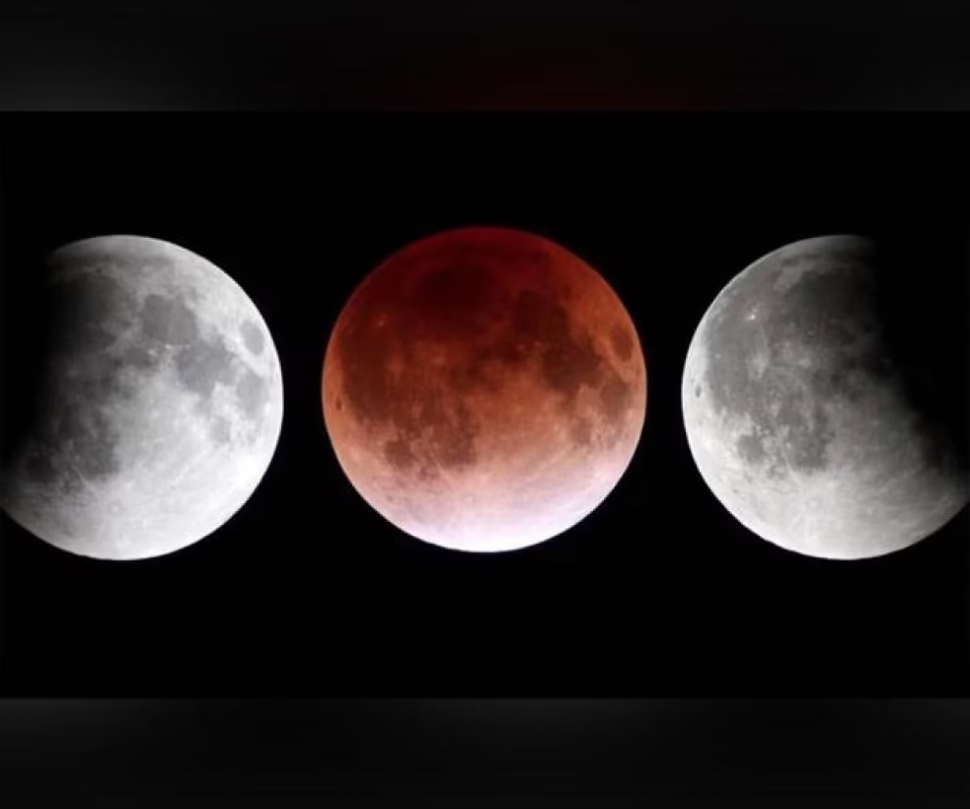
The next lunar eclipse: an astronomical event with limited visibility
On September 7, 2025, a total lunar eclipse will occur, also known as a Blood Moon, a phenomenon that will last approximately 1 hour and 22 minutes. However, according to data from Star Walk and NASA, this event cannot be observed from Mexico. Its visibility will be limited to specific regions such as Europe, Russia, Australia, Africa and Antarctica.
Why will it not be visible in Mexico?
Lunar eclipses occur between four and seven times a year, but their observation depends on geographical position. During these events, the Earth comes between the Sun and the Moon, casting a shadow that obscures our natural satellite. However, only half of the planet can witness each eclipse, and on this occasion, Mexico will be outside the visibility zone.
Types of lunar eclipses and their characteristics
There are three main varieties of lunar eclipses, each with unique characteristics:
1. Total lunar eclipse
In this case, the Moon completely penetrates the umbra (inner shadow) of the Earth. The sunlight filtered by the Earth’s atmosphere gives it a reddish or orange tone, a phenomenon popularly called “Blood Moon”.
2. Partial lunar eclipse
Here, the alignment of the Sun, Earth and Moon is partially imperfect. The Moon only passes through a portion of the umbra, which generates a gradual shadow effect that does not cover it completely.
3. Penumbral eclipse
This is the most subtle of the three. The Moon transits through the penumbra (diffuse outer shadow) of the Earth, causing a slight dimming that may go unnoticed by the inexperienced eye.
Recommendations for observing lunar eclipses
Unlike solar eclipses, lunar eclipses do not require special equipment for their observation. However, for an optimal experience, it is suggested:
- Use binoculars or a basic telescope to appreciate details.
- Look for locations with low light pollution.
- Allow your vision to adapt to the dark for 15-20 minutes beforehand.
- Check weather conditions to avoid cloudiness.
Scientific and cultural implications
Lunar eclipses are not only visually striking events, but also valuable tools for astronomical research. They allow us to study the composition of the Earth’s atmosphere and refine orbital models. Culturally, they have inspired myths and traditions in various civilizations, from the Mayans to the Nordic cultures.
Are you interested in astronomy? Share this article on your social networks and discover more content about celestial events in our section dedicated to the cosmos. The universe always has something new to show!