Mexican engineer competes for a space flight with Blue Origin

A young Mexican engineer competes in a global program for a suborbital flight, seeking digital support to represent his country in the new space age.

A Mexican Candidate for the New Space Frontier

The democratization of access to outer space is advancing through private initiatives, and on this occasion, a Mexican talent is positioned as a strong contender. Diego Pérez Reyes, a 25-year-old mechatronic engineer who graduated from the Autonomous Technological Institute of Mexico (ITAM), has launched a public call through digital platforms requesting the support of the national community. Its ultimate objective is to materialize an aspiration of cosmic proportions: to participate in a suborbital flight that constitutes a fundamental step towards its goal of contributing to the future colonization of Mars.

The Unity Mission: A Global Competition to Democratize Space

The context of this request is framed in the international call of the Space Exploration and Research Agency (SERA), an agency dedicated to space research and exploration. In alliance with the company Blue Origin, founded by tycoon Jeff Bezos, SERA has designed the “Unity Mission“. This program aims to select six individuals from various nations for a space flight experience, using a selection mechanism that combines merit with scientific dissemination. Candidates must accumulate points derived from interactions and support on social networks, transforming each “like” or registration into a kind of citizen vote that accredits them as space ambassadors of their countries of origin.

RelatedMexican engineer in NASA tests for Artemis lunar mission

Perez Reyes’ career is not that of a rookie. Originally from El Farallón, in Actopan, Veracruz, he has been recognized as the “youngest analogue astronaut in the world”. This title is awarded to professionals who participate in simulation missions in extreme environments on Earth, designed to replicate conditions on the Moon or Mars. Its roadmap includes a mission at the LunAres Research Station in Poland (2021) and another at the Advanced Space Academy (ASA). Beyond analog exploration, his training is deeply technical: he has advanced experience in artificial intelligence, machine learning, quantum computing and materials science, fundamental disciplines for human adaptation in extraterrestrial environments.

Rigorous Preparation and the Decisive Role of Digital Support

The physical and technical preparation of the engineer is meticulous. He has received training at facilities associated with NASA, undergoing acrobatic flights that subject the body to forces greater than 7G, hypoxia training to adapt to rarefied atmospheres, and diving practices to simulate lunar gravity. In addition, it has operated state-of-the-art space flight simulators and used pressurized space suits identical to those of real missions. This rigorous process has made him an ideal profile for the mission.

However, in this phase of the SERA process, technical excellence must be accompanied by a demonstration of community leadership and outreach capacity. The selection mechanism prioritizes those candidates who can mobilize a base of followers, measuring their influence and reach. Therefore, the strategy to support the candidacy of Diego Pérez Reyes is concrete and accessible from any device with an internet connection. First, you need to join their official community by registering through the highlighted link in the bio of your profiles on Instagram, X (formerly Twitter) or TikTok. This direct registration is the action that grants the most points. Secondly, it is recommended to massively share your content on platforms such as TikTok and YouTube, amplifying your scientific message. Finally, it is crucial to follow their accounts (@astrodiegoperez) to receive updated instructions for each stage of the call and not lose details of this historical process.

This case study illustrates an emerging paradigm in commercial space exploration, where merit, scientific preparation and digital social capital intertwine to open the floodgates of the cosmos. Diego’s success would not only represent a personal achievement, but a symbolic milestone for Mexico’s participation in the global space economy, inspiring a new generation of scientists and engineers in the country.

Help write the next page of Mexican space exploration. Share this story on your social networks and visit Diego’s profile to register and follow his journey to the stars.

Ingeniero mexicano busca apoyo para viajar al espacio

World Cup 2026: the technology that will transform how you watch football

Data, AI and 3D avatars will change the fan experience at the trinational tournament.

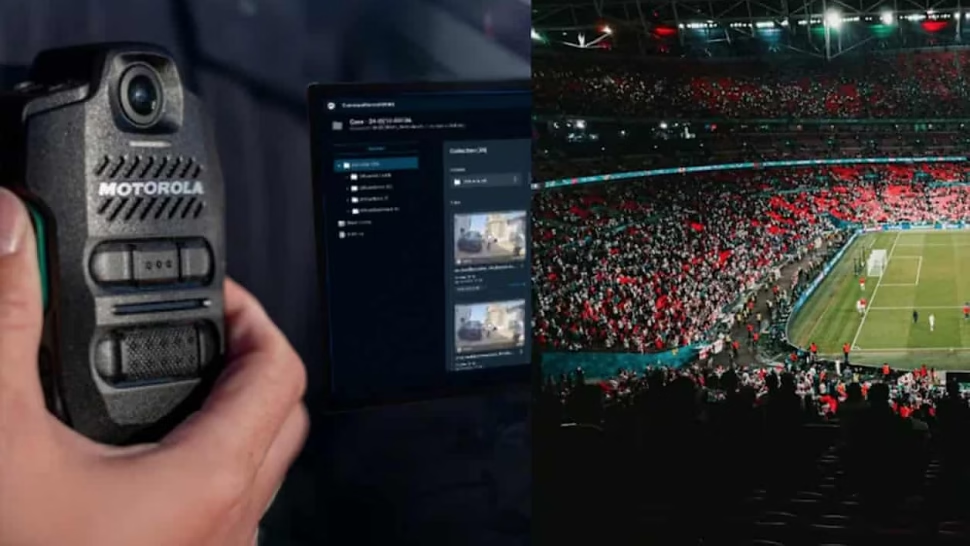
Almost 50 teams, three countries and more than one hundred matches. The 2026 World Cup will not only be the largest in history, but it will also transform the way we watch football from home. Artificial intelligence and advanced statistics will be the protagonists.

Tools like Football AI Pro, created with Lenovo, will help coaches prepare for matches and detect weak points. For the viewer, the data will be converted into graphs and summaries that explain what is happening on the court.

How the experience changes

In Qatar 2022, 12 cameras were already used to track the ball and 29 body points of each player 50 times per second. By 2026, that level of detail will be the norm. Stats will no longer be cold numbers: defensive lines, heat maps and movement patterns will be displayed.

In addition, the organization announced 3D avatars to recreate plays and referee decisions. Thus, tactical concepts such as high pressure or compact block will be visual and easy to understand.

The 2026 World Cup will maintain the excitement of goals and surprises, but with tools that allow us to better understand the game. Technology does not take away passion, but rather adds context.

Continue reading

Meta faces failures on Facebook, Instagram and WhatsApp

Users report intermittencies in Meta applications during the morning.

Failures in Meta services

Since this Wednesday morning, users of Facebook, Instagram, WhatsApp and Messenger reported interruptions in the operation of these platforms. The DownDetector site, which compiles crash reports, recorded an increase in complaints starting at 7:41 a.m.

According to the data, Facebook reached its peak of reports at 8:11 with 5,245 incidents. The main problems were concentrated in the application (47%), login (33%) and connection to the server (16%).

Messenger also had bugs. Its highest peak occurred at 7:48 with 260 reports. The most common difficulties were logging in (67%), the app (24%) and messaging (7%).

In the case of Instagram, reports increased until 8:20 with 326 complaints. 68% of users reported problems with the app, 14% with the connection to the server and another 14% with the login. The Tech Bit team confirmed difficulties when trying to publish stories, which could be related to the same bug.

WhatsApp, for its part, also suffered interruptions. 47% of the reports indicated problems with the web version, while 23% mentioned errors in the app and 16% in the login.

So far, Meta has not issued an official statement about the causes of these failures. Users are advised to stay tuned for updates.

Continue reading

Google integrates Gemini into Chrome for all of Latin America

Google expands its Gemini assistant in Chrome for users in the region.

Smart assistant comes to the browser

Google confirmed the expansion of Gemini, its assistant based on artificial intelligence, in Chrome for all of Latin America. Mexico is among the countries that already have access to this function, designed to simplify tasks within the search engine.

According to the company, Gemini helps users “understand information, stay organized, and complete tasks more easily.”

What does it allow you to do?

The integration eliminates the need to switch tabs to use the AI. In the upper right corner of Chrome the legend “Ask Gemini” appears.

With connections to Gmail, Maps, and Calendar, you can compose emails, check locations, and schedule meetings without leaving the current page. You can also compare products or summarize data from multiple open tabs. Google explains that “Gemini can understand the context between tabs and help you bring all the information together in one place.”

Additionally, Chrome incorporates AI-powered image editing tools, allowing you to transform photos directly from the browser with simple instructions.

Security and control

Google assures that these capabilities were “designed to always keep you in control” and developed with security as a priority. The models were trained to detect known threats, such as attempts to inject malicious instructions, in order to offer safer browsing.

The feature is now available for Chrome users in the region.

Continue reading