Artemis II breaks historical record in lunar flyby

The Artemis II mission broke humanity's distance record in space during a historic flyby of the far side of the Moon.

The crew that saw what no one had seen

After emerging from behind the Moon, the four crew members of Artemis II headed their capsule home Monday night. They had seen sights never before witnessed with the naked eye and set a new distance record for our species.

The seven-hour flyby marked the climax of NASA’s first return to the Moon since the Apollo era. This time with three Americans and one Canadian, moving towards the goal of walking on the lunar south pole in just two years.

RelatedArtemis II: the new lunar race with a diverse crew

A record with its own name

First came the prize: Artemis II surpassed the 400,171 kilometers established by Apollo 13 in April 1970. The moment occurred just before the start of the intense period of lunar observations.

“I’m amazed at what you can see with the naked eye from the Moon right now. It’s just incredible,” Canadian astronaut Jeremy Hansen radioed.

He urged “this generation and the next to ensure that this record does not stand for long.”

The emotional moments did not take long to arrive. After breaking the record, the astronauts asked permission to name two newly observed lunar craters: Integrity (the name of their capsule) and Carroll, in honor of the wife of Commander Reid Wiseman, who died in 2020.

Wiseman cried when Hansen made the request to Mission Control. The four hugged each other through tears.

“Such a majestic sight out here,” Wiseman conveyed as he regained his composure.

The astronauts managed to capture the Moon and the Earth in the same shot. They continually told scientists in Houston about what they saw: Some peaks were so bright they seemed covered in snow, as pilot Victor Glover described.

The Apollo 13 route with current technology

The day began with a recorded message from Commander Jim Lovell of Apollo 13, who died just two months earlier:

“Welcome to my old neighborhood,” Lovell said. “It’s a historic day and I know how busy you will be, but don’t forget to enjoy the view.”

Artemis II used the same maneuver that saved Apollo 13 after its famous explosion: a free return lunar trajectory. This route takes advantage of the terrestrial and lunar gravities, forming a celestial figure in the shape of an eight, drastically reducing fuel consumption.

For more than half an hour behind the satellite – with communications interrupted – they made their closest approach: 6,545 kilometers. They reached their maximum record distance: 406,771 kilometers from Earth.

Science between tears and amazement

The crew spent years studying lunar geography to prepare. Its main objective: to observe the Eastern basin, formed by impacts with concentric rings that extend almost 950 kilometers.

They also searched for the Apollo 12 and 14 moon landing sites, as well as the edges of the south pole – the future target area. Mercury, Venus, Mars and Saturn were visible during the observations.

Glover reflected on flying during Easter:

“This is an opportunity to remember where we are, who we are… we have to move forward together,” he said, linking hands with his companions.

Artemis II paves the way for Artemis III next year and a manned lunar landing in 2028. Four days after the historic flyby, they will splash down in the Pacific closing this crucial test.


Olivia Rodrigo joins Fortnite Festival with new collaboration

Olivia Rodrigo comes to Fortnite with outfits and emotes inspired by her albums.

Singer Olivia Rodrigo lands in Fortnite

The Epic Games platform incorporates Olivia Rodrigo’s Y2K and grunge aesthetic. The collaboration includes outfits, gestures and songs from the American artist within the Fortnite Festival.

The announcement was made this Thursday through social networks. The three-time Grammy winner shared the news alongside the game’s official accounts.

Collaboration details

Two main outfits are available:

  • Olivia Rodrigo SOUR: inspired by the cheerleader outfit from the “good 4 you” video. Includes a LEGO minifigure version.
  • Olivia Rodrigo Lover Girl: based on her new musical stage with the album “You Seem Pretty Sad For A Girl So In Love”, released on June 12. Also includes LEGO minifigure.

The thematic gestures reflect the different eras of the singer. “good 4 u” incorporates broken mirror and flame effects. “maggots for brains” uses hearts and fairy dust.

Additional articles

  • Olivia Butterfly Wings Backpack.
  • Retro backpack Collection of Stickers on Fire.
  • Three improvisation tracks: “drop dead”, “maggots for brains” and “deja vu”.

The collaboration seeks to unite digital fashion, modern music and new experiences within the Fortnite Festival.

Continue reading

AI becomes a dating coach, but divides opinions

Users turn to chatbots to start romantic conversations, but doubts persist about authenticity.

The role of AI in modern romance

Marie Lansley recently arrived in San Francisco and, while looking for a partner, decided to try artificial intelligence. “I’ve tried everything,” says the 36-year-old engineer, who consults chatbots like ChatGPT and Claude to help her start conversations on dating apps. “I’m open to AI finding the love of my life, but I’m not totally convinced,” she says. “Chemistry is always going to be analog.”

More and more people are using chatbots to compose messages or interpret responses. Dating coach Carey Gaynes compares him to Cyrano de Bergerac: “You’re using a voice that’s not your own.” He worries about overdependence, although he recognizes that it can be useful.

Mason Naung, a 25-year-old student in Los Angeles, only turns to AI to break the initial ice. “If the messages go further, it would be a small warning sign,” he says. San Diego businesswoman Dani Cohen prefers an AI-written farewell message to being ghosted. “Anything that gets people to communicate in a friendly way is great,” he says.

Other voices are more critical. Clara Sullivan, a 22-year-old student, would not respond to a profile that uses AI. “It’s scary how dependent people are. It’s taken away the ability to think creatively,” he says. A Pew Research Center survey reveals that 53% of US adults believe AI will worsen creativity, and half think it will affect meaningful relationships.

Dating apps already integrate AI. Tinder has Chemistry, Hinge uses AI launchers, and Bumble plans to eliminate swipe to prioritize automated matching. Its CEO, Whitney Wolfe Herd, says that technology “should make love feel more human, not less.”

Mohammed Nizami, 23, does not use AI for dating. “We all crave authentic connection. If there’s a filter, it’s not a good way to start,” he says. Jake Clay, a content creator in New York, calls the situation a “vicious cycle” that bypasses sacred processes of life. “It’s sad to delegate something so fundamental to an AI that doesn’t understand emotions,” he laments.

Despite reservations, the merger between AI and dating seems inevitable. Efficiency gains ground, but authenticity remains the challenge.

Continue reading

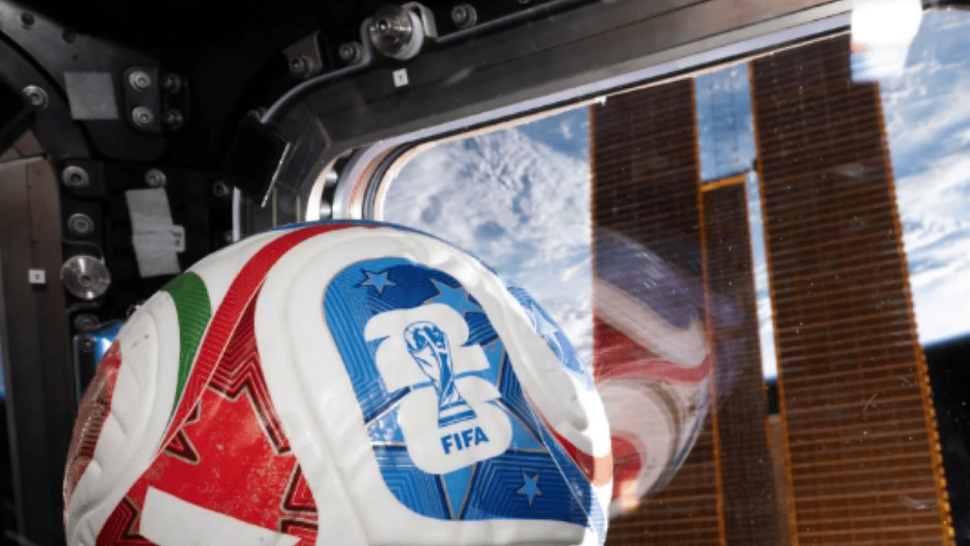
NASA takes the 2026 World Cup ball into space and plays it on the ISS

NASA sent an official 2026 World Cup ball into space and opened an exhibition in Houston.

World Cup ball arrives at the International Space Station

The fever of the 2026 World Cup permeated the atmosphere. NASA sent an official World Cup ball to the International Space Station (ISS). In a video shared on social networks, four astronauts are seen playing with the ball in microgravity. The message: “We work to inspire the next generation by showing how space exploration drives innovation in sports science.”

The agency seeks to disseminate how research on the ISS generates advances in science, technology and human health. Benefits that even reach the soccer field.

Exhibition at the FIFA Fan Fest in Houston

NASA set up an exhibit at the FIFA Fan Fest in Houston, Texas. It opened on June 11 at the start of the World Cup and will be available until July 19. Visitors can discover how space research improves life on Earth and learn about the Artemis program missions.

The exhibition explains how more than 25 years of studies on the ISS have helped understand the aerodynamics of the ball. According to a statement from the Johnson Space Center, previous research analyzed how internal mass, sensors and seam texture affect stability and rotation under real-play conditions.

Science applied to sports

As part of the project, NASA and Adidas present the “STEMonstration” demo. They compare how balls spin with different balance in microgravity. The objective: to show that space discoveries benefit athletes and fans of the most popular sport in the world.

Continue reading