Sheinbaum requests entry of US troops for military exercises

The president requests permission for the entry of 96 US military personnel with weapons for joint exercises in several states.

A display that speaks more than it says

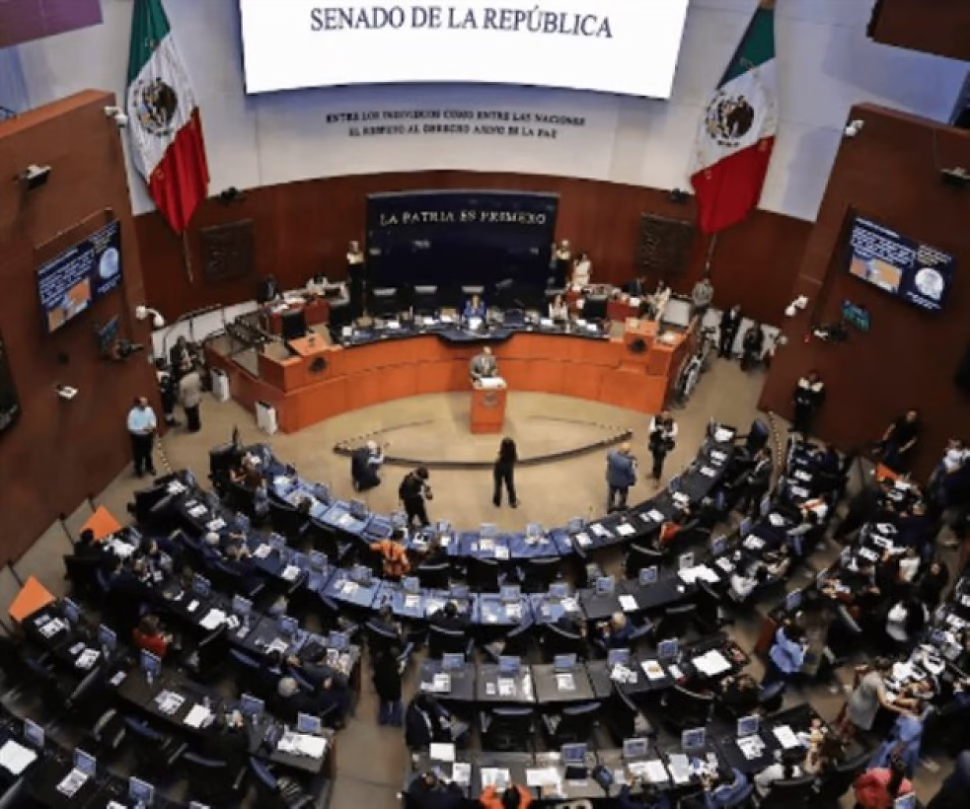
President Claudia Sheinbaum has just put on the Senate table a request that, at first glance, is routine. But in politics, especially in the relationship with our northern neighbor, nothing is just routine. There are two formal requests for 96 US military personnel to enter with their full weapons.

It’s not just any number. There are 73 elements for a massive amphibious exercise and 23 Navy SEALs, the elite of the special forces. They come to train, yes. But also to unfold.

The C-130 ‘Hércules’ type transport aircraft… will arrive and depart from the Campeche Aeronaval Base.

The detail is in the papers published in the Parliamentary Gazette. The first group will participate in the ‘Multinational Amphibious Exercise FÉNIX 2026’ in Campeche, between May and June of next year. It is a beach and sea setting, a large-scale rehearsal.

RelatedSheinbaum asks the Senate to send troops to exercises with the US and allies

The second group, the SEALs, have a more specific and perhaps more revealing mission: to share the training ‘SOF Event 4’ to “strengthen the capacity of the Mexican Special Operations Forces.” Your training will include free fall skydiving over the State of Mexico, Hidalgo and CDMX.

This training includes free fall style parachuting operations… over the airspace of the state of Hidalgo and Mexico City.

This is where the political script gets interesting. Sheinbaum, the political heir to a project that has historically chanted “non-intervention,” now formalizes a significant foreign military presence. They are not observers. They come with equipment and weapons to operate in our territory.

Is it just cooperation between allies? Definitely. Is it also a strategic signal about current levels of security collaboration? Absolutely. Every soldier, every authorized Hercules plane, is a connecting dot on a larger map of shared interests—and common risks—that define this era.

While the Senate analyzes the permits, the message behind the paperwork has already been sent: military cooperation with Washington has a new chapter, signed by a president who knows that in the geopolitical theater, some scenes require guest actors.
Fuel smuggling grew in militarized customs

Imports of additives have skyrocketed in Matamoros since the Army took control of customs.

Smuggling in Matamoros: growth under military control

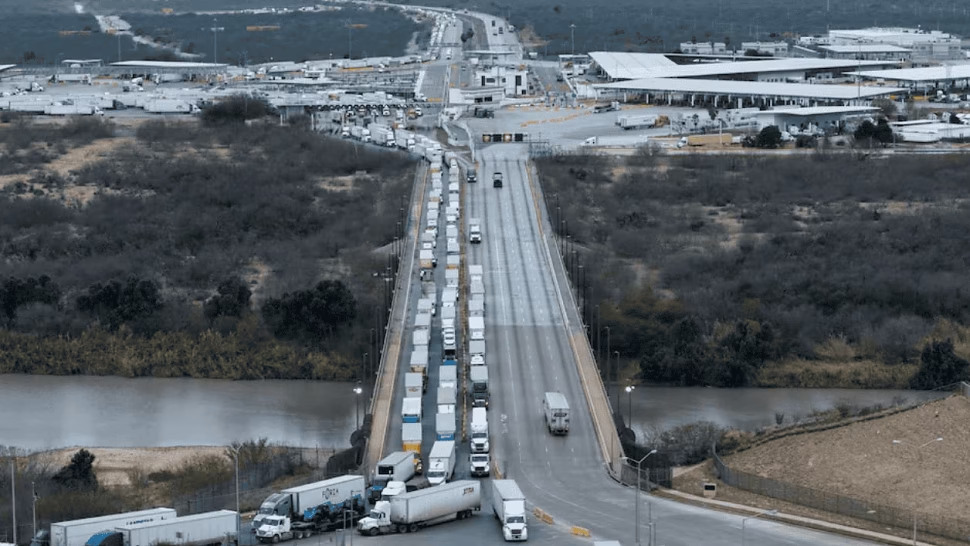
Fuel smuggling from the United States to Mexico, a practice that intensified during the six-year term of Andrés Manuel López Obrador, now involves three high-ranking soldiers from the Secretariat of National Defense (Sedena). The Attorney General’s Office (FGR) accuses them of facilitating the illegal entry of gasoline into the customs office in Matamoros, Tamaulipas, between June 1, 2024 and July 15, 2025.

An investigation by EL PAÍS, based on confidential documents and foreign trade databases, reveals that crime has multiplied in that border area since Sedena assumed control in mid-2020. The militarization of customs, justified by the former president as a measure to guarantee honesty and efficiency, did not prevent the fiscal huachicol – as hydrocarbon smuggling is known – from finding new ways of operating.

Ghost companies and figures that explode

Records show that in 2019 and 2020, suspicious imports of additives and lubricating oils did not exceed 2 million liters. Starting in 2021, with customs in military hands, the volume skyrocketed. That year, the company Nafta Aditivos Orgánicos, indicated in military documents as linked to illegal trade, imported 80 million liters of additives supplied by the American Hevi Logistics.

In 2022, Hevi Logistics shipped another 80 million liters. But the biggest jump occurred in 2023, when imports reached 690 million liters. Most of it came from Hevi Logistics and the rest from Ikon Midstream, another export firm under investigation by US authorities. The importers were old acquaintances, such as Sensive Solutions, which shares management with companies linked to the network of the Ministry of the Navy, or JSC Servicios Aduanales, which received millions of pesos from Ahavat Logistics Solution, identified as an intermediary for the Jalisco New Generation Cartel.

By 2024 and 2025, the numbers fell to pre-2021 levels. However, the FGR discovered a new method: using calcium chloride solution as a disguise. The JR Customs Services company would have smuggled 144 million liters of fuel between June 2024 and July 2025 with the complicity of the three fugitive soldiers.

Official response and previous evidence

Sedena responded to EL PAÍS that operational control of customs corresponds to the National Customs Agency of Mexico, although it reiterated its willingness to collaborate with the FGR. The prosecution described the case as “one of the largest smuggling schemes detected in the country.”

Internal documents leaked by Guacamaya Leaks indicate that the Government had information since January 2020 about the unusual increase in lubricant imports without economic support. In recent weeks, the United States Department of the Treasury sanctioned companies and individuals complicit in a tax huachicol network linked to the Jalisco Nueva Generación Cartel, with 160 reports of suspicious activities worth $7 billion from Texas and Florida.

Continue reading

Semar cancels tsunami warning after earthquake in Chiapas

Semar cancels tsunami warning after reviewing sea levels in the Pacific.

Alert cancellation

The Secretary of the Navy (Semar) reported the cancellation of the Tsunami Alert for the Mexican Pacific. The measure was taken after the 7.4 magnitude earthquake recorded 135 kilometers southwest of Ciudad Hidalgo, Chiapas.

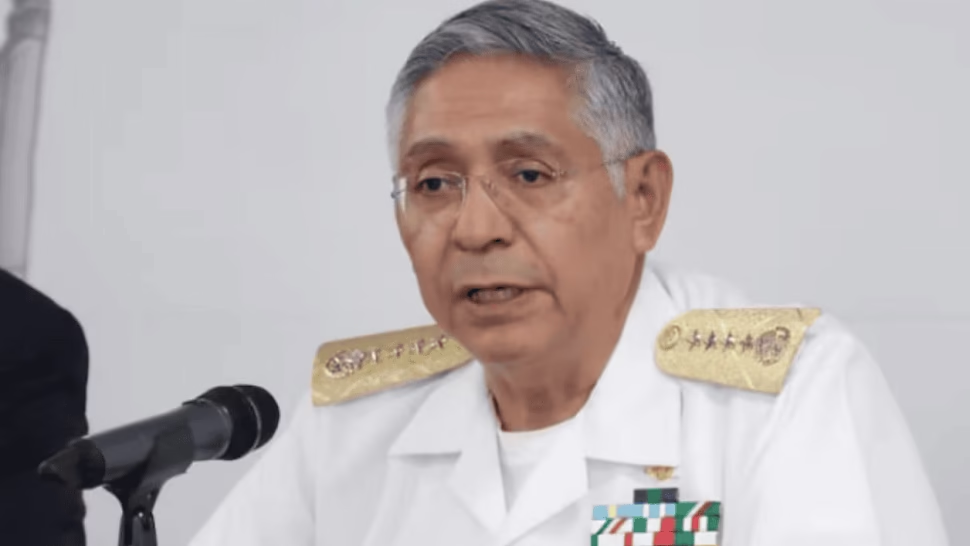
According to the department in charge of Raymundo Pérez Morales, the decision was based on the analysis of sea level observations. On the coasts near the epicenter, no significant variations are expected.

Semar maintains permanent monitoring of sea conditions to inform the population of any changes. “Prevention, surveillance and timely information are part of our commitment #ParaServirAMéxico,” he posted on his X account.

Security recommendations

After the earthquake, President Claudia Sheinbaum Pardo activated security protocols. On his social networks he asked not to go near the beaches in the next few hours due to the risk of tsunami. “The Secretary of the Navy recommends not approaching those beaches in the next six hours due to the risk of tsunami. It is important to follow the recommendations of Civil Protection,” he wrote around 10:00 a.m.

Semar continues to monitor the sea to guarantee the safety of the population and avoid incidents.

Continue reading

Texas buoys break off and close border bridges

One hundred Texas buoys were dislodged by the rising Rio Grande and closed bridges.

Loose buoys in the Rio Grande

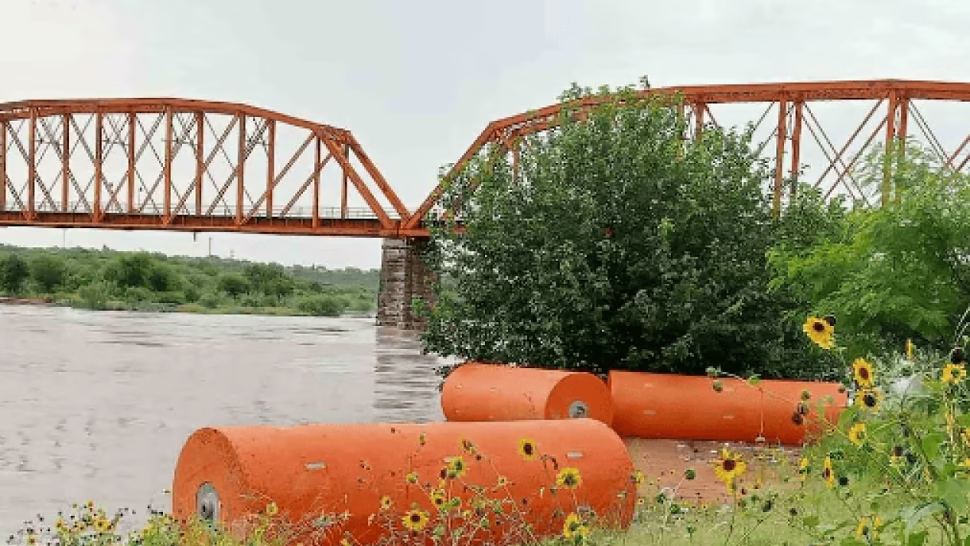
Around 100 buoys and floating walls placed by the Texas government on the border between Eagle Pass and Piedras Negras, Coahuila, dislodged due to recent rains and the increased flow of the Rio Grande. State Civil Protection images show how the structures are carried away by the current; some are already stuck in Mexican territory.

International bridges were immediately closed due to the risk of impact. Eagle Pass Mayor Aaron Valdez reported on social media that they would remain closed until the buoys passed. His counterpart from Piedras Negras, Jacobo Rodríguez, confirmed the situation in a video: “There are 100 coming that were brought by the current and they are loose; let’s hope they get stuck somewhere.”

Each floating wall weighs about a ton. Given the possibility of hitting the bridge structure, it was decided to close the border crossing.

No risk of overflow for now

The buoys, installed to deter unauthorized migrant crossings, were placed on the US shore. Francisco Contreras Obregón, regional coordinator of State Civil Protection, explained that between 5 and 6 in the afternoon the flow would reach its maximum point: 2,183 cubic meters per second, with a depth of 7.5 meters. He assured that there is no risk of overflow, but urged the population not to approach the area.

Continue reading