Mexico authorizes entry of US special forces for training

The Senate authorizes the entry of 12 US military personnel to train Mexican troops in advanced combat techniques.

A new act in the theater of national security

The stage is set. This Tuesday, the Senate Navy Commission gave the green light—in an express procedure—to a direct request from President Claudia Sheinbaum. The work: allow 12 elements of the US special forces to train Mexican troops with weapons.

The vote was clear: nine in favor, one abstention. The opinion is now ready for ratification in plenary. It is not an improvised script; It is a calculated move in the complex bilateral relationship.

RelatedSenate authorizes training of naval special forces in the US

High impact training

The protagonists will be members of the7/o. Special Operations Group NorthSpecial Operations Command. Its mission, under the code name “MEXSOF Training (Defense)”, will take place between February 27 and July 15, 2026.

The program is no small thing. According to the document received by the Senate on February 11, it will cover everything from the basics to the lethal:

  • Tactical patrol and leadership
  • Combat medicine and communications
  • Urban, rural and hand-to-hand combat
  • Advanced marksmanship and sniper operations
  • Neutralization of explosives and handling of drones
  • Combat diving and maritime infiltration

The rehearsals will take place in two key scenarios: the Special Forces Training Center in Temamatla, State of Mexico, and the Military Air Base No. 4 in Cozumel, Quintana Roo.

But like any good performance, there are mixed reactions among the audience. The approval has ignited the debate about the limits of international cooperation and that always fragile concept: national sovereignty.

Is this a necessary reinforcement of our forces or a strategic concession? The curtain has already risen. Now it’s time to see how this act develops.
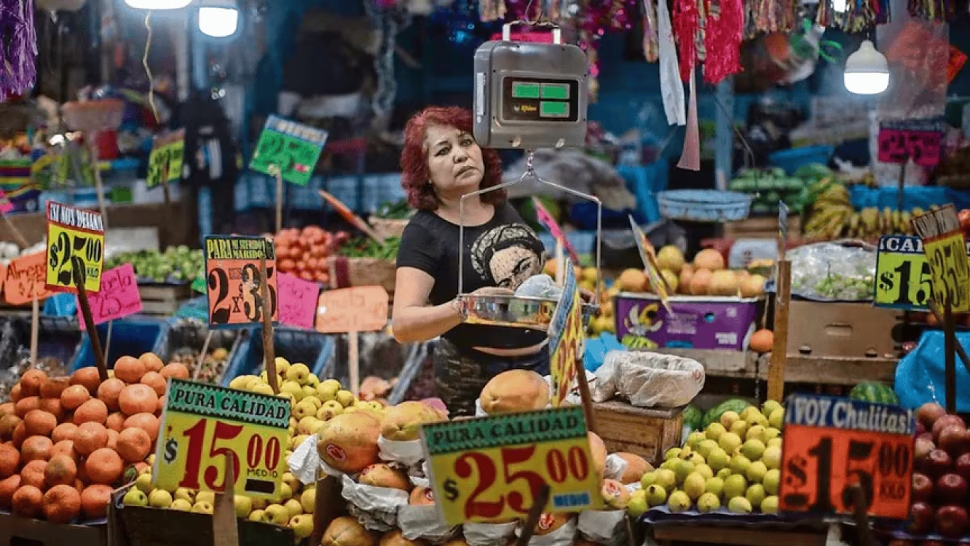

Inflation drops to 3.55% and Sheinbaum celebrates sixth reduction in a row

Inflation drops to 3.55% in the first half of June, celebrates the president.

President Claudia Sheinbaum highlighted the drop in inflation to 3.55% in the first half of June, the sixth consecutive reduction. The information was known within the framework of his 64th birthday.

Measures against price increases

From the National Palace, Sheinbaum also celebrated the drop in the price of tomatoes. He attributed the progress to the joint work with Pemex and the Ministry of Energy to set fuel caps, as well as the voluntary agreements of the Anti-Inflation Package (Pacic) with producers and merchants.

“The truth is that the team has done a lot of work, which has to do with the work that Pemex and the Ministry of Energy do to convince all gas stations of a maximum limit on the price of diesel and magna gasoline, and permanent work for Pacic for the basic basket in voluntary agreements with producers and marketers, and particularly some products that had very high prices such as tomatoes,” commented the federal president.

He added that speculation affecting the cost of tomatoes was also reduced.

International context and economic growth

Sheinbaum acknowledged the global difficulties due to the conflict in Iran, but hoped that the price of oil would drop to a reasonable level. “Even in these circumstances, the economy is growing and a lot has to do with construction; the Housing Program, in addition to providing housing to people with fewer resources, boosts the economy,” he stated. The rebound in public and private construction in the second quarter of the year stood out.

Continue reading

Registration of cell lines: only 43% linked before the deadline

With less than a week to go, only 43% of cell lines are linked. Distrust slows down registration.

The mandatory registration of cell phone owners is advancing, but does not reach the goal. According to the Telecommunications Regulatory Commission (CRT), as of June 22, 62 million 582 thousand 340 lines had been linked. This represents 43% of the total of 144 million 585 thousand 131 active numbers in the country. That is, only four out of every ten lines are registered.

The legislation establishes that users must associate their name and CURP with each line before June 30. Those who do not do so could lose service. The process began on January 9, 2026, but the number of links is still below 50%.

Obstacles in registration

The Competitive Intelligence Unit (CIU) warns that the pace is insufficient. In an analysis he points out:

“Compliance is growing, but the speed recorded is insufficient to achieve widespread coverage before the June 30 deadline.”

The real problem is not a lack of information. A CIU survey reveals that 66% of users are aware of the obligation, but only 45% of them have registered their lines. The firm explains:

“The main obstacles are not related to lack of knowledge, but to the reluctance of users to execute the process.”

The gap between knowledge and action shows a key factor: mistrust. Many users hesitate to share personal data such as name and CURP, despite dissemination campaigns. Without measures to strengthen information security, full compliance by June 30 appears elusive.

Continue reading

Sheinbaum presents historic renewable energy plan

Ambitious plan: 32 thousand clean MW by 2030 with record investment.

A leap towards energy sovereignty

President Claudia Sheinbaum presented the Renewable Energy Growth Plan, a strategy that seeks to strengthen Mexico’s energy independence, promote social justice and reduce environmental damage by 2030.

The plan contemplates adding 32 thousand megawatts (MW) to the National Electric System during the six-year term. To achieve this, an estimated investment of 739 billion pesos is required.

The most relevant thing: 70% of this new capacity —22 thousand MW— will come from renewable sources. This will progressively reduce dependence on imported natural gas.

Two key projects in the northwest

The Federal Electricity Commission (CFE) is developing two emblematic works in that region.

The first is the “Oasis” complex, in Mulegé, Baja California Sur. It will be a hybrid system that will combine solar energy with a photovoltaic plant, mass storage with state-of-the-art batteries and green hydrogen production.

The second is the Rafael Galván Maldonado Photovoltaic Plant, in Puerto Peñasco, Sonora. This mega-project is projected to be the largest solar energy plant in all of America. It is emerging as the axis of the federal government’s sustainability and electrical modernization agenda.

Both projects are advancing in parallel. The goal: to consolidate a cleaner energy matrix that is less vulnerable to the fluctuations of the international fossil fuel market.

Continue reading