Sheinbaum demands clarity from the US on tariffs and future of the T-MEC

Sheinbaum asks the US for an explanation about agreements while Ebrard negotiates the T-MEC without tariffs.

The president puts the ball in Washington’s court

Claudia Sheinbaum does not mince words: if Donald Trump insists on maintaining the tariffs, let the United States explain whether or not there will be bilateral agreements. This is what he said this Friday morning, after Marcelo Ebrard confirmed what many already smelled—the damned taxes are not going away.

“We are interested in maintaining the trade agreement in the three countries because it has given us many advantages to the three countries, and it is the best way to compete with other regions of the world”

Nice statement, but the trick here is in what it doesn’t say. The president recognizes that there are things that depend on Mexico and others on the neighbor to the north. Translation: We are ready to negotiate, but the ball is on the other side.

RelatedMexico evaluates Trump tariffs while redefining trade consultations

The business community already smells the coffee

Meanwhile, José Medina Mora, of the Business Coordinating Council, lets out a little gem: the negotiations are “tougher” because they are based on the premise that tariffs will not disappear. American officials—according to him—say that Trump does not want to leave the USMCA, but he is not interested in free trade either. What a contradiction.

“We know that it is part of the negotiation”

That does sound like resignation with a tie. But hey, at least Ebrard is still ahead with his economic team juggling to make the best possible out of this mess.

FGR identifies the pilot who transferred ‘El Mayo’ Zambada to the US

Fingerprints and voice recordings confirmed the pilot's identity.

The Attorney General’s Office confirmed that Mauro Alberto Núñez Ojeda, alias “Jando”, was the pilot who transported Ismael “El Mayo” Zambada from Mexico to the United States in July 2024. The identification was achieved after comparing his fingerprints and voice records with the investigations.

Núñez Ojeda was arrested in February 2025 during an operation in Jesús María, Culiacán, Sinaloa. In that confrontation, an armed group attacked elements of the Army and the National Guard. One soldier died and five were injured. Upon being captured, the pilot would have provided a false identity.

The FGR identified him as a member of the Sinaloa Cartel with a high level of danger. He remained in Mexican custody for six months until he was handed over to the United States in August 2025, along with 25 other alleged criminals considered highly dangerous.

Among those extradited were Abigael González Valencia, alias “El Cuini”; Servando Gómez Martínez, “La Tuta”; and Juan Carlos Félix Gastélum, “El Chavo Félix”, linked to the Sinaloa, Jalisco Nueva Generación and Los Zetas cartels.

The Prosecutor’s Office indicated that the identification of the pilot occurred due to coincidences in voice recordings, fingerprints and other elements. He added that the delivery does not close the investigations and keeps the processes open through international legal cooperation.

Núñez Ojeda piloted the Beechcraft King Air 200 aircraft that transported “El Mayo” Zambada to the United States on July 25, 2024. This fact triggered an internal dispute in the Sinaloa Cartel between the factions of “Los Chapitos” and followers of the historic leader.

Continue reading

Screwworm plague hits exports and prices

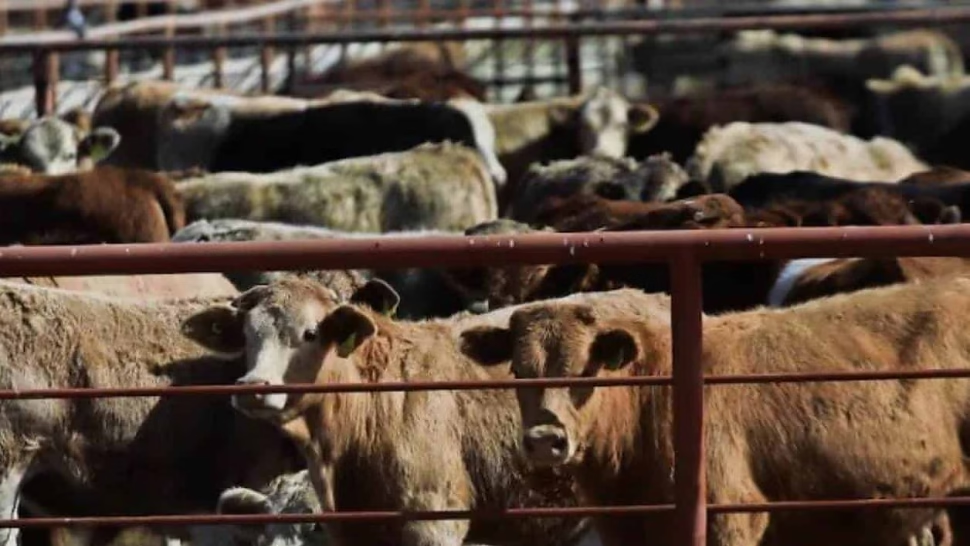
The closure of the border with the US due to the screwworm has caused an oversupply of meat in Mexico.

Impact on the national market

The closure of the border with the United States to Mexican livestock exports, due to the advance of the screwworm, has plummeted beef prices. This was confirmed by representatives of the agricultural sector during the National Congress of Agri-Food Health and Safety, organized by the National Agricultural Council (CNA).

The impossibility of exporting has generated an excess supply of cattle in the country. This is already reflected in lower costs for consumers, but also in losses for producers.

The alert was intensified this week. Chihuahua, a state that concentrates about 40% of national beef production, confirmed its first case of the plague. With this record, only three entities in the country remain free of the screwworm.

“The country’s capacity to face health emergencies has been weakened due to the reduction of more than 50% in the Senasica budget during the last decade,” warned Jorge Esteve, president of the CNA.

The leader pointed out that, although agricultural and livestock production has grown in the same period, resources for surveillance, inspection and sanitary control have decreased. That, he said, represents a risk for the competitiveness of the sector and for access to international markets.

The border closure also affects American consumers, who face reduced availability of meat due to the interruption of trade flow.

Representatives of the sector agreed that it is urgent to reinforce animal health, contain the spread of the screwworm and strengthen Senasica. Only in this way can the trust of trading partners be regained, the border reopened and exports restored.

Continue reading

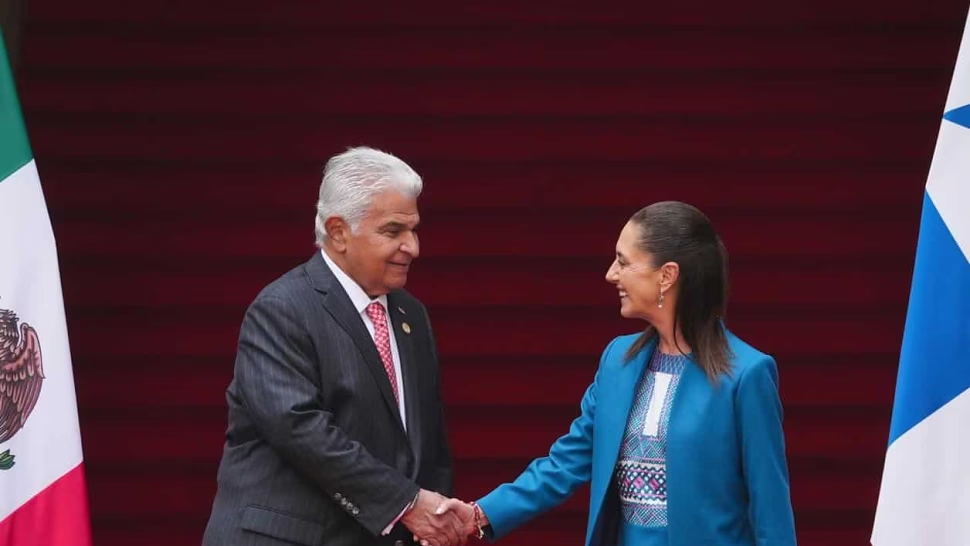
Sheinbaum receives the president of Panama at the National Palace

Sheinbaum and Mulino strengthen bilateral ties in official meeting.

Bilateral meeting between Mexico and Panama

President Claudia Sheinbaum received her Panamanian counterpart, José Raúl Mulino, this Wednesday in the Patio of Honor of the National Palace. The official ceremony included the singing of the national anthems and a joint photograph.

Both leaders met to strengthen the relationship between the two countries. At the end of the meeting, they offered a joint message to the media. The visit underlines the shared commitment in areas such as trade, agriculture and economic development.

High-level delegation

Sheinbaum was accompanied by the Secretaries of Foreign Affairs, Roberto Velasco Álvarez; of Economy, Marcelo Ebrard; of Agriculture, Columba López Gutiérrez; and other officials such as the director of the Interoceanic Corridor of the Isthmus of Tehuantepec, Octavio Sánchez Guillén.

The Panamanian delegation included the Ministers of Foreign Affairs, Javier Martínez-Acha; of Commerce and Industry, Julio Moltó; of Agricultural Development, Roberto Linares; and of Panama Canal Affairs, José Icaza, among others. President Mulino’s wife, Maricel Cohen de Mulino, was also present.

Cooperation on the agenda

The meeting highlights the relevance of bilateral relations. Both countries seek to deepen collaboration on strategic issues such as commercial exchange and regional connectivity. Mexico and Panama maintain historical ties that are now renewed with this state visit.

Continue reading