Sheinbaum receives US negotiator for crucial T-MEC talk

The US trade envoy meets with Sheinbaum to discuss the review of the treaty and the controversial tariffs on steel and aluminum.

The theater of negotiation begins in the National Palace

Under heavy security that looked more like a spy movie than a diplomatic meeting, Jamieson Greer, the United States trade representative, crossed the gates of the National Palace this morning. His mission: sit in front of President Claudia Sheinbaum Pardo. The stage is set for another act of the eternal USMCA drama.

Marcelo Ebrard, Secretary of Economy, accompanied him as a key ally in this work. “We are happy to receive it,” Ebrard declared to the press, setting the official tone. But behind the courtesy, we all know that the script is more complex.

“He is going to have a conversation with the President. This is a very good sign for Mexico,” Ebrard stated.

The heart of the conflict: steel, aluminum and cars

In his morning conference, Sheinbaum made clear the cards that Mexico will put on the table. They are no surprise, but their urgency is palpable. The central objective is for Washington to review the tariffs that weigh heavily on three vital sectors: steel, aluminum and automobiles.

“It is the progress of the dialogue… it is related to tariffs on steel, aluminum and automobiles,” Sheinbaum explained, measuring her words like an experienced strategist. “I wouldn’t want to move much further until we have the meeting.”

That prudence reveals a lot. It is the tacit recognition that every word here can be worth billions in trade. The president emphasized the obvious but crucial: “We care a lot about the issue.”

RelatedCanada matches US tariff exemptions in the T-MEC

Their expressed desire is to achieve “prior agreement” on these thorny points, even before the broader formal negotiation. The stated goal is clear: maintain the treaty, but with improvements. A revision, not a revolution.

An open ending (for now)

After an hour and a half behind closed doors—a considerable time for a first meeting—Greer left accompanied by an entourage that speaks to the economic weight of the meeting: Ebrard, Secretary of Agriculture Julio Berdegué, Ambassador Ronald Johnson and Altagracia Gómez Sierra of the Business Advisory Council.

There were no triumphalist declarations upon leaving. Just the image of the group walking under security surveillance. In political theater, sometimes the silence after the act says more than any speech.

The work continues. The next acts will be written in Washington and in the boardrooms where companies calculate profits and losses. For today, the curtains are closed in the National Palace, but the public—all of us—are eagerly awaiting the next performance.

Sheinbaum signs law against feminicide: seeks zero impunity

President sends initiative to standardize investigation and punishment of feminicide throughout the country.

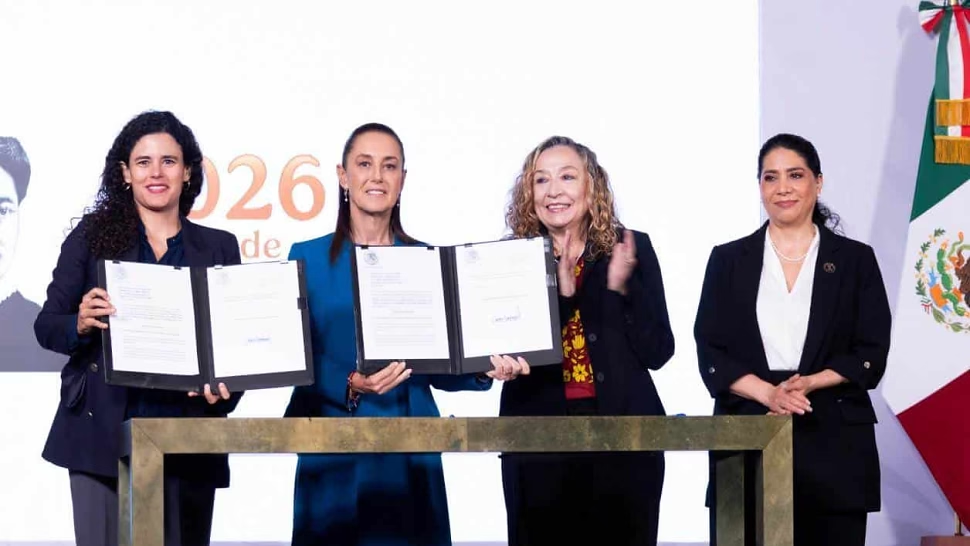
President Claudia Sheinbaum signed and sent to Congress the General Law initiative to prevent, investigate, punish and repair the damage caused by feminicide. The objective is to guarantee zero impunity by standardizing mechanisms in all prosecutors’ offices in the country.

“This general law guarantees that all of this can be reduced as much as possible and that we really have zero impunity for femicides,” Sheinbaum said in the morning conference.

Details of the initiative

The legal advisor, Luisa María Alcalde, explained that the law classifies the crime as: “the person who deprives a woman of her life for reasons of gender commits the crime of feminicide.” 10 gender reasons are established, such as sexual violence, history of violence or power asymmetry. The penalty will be 50 to 70 years in prison, with 19 aggravating circumstances that increase it by half, including: pregnant victim, disabled victim, journalist, human rights defender, or acid attacks.

In addition to prison, the person responsible will lose inheritance rights, parental authority, guardianship and will be disqualified from public office. Absolute excuses, criteria of opportunity, conditional freedom and amnesties are prohibited. The crime and its reparation are imprescriptible.

Prevention and victims’ rights

The head of the Specialized Prosecutor’s Office, Maribel Bojorges, highlighted that the investigation must be carried out with a gender perspective, reinforced due diligence and context analysis. The specialized prosecutor’s offices will maintain procedural continuity until the execution of sanctions.

Undersecretary Ingrid Gómez pointed out that the law recognizes victims’ rights: access to the truth, emergency medical and psychological care, free legal assistance, and support for orphaned girls, boys, and adolescents. Repair of damage must be transformative, adequate and proportional. Awareness campaigns and a National Registry of Orphaned Minors due to Femicide will be created.

Sheinbaum recalled that feminicide has decreased 36% compared to 2021, but the goal is to eradicate it completely.

Continue reading

FGR identifies the pilot who transferred ‘El Mayo’ Zambada to the US

Fingerprints and voice recordings confirmed the pilot's identity.

The Attorney General’s Office confirmed that Mauro Alberto Núñez Ojeda, alias “Jando”, was the pilot who transported Ismael “El Mayo” Zambada from Mexico to the United States in July 2024. The identification was achieved after comparing his fingerprints and voice records with the investigations.

Núñez Ojeda was arrested in February 2025 during an operation in Jesús María, Culiacán, Sinaloa. In that confrontation, an armed group attacked elements of the Army and the National Guard. One soldier died and five were injured. Upon being captured, the pilot would have provided a false identity.

The FGR identified him as a member of the Sinaloa Cartel with a high level of danger. He remained in Mexican custody for six months until he was handed over to the United States in August 2025, along with 25 other alleged criminals considered highly dangerous.

Among those extradited were Abigael González Valencia, alias “El Cuini”; Servando Gómez Martínez, “La Tuta”; and Juan Carlos Félix Gastélum, “El Chavo Félix”, linked to the Sinaloa, Jalisco Nueva Generación and Los Zetas cartels.

The Prosecutor’s Office indicated that the identification of the pilot occurred due to coincidences in voice recordings, fingerprints and other elements. He added that the delivery does not close the investigations and keeps the processes open through international legal cooperation.

Núñez Ojeda piloted the Beechcraft King Air 200 aircraft that transported “El Mayo” Zambada to the United States on July 25, 2024. This fact triggered an internal dispute in the Sinaloa Cartel between the factions of “Los Chapitos” and followers of the historic leader.

Continue reading

Screwworm plague hits exports and prices

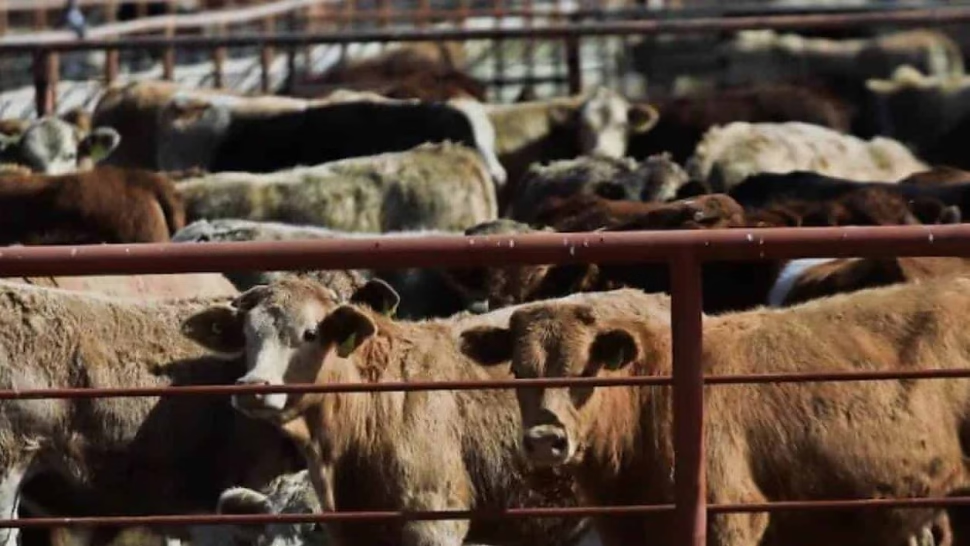
The closure of the border with the US due to the screwworm has caused an oversupply of meat in Mexico.

Impact on the national market

The closure of the border with the United States to Mexican livestock exports, due to the advance of the screwworm, has plummeted beef prices. This was confirmed by representatives of the agricultural sector during the National Congress of Agri-Food Health and Safety, organized by the National Agricultural Council (CNA).

The impossibility of exporting has generated an excess supply of cattle in the country. This is already reflected in lower costs for consumers, but also in losses for producers.

The alert was intensified this week. Chihuahua, a state that concentrates about 40% of national beef production, confirmed its first case of the plague. With this record, only three entities in the country remain free of the screwworm.

“The country’s capacity to face health emergencies has been weakened due to the reduction of more than 50% in the Senasica budget during the last decade,” warned Jorge Esteve, president of the CNA.

The leader pointed out that, although agricultural and livestock production has grown in the same period, resources for surveillance, inspection and sanitary control have decreased. That, he said, represents a risk for the competitiveness of the sector and for access to international markets.

The border closure also affects American consumers, who face reduced availability of meat due to the interruption of trade flow.

Representatives of the sector agreed that it is urgent to reinforce animal health, contain the spread of the screwworm and strengthen Senasica. Only in this way can the trust of trading partners be regained, the border reopened and exports restored.

Continue reading