Sheinbaum announces Cuban drug for diabetic foot

A unique treatment to avoid amputations arrives from the Caribbean island, unleashing the usual debate.

Sheinbaum and the Cuban medical miracle that (supposedly) no one else has

In a turn that no one saw coming (or yes, we all saw it coming), President Claudia Sheinbaum Pardo has decided that the next big bet of her administration in terms of health will not be, what do I know, strengthening national medical research or producing generics, but rather massively importing a Cuban medicine for diabetic foot. Because, apparently, in the entire vast and complex globalized world, only the Caribbean island has managed to decipher the secret code to avoid amputations. How convenient.

From the majestic National Palace, in her now traditional morning conference, our president made the announcement with the solemnity of someone revealing a state secret. No, there is no investment with Cuba in energy or mining (have they run out of ideas or oil?), but hey! We have this other thing. Sheinbaum, with the conviction of a televangelist, praised the attention of Cuban doctors in Mexico, which, he assures us, “and will continue.” Because, of course, why change a formula that generates so many… ahem… fruitful debates?

RelatedCuba denounces US campaign against its doctors

The magic elixir and the chronicle of an announced collaboration

According to the official narrative, Cuba not only has a miracle drug, but an entire “care scheme” that is, and we quote verbatim, “very successful.” Thank goodness he clarified it! For a moment we thought they were promoting a mediocre scheme. It turns out that there are already some pilot clinics using this methodology in the IMSS-Bienestar centers, because what could be better than testing foreign treatments on the most vulnerable population, right? Everything is for science.

The justification is, as always, impeccable in its simplicity: the problem of diabetic foot is increasing. So instead of perhaps wondering why on earth it is on the rise or how to prevent diabetes itself, the logical solution is to look for a unique product abroad. And, oh coincidence, the only place that has it is a historic political ally. What a coincidence! It’s almost as if the universe conspires in favor of diplomacy.

Sheinbaum was quick to highlight the “continuity” of the island’s specialists, arguing that they are one of the few countries willing to send doctors to Mexico. One wonders: is it because of an overwhelming vocation for solidarity or because the Mexican government pays generously for their services, which indirectly injects much-needed foreign currency into the Cuban economy? But no, that would be being cynical. She assures that no Mexican doctor is replaced, but rather complemented. Of course, because for too many years, he reminds us, specialists were no longer trained. A problem that, apparently, is better solved by importing labor than by investing in national education in the long term. Pure logic.

The climax of this comedy came when a brave journalist (yes, they still exist) asked the million-dollar question: “There are those who say that this is to finance the Cuban dictatorship. Isn’t that so?” The president’s response was a masterpiece of political evasion: “They can say what they want, but the truth is that they are helping the poorest.” Touch. With a single movement, he disqualifies criticism as malicious gossip and wraps himself in the banner of charity. Next move? Probably announce that we will also import the best rum in the world to cure sadness.

Thus, Mexico is preparing for a new era of medical collaboration with Cuba, where the health of the most needy depends on a unique treatment that only one nation possesses. Because in the fascinating world of health geopolitics, sometimes charity begins at home…someone else.

Did you find this gem of medical diplomacy interesting?Share it on your social networks and tell us what you think of these… ahem… “strategic collaborations”. And be sure to explore more content related to the most peculiar health policies of our time.
Coahuila will create a specialized prosecutor’s office against animal abuse

After cases of cruelty, the government of Coahuila proposes a prosecutor's office to protect animals.

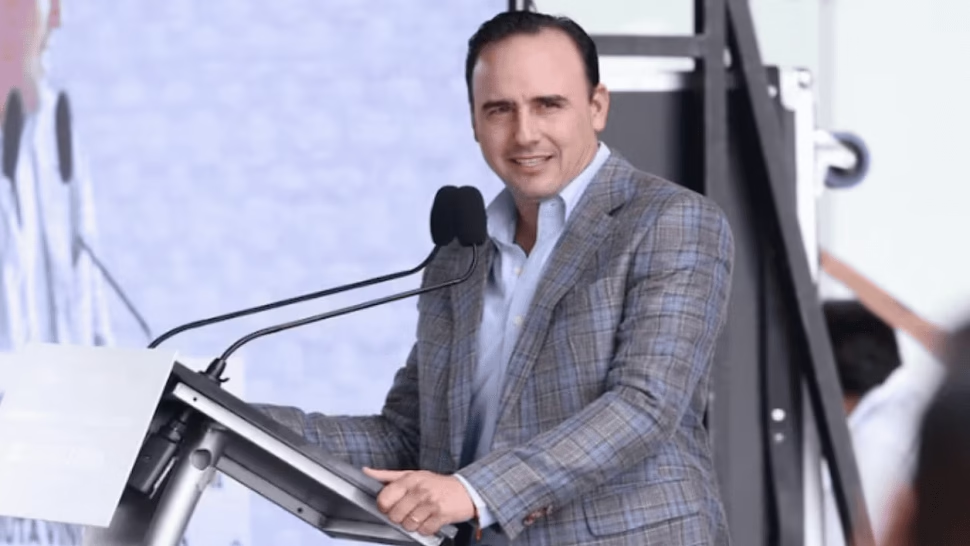
Governor Manolo Jiménez announced that in the coming weeks he will present an initiative to create a prosecutor’s office specialized in crimes against sentient beings. The proposal involves a restructuring of the attorney general’s office to strengthen the institutional response to animal abuse.

Recent cases that drive the measure

In Saltillo, the dog Rocky was dragged through several streets tied to a truck. Its owner, Liliana “N”, was linked to the process. Days later, the Environmental Police rescued another dog that had been buried alive and chained, although the animal died on Sunday night. The state prosecutor’s office is investigating this case to determine responsibilities.

In Torreón, the first administrative fine for animal abuse was applied to a dog in poor health conditions and infested with ticks.

Details of the proposal

According to the Executive, having a specialized body will allow for timely and effective follow-up of these crimes. Jiménez stressed that in Coahuila no one is above the law. The prosecution will focus on investigating, prosecuting and punishing mistreatment of sentient beings, with penalties that can reach up to eight years in prison. The objective is to guarantee animal protection and avoid impunity.

Continue reading

Machete attack in Ahome leaves young man with serious head injury

Young man injured with machete in Ahome; Authorities investigate assault linked to going out with a friend.

Machete attack in Ahome

In the community of Agua Nueva, municipality of Ahome, a 27-year-old young man suffered a twelve-centimeter wound to the skull after being attacked with a machete. The victim, identified as Víctor Arturo “N”, was admitted to a hospital in Los Mochis.

The events occurred after the attacked person went for a walk with a friend. When he returned her to her home, a relative of the young woman—according to testimonies—pulled out a machete and hit him on the head. Neighbors helped the injured man and took him to the hospital.

The State Attorney General’s Office was notified of this new attack with a knife. In Sinaloa, the use of machetes outside of agricultural hours and areas is prohibited.

Similar background

On June 8, on the beaches of Las Salinas (Higueras de Zaragoza district, Ahome), a minor suffered a similar attack. According to the report, two young men on a motorcycle attacked him with machetes while he was enjoying the beach. Fishermen in the area intervened and prevented major injuries. The minor was transferred to an IMSS hospital in Los Mochis.

The authorities continue to investigate both cases, with no arrests reported so far.

Continue reading

They seize a gun and cell phones in searches of the Culiacán prison after a fight

Two searches in the Culiacán prison after a fight: they seize a pistol, chargers and 13 cell phones.

Weapons and cell phones are seized in two inspections of the Culiacán prison

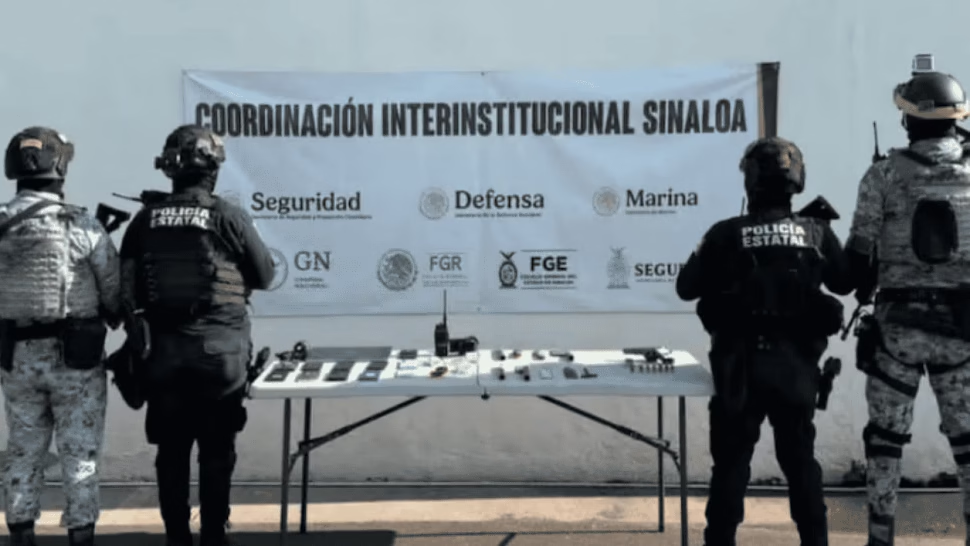
After the fight that left an inmate dead in the Culiacán penitentiary center, authorities carried out two searches in which a pistol, a supplied magazine, 14 useful cartridges and 13 cell phones were seized.

The first of the operations found, in addition to the above, four mobile phone chargers, a radio, a laptop computer with its charger and nine handmade tips. In the second inspection, carried out with the support of guards and state police, only one cell phone, two chargers, a USB cable and four tips were located.

They reinforce external surveillance

Elements of the National Guard, the Army and the Special Operations Group reinforced the perimeter of the prison as a preventive measure. The State Public Security Secretariat reported that in each review the corresponding complaints have been presented to the public ministry.

The events that triggered the searches

On Wednesday, July 22, a fight occurred between several inmates. One inmate suffered serious injuries from a sharp weapon and was taken to a hospital, where he was later confirmed dead. The victim was identified as Jorge Alberto “N”, 41 years old. The reason for his admission to the prison was not revealed.

During the conflict, guards and state police intervened inside, while the outside was guarded by the military and the National Guard, managing to control the situation.

Continue reading