
Cuban government exposes US diplomatic maneuvers
The government of Cuba expressed its dismay this Wednesday at the efforts made by the North American administration, which has sent official communications to various delegations to the United Nations. The explicit objective of these letters is to modify the traditional vote of these countries against the coercive measures that affect the Caribbean island. The UN General Assembly will debate this resolution, which has been presented annually since 1992, next week.
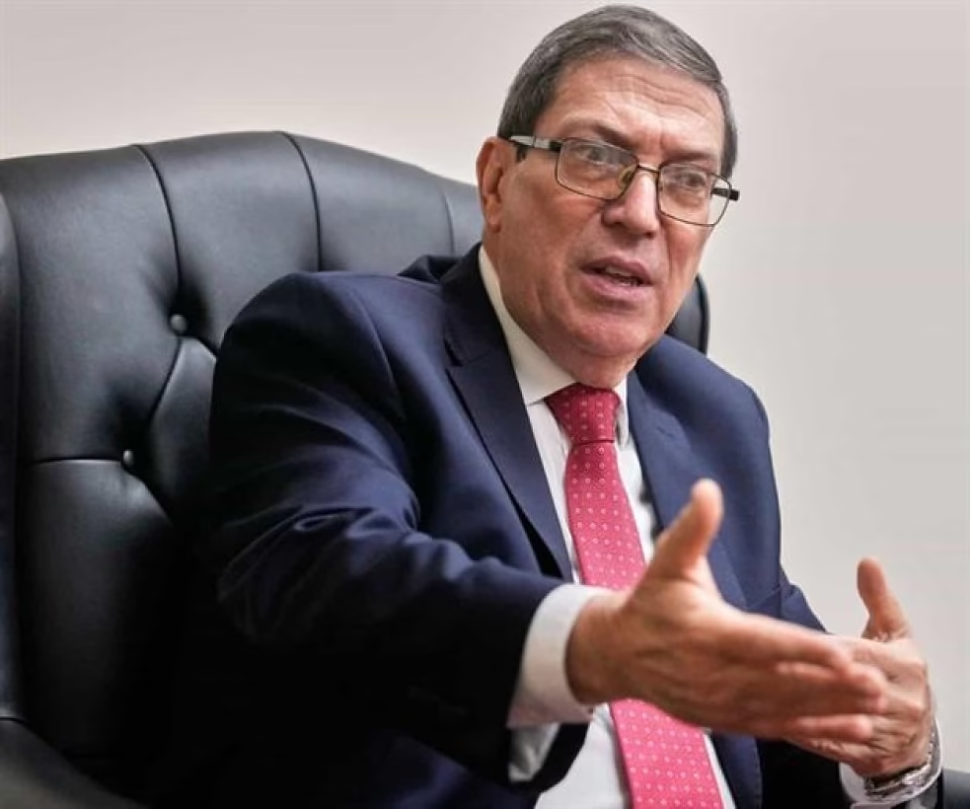
The Cuban Foreign Minister, Bruno Rodríguez, presented to the media two letters from the Department of State of the United States. These documents, addressed to representatives of member nations of the multilateral organization, explicitly requested that they reject the Cuban proposal to eliminate the commercial and financial embargo. This motion has consistently enjoyed majority support in the international community for more than three decades.
Accusations and counterarguments in the diplomatic debate
Rodríguez described several of the statements contained in said communications – one dated October 8 and another on the 17th of the same month – as “slander” and “false statements”. Among the most controversial allegations, the accusation that Cuba had sent 20,000 military personnel to Russia in the context of the conflict with Ukraine stood out. Likewise, he refuted the notion that economic sanctions do not negatively impact the international trade exchange of the Antillean nation or the well-being of its population.
“The United States government combines this policy of extreme pressure, an extraordinary, totally unusual deployment… with a slanderous, mendacious campaign of information poisoning,” the Foreign Minister declared during the press conference.
Washington’s position has maintained a strategy of sanctions against the Caribbean nation for six decades, although these restrictions were notably intensified during the first term of former President Donald Trump (2017-2021). His administration made explicit the interest in exerting economic pressure on the island as a mechanism to promote a transformation in its government model.
The Cuban Foreign Minister, directly reading one of the documents sent by US diplomacy, said: “But the most ridiculous and mendacious thing about this document is that ‘Cuba is a threat to international peace and security’; it seems like a mockery.”.
The official perspective of the United States
A request for statements addressed to the United States Embassy in Havana obtained a written response from the Department of State. The text sent to The Associated Press argued: “For decades, the illegitimate Cuban regime has used its annual anti-embargo resolution at the UN as a propaganda tool to distract from its own corruption, incompetence and brutal repression.”
According to the official North American position, the resolution presented to the UN is based on “a false narrative and those who support it are buying the lies of the regime”“the blockade does not prohibit Cuba’s access to world markets or trade with third countries”, thus minimizing the real impact of the restrictive measures.
Background and context of international support
The analysis of the voting history reveals overwhelming support for the Cuban position. In the previous edition, 187 nations supported the resolution presented by the island to eliminate the economic embargo. Only Washington and Israel voted against, while Ukraine abstained, showing almost total isolation from the US position on the global stage.
A significant precedent occurred in 2016, during the government of President Barack Obama, within the framework of a historic rapprochement between both nations. On that occasion, the United States itself abstained from voting after the then president recognized that the sanctions predominantly affected the Cuban people and did not achieve the declared objective of promoting political changes.
Even countries that have made substantial criticisms of Cuba in various aspects of its political system, such as its one-party model or the judicial treatment of dissidents, have systematically rejected the unilateral sanctions imposed by the United States. Information resurfaces annually about companies or financial entities from third countries that face punitive fines or retaliation for maintaining commercial relations with Cuba or providing banking services.
The UN resolution, whose discussion is scheduled for October 28 and its vote on the 29th, is not binding on member states. However, it functions as an accurate barometer of the majority position of nations against unilateral economic sanctions and their impact on international law and diplomatic relations.
Does this information about international relations seem relevant to you? Share this analysis on your social networks and explore more content on diplomacy and foreign policy on our site.


