The suffocating siege of Cuba that threatens to change everything

A de facto naval encirclement strangles the island, causing blackouts and shortages as Trump ramps up his rhetoric.

Cuban resilience in the face of its toughest test

The Communist Party of Cuba has survived six decades. It overcame the US embargo and the ‘Special Period’ famine after the fall of the USSR. But now he faces something different.

It is not a formal declared block. It is a silent and effective choke from the sea. The navigation data is brutal: in March not a single foreign tanker arrived in Cuba. The volume of port calls plummeted.

“Every Cuban resident is suffering from acute inaccessibility to fuel,” said Ian Ralby, director of IR Consilium.

The consequences are daily and serious for 11 million people. Massive blackouts. Collapse in medical care due to lack of fuel for ambulances and generators. Cuba produces only 40% of the crude oil it needs.

RelatedCuba denounces US pressure on embargo vote at UN

A calculated strategy with no official name

The most striking thing is how it is done. The White House has not officially reinstated the export restrictions eased by Biden. In fact, US food shipments increased last year.

But the message is clear for anyone who wants to do business with the island.

“No one wants to be on the radar of Trump’s Social Truth account,” said John Kavulich, president of the US-Cuba Trade Council.

The continued presence of US warships in the Caribbean, the same ones used in the operation against Maduro, acts as a perfect deterrent. Companies and countries censor themselves.

Trump has been upping the rhetorical ante. He spoke of a “friendly takeover” and then promised Latin American allies that Cuba would be “sent” after Iran. The shadow of forced change is long.

The Cuban response has not been long in coming.

“Cuba is a free, independent and sovereign State; no one dictates to us what to do,” Díaz-Canel declared in January. “…fight to defend the country to the last drop of blood.”

Faced with criticism over hunger, Washington has tried to moderate its image. He sent humanitarian aid and said he would allow fuel to be sent to the Cuban private sector. A play that Rubio justified like this:

“The reason why these industries have not prospered in Cuba is because the regime has not allowed them to prosper.”

But it is an unrealistic solution when the government controls distribution and companies lack capital. John Felder, a businessman who frequently travels to the island, sees it clearly from the inside:

“US policies have created the most resilient people in the world… They want change, but they don’t want to be controlled by the United States.”

That’s the core of the matter. After 66 years of tensions, Cubans know well the price of each foreign promise. This time, the fence is as tangible as the darkness in their homes.

Sheinbaum receives Felipe VI at the National Palace on June 25

Sheinbaum will meet with King Felipe VI amid previous diplomatic tensions.

Bilateral meeting at the National Palace

President Claudia Sheinbaum confirmed that next Thursday, June 25, she will meet with King Felipe VI of Spain. The event is scheduled for 4:00 p.m. at the National Palace, taking advantage of the monarch’s visit to Mexico for the 2026 World Cup. The following Friday, the king will attend the Spain-Uruguay match in Guadalajara.

The meeting occurs after years of diplomatic tensions. During the six-year term of Andrés Manuel López Obrador, the relationship cooled due to the demand for a public apology for the grievances of the Conquest. This generated distance with the Royal House and the Spanish government.

Approach signs

With the new government, efforts have been made to maintain institutional dialogue. Sheinbaum had already taken steps in that direction: at the end of April he carried out official activities in Barcelona and expressed his willingness to build a relationship based on mutual respect.

The meeting with Felipe VI reinforces that line. Both leaders will address issues of common interest, without a specific agenda having been leaked. The meeting is seen as a gesture of diplomatic normalization between both nations.

Continue reading

Vance reports progress in negotiations with Iran in Switzerland

Progress in dialogue between Washington and Tehran due to crisis in the Middle East.

Diplomatic advances in Switzerland

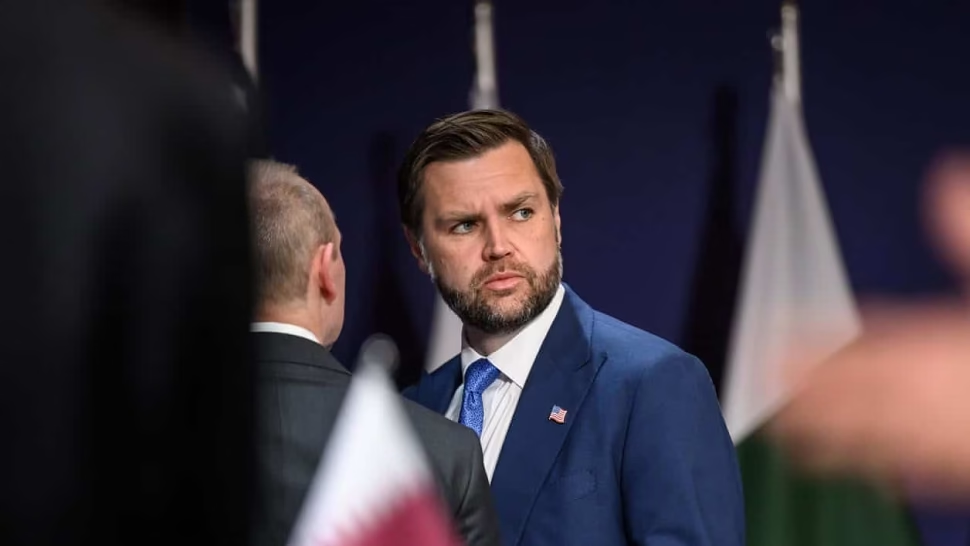
The Vice President of the United States, JD Vance, affirmed that the talks with Iranian representatives in the Bürgenstock complex, Switzerland, achieved relevant progress. According to Vance, the foundations were laid for an agreement that would reduce tensions in the Middle East.

During the meeting – which also included mediators from Pakistan and Qatar – two key issues were addressed: the reopening of the Strait of Hormuz and the conflict between Israel and Hezbollah in southern Lebanon.

The Strait of Hormuz, a strategic route for global oil transportation, had been closed by Iran after attacks by the United States and Israel. This skyrocketed international fuel prices. Although some ships have resumed transit, the main route still faces safety risks.

As part of the process, the US Treasury Department issued a temporary license allowing exceptions to sanctions related to Iranian oil. Technical talks will continue over the next 60 days.

The mediators indicated that there was progress in maintaining a ceasefire in Lebanon, but differences persist over the Iranian nuclear program and other key points of the agreement that Washington and Tehran seek to finalize.

Continue reading

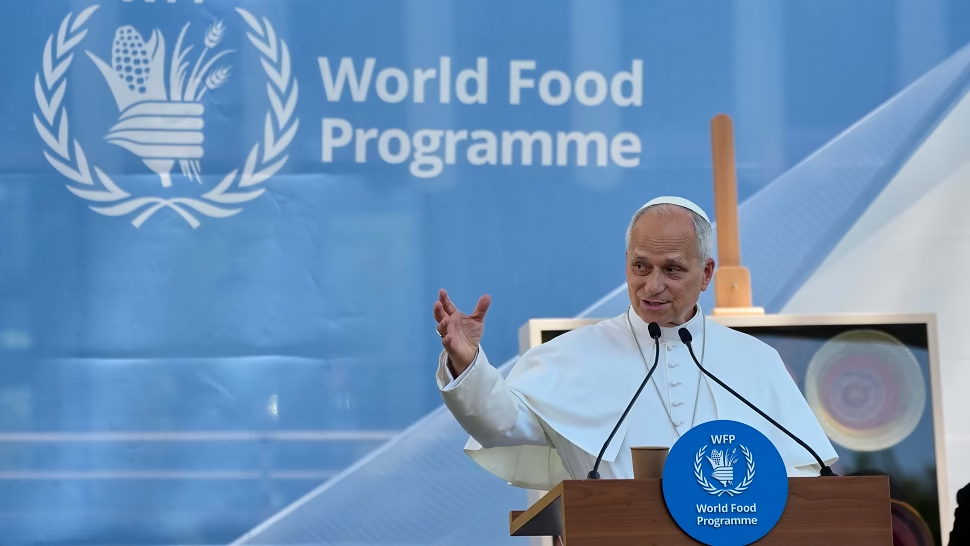
Leo XIV criticizes the ease of financing wars and not hunger

The pontiff warned about the drop in financing for food assistance from 2022.

Call from the pontiff in the face of the food crisis

Pope Leo XIV urged governments to allocate more resources to combat hunger. During a meeting in Rome with the UN World Food Program (WFP), he pointed out that it is easier to finance armed conflicts than to guarantee food for millions of people in vulnerable situations.

The pontiff warned that political and administrative obstacles delay humanitarian aid. In contrast, military spending is advancing with fewer obstacles. This paradox reflects a serious inequality in global priorities.

Leo XIV indicated that funding for food assistance has decreased considerably since 2022. Although needs increased due to conflicts, climate crises and economic problems, funds did not grow at the same pace.

He highlighted that recent international contributions, such as the one announced by the United States for the WFP, will benefit millions of people. However, he stressed that there is still a significant gap to cover the necessary resources.

Before the UN body, the pope called on world leaders to place human dignity at the center of their decisions. Strengthening international cooperation is key to confronting hunger and inequality.

Continue reading