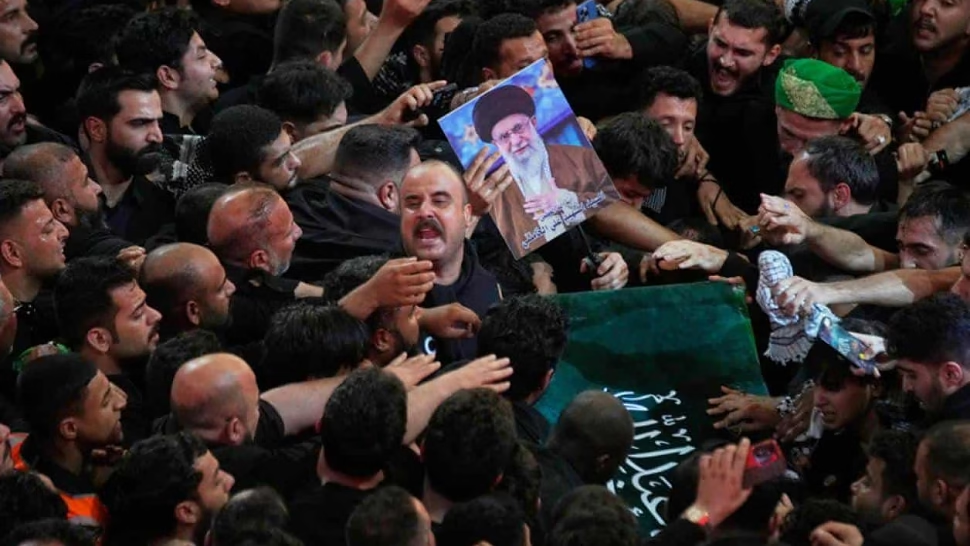
Russia and China push ceasefire at UN after attacks in Iran

A diplomatic initiative seeks to calm global tension amid growing regional conflicts.

A Call for Peace in the Middle of the Storm

In a world where geopolitical tensions seem to escalate unchecked, Russia, China and Pakistan have raised their voices with a bold and necessary proposal: an immediate and unconditional ceasefire. This historic movement, presented before the UN Security Council in New York, is not just a diplomatic gesture, it is a beacon of hope in the midst of uncertainty!

Diplomacy in Times of Crisis

The initiative arose during an emergency meeting called to analyze the recent attacks in Iran, where the secretary general of the United Nations warned about the risk of a military escalation. “Each warlike action deepens the cracks in an already fragile region,” he declared, underlining the urgency of seeking peaceful solutions. And that’s exactly what these three countries are doing!

RelatedRussia and China promote resolution to stop conflict in the Middle East

But here is the challenge: for this resolution to be approved, it needs the support of 9 of the 15 members of the Council, in addition to avoiding the veto of any of the five permanent powers. Can nations unite for a greater good? This is the time to demonstrate that international cooperation is not just an ideal, but an achievable reality!

Imagine the impact of this agreement: entire communities breathing a sigh of relief, resources dedicated to rebuilding instead of destroying, and a precedent for resolving conflicts without violence. That’s the world we can create together!

Your Voice Counts Too

Peace is not only the responsibility of governments; Each of us has the power to advocate for solutions through dialogue. Share this news to amplify the message: diplomacy and understanding are the way! What other initiatives do you think could strengthen global stability? Explore more content on international cooperation and be part of the change.

#GlobalPeace #DiplomacyNow – Because every step counts, let’s make this one giant!
PAHO alerts: health risks after earthquakes in Venezuela

PAHO warns about outbreaks and lack of water after earthquakes in Venezuela.

Immediate health risks

The Pan American Health Organization (PAHO) warned that the greatest risks after the June 24 earthquakes in Venezuela do not only come from injuries. Limited access to vaccines, disruption of routine medical services and deficiencies in the supply of clean water are the main threats.

“In the coming weeks, the greatest health risks could arise not only from injuries caused by earthquakes, but also from disruptions in health services, conditions of access to medical care, deficiencies in water and sanitation, and access to vaccination and routine medical care,” said Jarbas Barbosa, director of PAHO, in a video conference from Washington.

PAHO collaborates with the Venezuelan Ministry of Health to detect outbreaks in shelters. Barbosa explained that respiratory diseases, like the flu, spread quickly in small spaces. Conditions resulting from the consumption of non-potable water or spoiled food are also of concern.

Damage and needs

Armando Denegri, PAHO representative in Venezuela, reported that three hospitals suffered structural damage and were evacuated. Another 24 had damages that temporarily compromised their operation, although most of them have already been repaired.

“50% of La Guaira’s health professionals were directly affected. Some disappeared, some died, others were greatly affected by the crisis, impacting their families,” Denegri detailed, without specifying more.

PAHO estimates that $24 million is required to cover urgent health needs until the end of the year. According to Barbosa, this amount will allow maintaining services, supporting rehabilitation and restoring facilities.

The magnitude 7.2 and 7.5 earthquakes occurred 39 seconds apart along the northern coastal mountain range of Venezuela, the United States Geological Survey reported. They were the strongest in the country in more than a century.

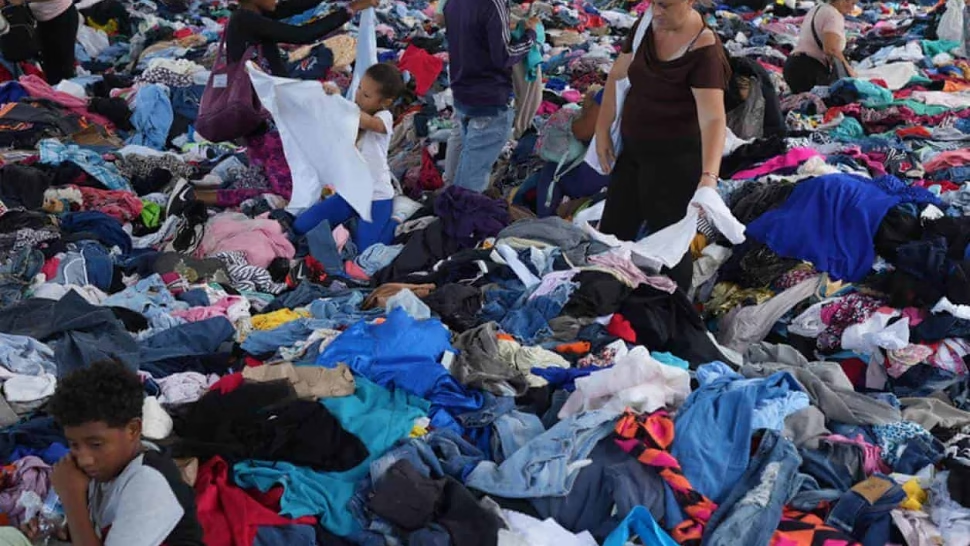
Venezuelan authorities reported 3,811 deaths and 16,740 injuries in Caracas, La Guaira and Miranda. Most of the deaths were concentrated in La Guaira, 20 kilometers north of Caracas. The government of interim President Delcy Rodríguez estimated that 18,000 people lost their homes and now live in schools, parks and public squares.

Continue reading

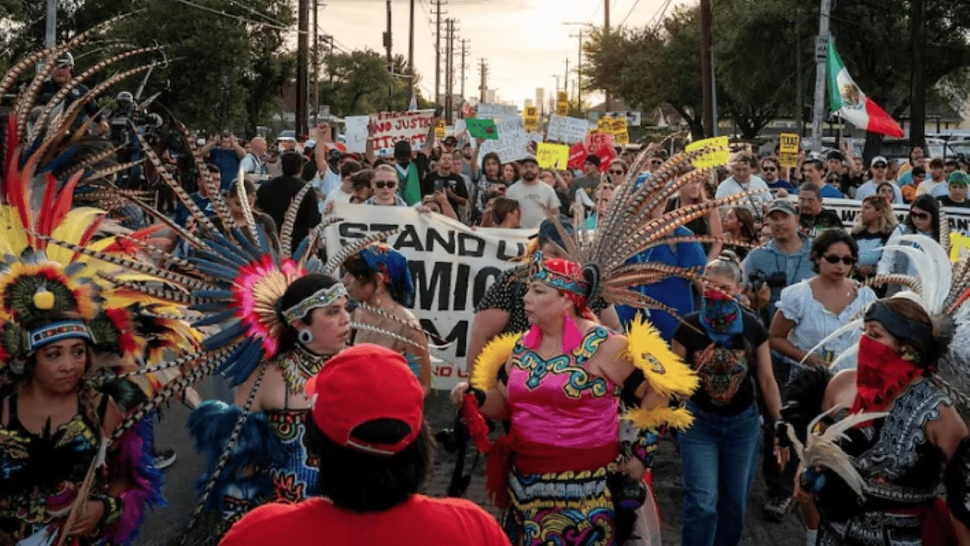
Death of Mexican in Houston sparks support campaign

Hispanic community in the US raises funds and demands investigation after the death of Lorenzo Salgado.

The case of Lorenzo Salgado Araujo

The death of Mexican Lorenzo Salgado Araujo, 52, on July 7 in Houston after being shot by an Immigration and Customs Enforcement (ICE) agent, has generated shock in the Hispanic community.

The League of United Latin American Citizens (LULAC) launched a GoFundMe campaign to support the family. As of this Thursday, 242,109 dollars (4.2 million pesos) had been raised out of a goal of 350,000. Among the donors, the activist Carlos Eduardo Espina stands out.

“Lorenzo was taken from those who loved him most. He was a husband, father of three children, owner of a small business and the soul of his family,” the campaign states.

The funds will go towards funeral and legal expenses and daily needs of the wife and children.

The Department of Homeland Security (DHS) states that Salgado attempted to flee and rammed his vehicle into an agent, who fired in self-defense. However, the family and activists demand an independent investigation. A video spread on social media shows ICE chasing the truck, not the attacking Mexican.

LULAC recalled the case of Renee Good, where a similar version was denied by videos.

Hundreds of people protested Wednesday in the Magnolia Park neighborhood. César Espinosa, from FIEL Houston, declared:

“This is the place where Lorenzo breathed his last. If they come for one of us, they come for all of us.”

Activist Conchita Reyes, on behalf of the family, said:

“My dad was shot and bled to death. He didn’t deserve to die. He deserved to come home to his wife.”

The organization demands that Lorenzo Salgado’s name be repeated and that the facts be clarified.

Continue reading

US and Iranian attacks threaten Middle East ceasefire

New US airstrikes on Iran and Iranian retaliation put the truce in the region at risk.

New attacks and reprisals

Early Thursday morning, the United States launched new airstrikes against Iran. In response, Tehran attacked Persian Gulf countries allied with Washington. The escalation puts at risk a provisional agreement that sought to end the war in the region.

Warning sirens sounded at least three times in Bahrain, headquarters of the US Fifth Fleet. Missiles also hit Kuwait and Qatar. Later, Jordan, where the US has troops and aircraft, also raised its alarms.

Iranian reaction and victims

An Iranian official accused Washington of attacking the area around the country’s only nuclear power plant. During the afternoon, more explosions were reported in other areas.

According to Iran’s Ministry of Health, the two days of bombing have left at least 14 dead and 78 injured. The majority belonged to the armed forces.

In Kuwait, one person was injured by debris when air defenses shot down three ballistic missiles, a cruise missile and 10 drones. Bahrain reported that it intercepted incoming fire, without further details. Jordan, through its spokesman Mohammad al-Momani, confirmed that all Iranian fire was intercepted.

Iranian state television reported that the Revolutionary Guard fired missiles at a US base in Jordan. So far there are no reports of damage in Qatar.

The actions come hours after President Donald Trump warned that Iranian attacks on ships in the Strait of Hormuz meant the end of the fragile ceasefire. He threatened to escalate the conflict if the attacks did not stop. The international community fears that the region will once again fall into a multiple war, which could block energy shipments through the strait, vital for the global economy.

Continue reading