Russia and China support Venezuela in the face of US pressure

Moscow and Beijing support Caracas in the face of American pressure, in a call that reveals new global alliances.

A Triangle of Power in the Caribbean that Nobody Saw Coming

It seems that the season of geopolitical alliances is hotter than a trend on TikTok. This Monday, Venezuelan Foreign Minister Yvan Gil emerged from his call with his Russian counterpart, Sergei Lavrov, probably feeling as if he had earned the support of the most powerful influencers in the United States’ backyard. It turns out that the government of President Nicolás Maduro is not playing alone; It has the full backing of two heavyweights: Russia and China. All this while feeling the heat of military and economic pressure from the United States. Basically, it’s the ultimate neighborhood drama, but with missiles and economic sanctions.

Direct Message Backup (Not by DM, but by Telegram)

Where are these 21st century alliances announced? Not in a treaty with wax seals, but in Telegram, the trendy app for official communications and memes. Gil shared that Lavrov not only sent greetings, but also “firmly expressed Russia’s solidarity with the Venezuelan people” and reiterated his full support against the hostilities. Translation: Russia has Caracas’s back, which in today’s geopolitical parlance is the equivalent of “I support you” in a complicated Facebook post.

RelatedThe United States carries out a military operation and captures Maduro in Venezuela

But it wasn’t just talk. The Venezuelan foreign minister explained that Moscow promised cooperation and total support against the famous blockade, also supporting all Venezuelan moves in the United Nations Security Council. That is, they are not only allies in networks, but also in the general assembly.

And Don’t Forget the Asian Giant

As if a superpower wasn’t enough, Gil also released a public thank you to the People’s Republic of China. On behalf of Maduro, he thanked Beijing for its “firm defense of international law” and for rejecting what they call “unilateral hegemonic practices” of the US. Basically, China is that friend that defends you in the group discussion and then helps you with your homework, in this case, supporting the “right to freely develop” Venezuelan trade. A complete combo of political and economic support.

From Moscow, the narrative was similar but with an extra touch of apocalyptic warning. The Russian Foreign Ministry reported that both ministers expressed “deep concern” about Washington’s measures in the Caribbean, which – attention – “could have far-reaching consequences for the region and represent a threat to international maritime traffic.” That is, it is not just a local problem; It is a potential blockage on the global maritime highway. A logistical chaos that no one asked for.

This movement is one more chapter in the reconfiguration of the global board. While the United States tightens its grip, Venezuela seeks and finds oxygen in the alliance with Moscow and Beijing, two actors more than happy to extend their influence in an area of ​​traditional American interest. It is a realpolitik play with a Caribbean flavor, where support is measured in public statements, strategic cooperation and, above all, in the ability to challenge the hegemon. The result is a Venezuela that, despite a deep internal crisis, remains a crucial pawn – or an actor – in the great game between powers. The question that remains floating, more viral than a reel, is how Washington will respond to this explicit support and what new pieces will move in this complicated Caribbean chess.

Are you surprised by this alliance between Venezuela, Russia and China? Share this note on your social networks and explore more content about the new axes of global power.
IMF and Venezuela: call for emergency funds after earthquakes

IMF confirms call with Venezuela to release $350 million in humanitarian aid after earthquakes.

Key call between Georgieva and Rodríguez

The International Monetary Fund (IMF) confirmed this Thursday that its managing director, Kristalina Georgieva, spoke by phone with the interim president of Venezuela, Delcy Rodríguez. The central issue was access to the country’s reserve tranche in the organization, an immediate liquidity mechanism valued at approximately $350 million, intended to cover urgent humanitarian needs.

IMF spokesperson Julie Kozack explained that both officials analyzed the economic impact and humanitarian needs caused by the twin earthquakes of June 24. So far, the earthquakes have caused more than 3,800 deaths, nearly 17,000 injuries and have left almost 18,000 people homeless in the north of the country.

“It is an important and easily available source of liquidity that can be mobilized quickly to help meet urgent humanitarian needs arising from the disaster,” Kozack explained.

Available resources and political context

This reserve tranche is independent of the Special Drawing Rights (SDR) retained by the IMF, which amount to about $4.5 billion. In total, Venezuela’s assets in the organization add up to nearly $5 billion. The IMF indicated that it has worked with counterparts to facilitate access to the country’s own resources.

The conversation occurs as emergency response efforts and damage assessment continue in several regions. Days before the earthquakes, Venezuela fully reestablished its membership in the IMF, after years of distancing during the governments of Hugo Chávez and Nicolás Maduro. This approach occurs in the new political context after the capture of Maduro by US forces on January 3.

Continue reading

PAHO alerts: health risks after earthquakes in Venezuela

PAHO warns about outbreaks and lack of water after earthquakes in Venezuela.

Immediate health risks

The Pan American Health Organization (PAHO) warned that the greatest risks after the June 24 earthquakes in Venezuela do not only come from injuries. Limited access to vaccines, disruption of routine medical services and deficiencies in the supply of clean water are the main threats.

“In the coming weeks, the greatest health risks could arise not only from injuries caused by earthquakes, but also from disruptions in health services, conditions of access to medical care, deficiencies in water and sanitation, and access to vaccination and routine medical care,” said Jarbas Barbosa, director of PAHO, in a video conference from Washington.

PAHO collaborates with the Venezuelan Ministry of Health to detect outbreaks in shelters. Barbosa explained that respiratory diseases, like the flu, spread quickly in small spaces. Conditions resulting from the consumption of non-potable water or spoiled food are also of concern.

Damage and needs

Armando Denegri, PAHO representative in Venezuela, reported that three hospitals suffered structural damage and were evacuated. Another 24 had damages that temporarily compromised their operation, although most of them have already been repaired.

“50% of La Guaira’s health professionals were directly affected. Some disappeared, some died, others were greatly affected by the crisis, impacting their families,” Denegri detailed, without specifying more.

PAHO estimates that $24 million is required to cover urgent health needs until the end of the year. According to Barbosa, this amount will allow maintaining services, supporting rehabilitation and restoring facilities.

The magnitude 7.2 and 7.5 earthquakes occurred 39 seconds apart along the northern coastal mountain range of Venezuela, the United States Geological Survey reported. They were the strongest in the country in more than a century.

Venezuelan authorities reported 3,811 deaths and 16,740 injuries in Caracas, La Guaira and Miranda. Most of the deaths were concentrated in La Guaira, 20 kilometers north of Caracas. The government of interim President Delcy Rodríguez estimated that 18,000 people lost their homes and now live in schools, parks and public squares.

Continue reading

Death of Mexican in Houston sparks support campaign

Hispanic community in the US raises funds and demands investigation after the death of Lorenzo Salgado.

The case of Lorenzo Salgado Araujo

The death of Mexican Lorenzo Salgado Araujo, 52, on July 7 in Houston after being shot by an Immigration and Customs Enforcement (ICE) agent, has generated shock in the Hispanic community.

The League of United Latin American Citizens (LULAC) launched a GoFundMe campaign to support the family. As of this Thursday, 242,109 dollars (4.2 million pesos) had been raised out of a goal of 350,000. Among the donors, the activist Carlos Eduardo Espina stands out.

“Lorenzo was taken from those who loved him most. He was a husband, father of three children, owner of a small business and the soul of his family,” the campaign states.

The funds will go towards funeral and legal expenses and daily needs of the wife and children.

The Department of Homeland Security (DHS) states that Salgado attempted to flee and rammed his vehicle into an agent, who fired in self-defense. However, the family and activists demand an independent investigation. A video spread on social media shows ICE chasing the truck, not the attacking Mexican.

LULAC recalled the case of Renee Good, where a similar version was denied by videos.

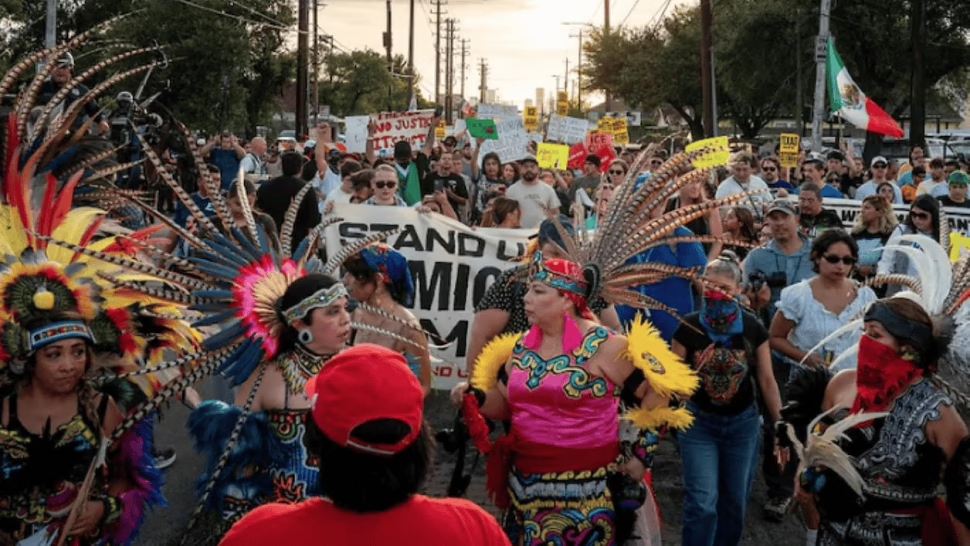
Hundreds of people protested Wednesday in the Magnolia Park neighborhood. César Espinosa, from FIEL Houston, declared:

“This is the place where Lorenzo breathed his last. If they come for one of us, they come for all of us.”

Activist Conchita Reyes, on behalf of the family, said:

“My dad was shot and bled to death. He didn’t deserve to die. He deserved to come home to his wife.”

The organization demands that Lorenzo Salgado’s name be repeated and that the facts be clarified.

Continue reading