Trump’s peace initiative faces rejection from Moscow

Washington's peace initiative encounters a wall of preconditions from Moscow, deflating initial optimism and revealing the complexity of the conflict.

The diplomatic announcement and the geopolitical reality

The president of the United States, Donald Trump, began the week with a statement that resonated in international diplomatic circles: the affirmation of significant progress in his efforts to bring the positions of Moscow and kyiv closer together. His administration announced that it had begun preparations to facilitate direct talks between Russian President Vladimir Putin and his Ukrainian counterpart Volodymyr Zelenskyy. This movement was presented as a crucial step towards the long-awaited peace in a region devastated by a prolonged conflict.

However, the initial optimism quickly dissipated. In a period of just four days, the position of the main diplomatic body of the Russian Federation revealed the deep divergences that persist. Friday’s statements made it absolutely clear that Putin would not agree to a summit with Zelenskyy until the Ukrainian government agreed in advance to a series of key demands raised by Moscow. This precondition, which addresses the very core of the territorial and security disputes, constituted a conclusive setback for the White House strategy, which had been promoted as a diplomatic offensive decisive to stop a war that Trump had promised to resolve at the beginning of his term.

RelatedTrump and Putin meet to define the future of Ukraine

Washington’s strategic response and growing skepticism

Faced with this obstacle, President Trump indicated that he would evaluate his next actions within a period of fourteen days, conditioning them on the materialization or failure of the direct talks. Among the options considered, he mentioned the possibility of imposing new economic sanctions or trade tariffs against Russia, a recurring threat in his rhetoric that, to date, has not been translated into large-scale concrete measures. “We’re going to see if they have a meeting or not,” Trump told reporters in the Oval Office, projecting an attitude of vigilant expectation. “It will be interesting to watch. If they don’t have one, why didn’t they have a meeting? Because I told them to have one. But I’ll know what I’m going to do in two weeks.”

This announcement of a breakthrough came immediately after Trump concluded a round of consultations at the White House with Zelenskyy and several European leaders, complemented by a telephone communication with Putin. European leaders initially welcomed Trump’s tone during those meetings, especially after his vague promises to support future European security guarantees for Ukraine once hostilities end. That stance seemed to calm the anxiety generated in Europe after the Alaska summit, where Trump had seemed to lean toward Russia’s demand that Ukraine cede currently occupied territories.

Moscow’s inflexible stance and the dynamics of the conflict

However, uncertainty regarding the Kremlin’s true commitment to the peace efforts promoted by Washington has only intensified. Russian officials have openly objected to the fundamental pillars of the nascent proposals on the negotiating table. Russian Foreign Minister Sergey Lavrov was categorical in stating that Putin is willing to meet with Zelenskyy, but only to discuss the terms of a peace once the key issues have been resolved beforehand. This position, in practice, implies a prolonged negotiation process, given that the demands of both parties remain diametrically opposed. “There is no meeting planned,” Lavrov said in an interview. “Putin is willing to meet with Zelenskyy when the agenda is ready for a summit, and this agenda is not ready at all.”

The uncertainty injected by Moscow also extends to the crucial issue of security guarantees. As Ukraine and its allies in the West work on detailed proposals to deter future aggression, Lavrov declared that any security arrangement for Ukraine that is made without Moscow’s active participation would be useless. In parallel, Putin made a symbolic visit to Sarov, a city historically linked to Russia‘s nuclear weapons program, a not-so-subtle reminder of its status as a global nuclear power. “He has not moderated his position significantly,” said Nigel Gould-Davies, a researcher at the International Institute for Strategic Studies in London and former British ambassador to Belarus.

Continuous violence and warnings from Europe

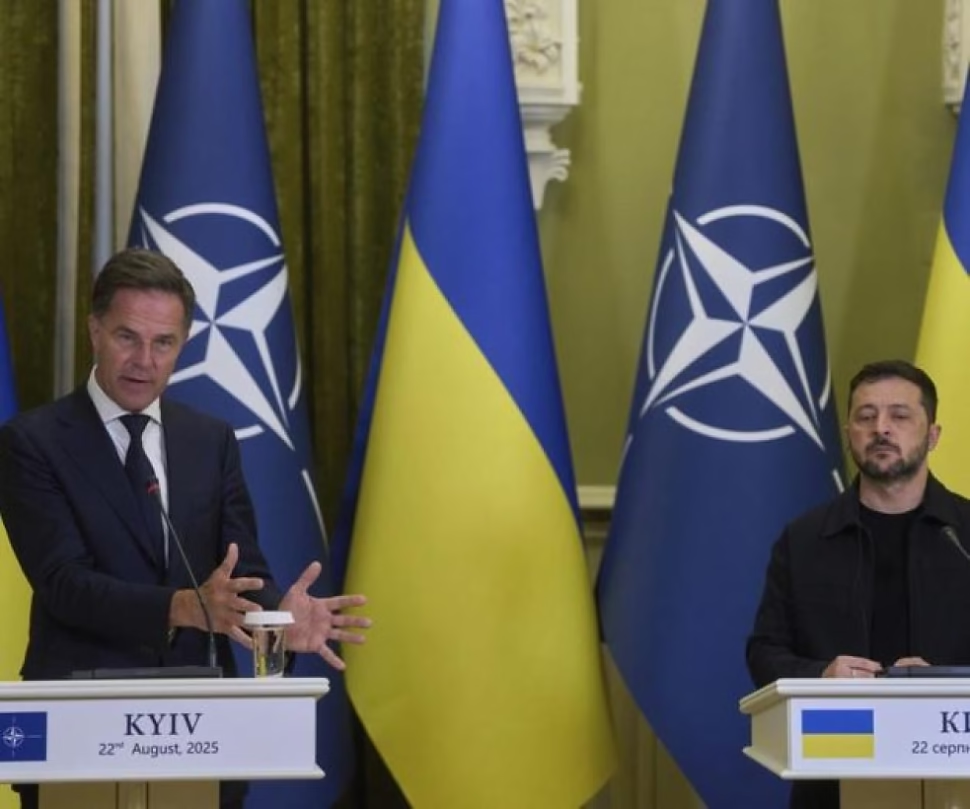
The contradiction between the rhetoric of peace and the reality of the conflict became evident when, at the same time that Trump was promoting his plan for talks, Russia launched one of its largest air assaults of the year, concentrating its attack on western Ukraine with a barrage of 574 drones and 40 ballistic and cruise missiles. “The Russians are trying to do anything to prevent the meeting (summit). The problem is not the meeting itself, the problem is that they do not want to end the war,” Zelenskyy said during NATO Secretary General Mark Rutte’s visit to kyiv.

Rutte, for his part, explained that Trump’s objective is to “break the stagnation” and involve the United States in a scheme of bilateral security guarantees for Ukraine, structured in two layers: the strengthening of the Ukrainian armed forces and direct security commitments from Europe and the United States. Not everyone shares this cautious optimism. The European Union’s foreign policy chief, Kaja Kallas, warned that the mere discussion of the possibility of Ukraine giving up territory as part of an agreement is “a trap” set by Putin. Granting concessions in exchange for stopping the invasion, he argued, would be equivalent to rewarding the aggressor who started the conflict. “The whole discussion revolves around what Ukraine should give up… but we forget that Russia has not made a single concession,” Kallas stressed in an interview with the BBC, concluding that “Russia is only buying time. It is clear that Russia does not want peace.”

Did you find this analysis of the complexities of international diplomacy useful?Share this article on your social networks to contribute to an informed conversation and explore more content related to global politics and international security on our platform.


Drug trafficking advances on Ashaninka lands in the Amazon

The Ashaninka community faces armed invasions while asking for state protection in Brazil.

The Ashaninka indigenous community, which recovered its territory on the Brazilian border with Peru three decades ago, now faces a growing threat. Gangs and drug trafficking groups invade their lands, using the Amazon rivers to move drugs. Leaders have reported violent episodes, including this month, and demand protection from the Brazilian government.

The invasion is part of the expansion of criminal routes in the Amazon, known as the Solimões River route. Experts point out that indigenous territories are key to stopping deforestation, but they also offer attractive hideouts for traffickers.

Blind spot in security

Jonatas Soares, mayor of Tabatinga and police officer, said:

“There is an institutional and intercultural blind spot in the public security services provided to indigenous peoples. The State formally recognizes their territories, but fails to translate that presence into continuous protection adapted to their specific needs.”

The Solimões route—from the border with Peru to Manaus—is largely controlled by the Red Command, according to retired colonel César Mello, an expert in Amazon security. Mello warns that indigenous communities are vulnerable due to their remote location, lack of supervision and cultural differences.

Resistance and complaints

The Ashaninka have refused to collaborate with traffickers. In the past, they rejected the construction of a clandestine landing strip. Francisco Piyãko, coordinator of the Organization of the Indigenous Peoples of the Juruá River, related:

“We have a long history of opposing any type of illegal activity.”

On July 6, a group of five armed men—Spanish speakers with machine guns—invaded Kampa territory, threatening families and searching for leaders. Piyãko filed a formal complaint and security forces were deployed. “They came looking for our leaders, with the intention of killing them,” he said.

Brazil’s Indigenous Peoples and Justice ministries did not respond to requests for comment. The Foreign Ministry reported that they will receive the Ashaninka leaders in Brasilia to evaluate joint actions with Peru.

In previous months, Judge Flávio Dino ordered the federal government to intensify work against organized crime in the Amazon. Piyãko stressed that confronting these groups is not the responsibility of the indigenous people, but of the State: “They allowed this to happen due to their absence, so they bear that responsibility.”

Continue reading

Ford and Geely join forces to produce ecological cars in Spain

Ford and Geely will manufacture low-emission vehicles in Valencia, Spain.

A strategic alliance

Ford and China’s Geely Auto announced an agreement to jointly manufacture low- or zero-emission vehicles at a Ford plant in Valencia, Spain. The alliance seeks to reactivate Ford’s offer in Europe and compete with Chinese manufacturers that dominate the global market.

If it receives regulatory approval, Ford will own two-thirds of the joint venture; Geely, also owner of Volvo and Polestar, will control the rest.

Planned vehicles

Both companies plan five models. Ford will continue production of the Kuga plug-in hybrid and will launch a new Bronco in 2028. Geely will build two electric trucks at the plant, the first also in 2028. In addition, they will develop a “multi-energy” crossover that will hit the market that same year.

“The joint venture addresses the new realities of the European market—intense global competition, relentless cost pressure and increasingly strict regulations,” said a statement from the two companies.

Context of the decision

Ford has lost ground in Europe: from selling more than a million vehicles a decade ago, last year it sold less than half a million. The Valencia plant has capacity for 500,000 cars annually, but its production fell below 100,000 in 2025.

The alliance reduces financial pressure by sharing costs. Ford and Geely already have history: Ford sold Volvo Cars to the Chinese company in 2010.

“This deal provides a roadmap for how traditional manufacturers can survive and thrive in Europe,” said Jessica Caldwell, director of analytics at Edmunds. “Ford gains scale and cost efficiencies; Geely a shortcut to avoid EU tariffs.”

Challenges in the US

Meanwhile, in the United States, Donald Trump’s administration has weakened fuel efficiency standards and eliminated tax credits for electric vehicles. This creates uncertainty, but also drives manufacturers like Ford to look for opportunities in Europe.

“Like GM, Ford has been reducing its dependence on Europe. Now, with Geely, it can have new products designed for that market without assuming the entire development cost,” said Sam Fiorani, vice president of AutoForecast Solutions.

Chinese automakers, with government subsidies, have gained ground in Asia, Latin America and parts of Europe. The alliance with Geely not only expands China’s presence in local European production, but also helps keep Ford workers on the assembly line.

Continue reading

Houthis attack Saudi oil tankers and crude oil exceeds $100

Houthi attacks on Saudi ships raise crude oil prices to $100 and strain the trade route.

Yemen’s Iran-backed Houthis attacked two Saudi oil tankers in the Red Sea. Brent surpassed $100 a barrel, its highest level since May. The conflict threatens to close a second key trade route, following Iran’s blockade of the Strait of Hormuz.

Military and economic escalation

The United States intensified its attacks against Iran for the twelfth consecutive night. President Donald Trump warned of “significant military punishment” if the Houthis persist. “If they do this again, the United States will hold Iran responsible,” he wrote on social media.

The price of Brent crude oil rose more than 6% on Thursday. Last week, the Houthis announced a blockade of Saudi-linked shipping through the Bab el-Mandeb Strait. 12% of world trade and a quarter of container traffic pass through this passage.

The rebels claimed to have hit the Encelia and Layla oil tankers, setting fires. No victims were reported. Lloyd’s List Intelligence said the attacks represent a “double blow” for Saudi oil shipments, which have already diverted millions of barrels via onshore pipeline.

UN Secretary General António Guterres warned that the region is being dragged into an increasingly widening circle of confrontation. “Diplomacy is the only way forward,” he told the Security Council.

Regional reactions

Iraqi Prime Minister Ali al-Zaidi traveled to Tehran to sue for peace and vowed not to allow his territory to be used against Iran. An Arab diplomat, on condition of anonymity, noted that the Gulf states are pessimistic about an exit.

Iran maintains its “tit for tat” policy in the face of US attacks. Secretary of State Marco Rubio responded that Trump’s policy is “head for an eye.” Meanwhile, the Iranian Ministry of Health reported 55 deaths and 629 injuries since US bombing resumed on June 27.

Jordan intercepted three missiles and six drones. Kuwait reported a drone attack on its border with Iraq, without casualties. The war remains unpopular among Americans, reflected in a symbolic vote in the House of Representatives to stop it.

Continue reading