Rita Cetina Scholarship Money Arrives in August

The cards for the Rita Cetina Scholarship have already been delivered. In August the money reaches thousands of students.

The curtain rises for the Rita Cetina Scholarship

They have already distributed the cards. Now comes the part that really changes lives in homes. Starting in August, the money will begin to arrive in the accounts of the beneficiary students.

It’s 2,500 pesos per head. Direct support, without intermediaries. For a family with two or three children in school, this is not a simple gesture. It is a monthly lifeline against school dropouts.

“This benefit seeks to contribute to school permanence and reduce dropouts,” said the authorities.

Here’s the trick, and it’s important: only those who already have their card and validated all their data between May and July will receive the payment. If you did not complete that process on time, you were left out of this role. The rules of the game were clear.

RelatedConfirm your Rita Cetina scholarship and transform your future

An incentive with a woman’s name

They named her Rita Cetina for a reason. She was a 19th century Yucatecan teacher and poet who fought for women’s education. This program carries its flag: keeping young people in the classrooms, especially when expenses on supplies, uniforms and transportation threaten to drive them out.

My wife, who is a teacher, sees this every day. Intelligent children who are missing because they don’t have the money for fare or shoes. These 2,500 pesos can be the difference between a completed semester or a truncated dream.

The authorities ask beneficiaries to keep their data updated and take care of that card like gold. It is your only ticket to receive the resource. And attention: any change or official notice will go out through its designated channels. Don’t fall for rumors.

In the end, more than a subsidy, this is a declaration of principles. A public commitment to believe that investing in a student today is building a citizen with more tools tomorrow. The money arrives in August, but the message that education matters should resonate all year long.


FDA recognizes false positive in Taylor Farms lettuce

Cofepris analysis rules out contamination; FDA admits error in initial sample.

Analysis results

The Ministry of Health reported that tests carried out on lettuce and water samples from the Taylor Farms Mexico plant were negative for the parasite Cyclospora cayetanensis —which causes severe diarrhea— and also for fecal coliforms. The analyses, carried out by Cofepris, confirmed that the product complies with the physicochemical parameters established in national standards.

Traceability and false positive

Taylor Farms has a traceability system that allowed United States authorities to identify the origin of the product and track a batch held at customs in Laredo, Texas. That batch never entered US territory.

The sample obtained from that batch returned a false positive, a situation that the United States Food and Drug Administration (FDA) recognized in an update published on July 19. The Ministry of Health emphasized that the product is suitable for human consumption.

Continue reading

UIF identifies 55 people in the CJNG financial network

The FIU detected 55 people linked to a CJNG financial network, including 16 front companies.

The Financial Intelligence Unit (UIF) of Mexico detected 55 people allegedly linked to a financial network of the Jalisco New Generation Cartel (CJNG). The finding was achieved through specific financial indicators, as reported by the Ministry of Finance and Public Credit (SHCP).

Release 61 details that the Office of Foreign Assets Control (OFAC) of the United States Department of the Treasury designated 55 people – 39 individuals and 16 legal entities – related to this structure. The action is part of bilateral cooperation against the finances of organized crime.

Indicators detected

The FIU identified “indicators related to possible operations with resources of illicit origin.” Among them: cash operations, acquisition of high-end vehicles, jewelry and real estate, international transfers, intensive use of credit and service cards, and inconsistencies in income reported to the SAT.

The authorities detected “possible inconsistencies between the income reported to the tax authority and the resources observed in the financial system,” which strengthened the identification of the network.

Front companies and complaints

Of the total, 16 legal entities had illegal activities. According to the FIU, some registered relevant operations, while others were front companies with “limited or no apparent economic activity.”

The UIF filed a complaint with the Attorney General’s Office (FGR) for the crime of operations with resources of illicit origin. It also included the subjects designated by OFAC on the List of Blocked Persons (LPB), and added eight additional ones—four individuals and four legal entities—linked to the same financial structure.

International coordination

The Treasury stressed that the coordinated actions with the United States seek to “prevent improper use of the financial system, combat money laundering and weaken the economic structures of organized crime.” The FIU maintains cooperation with national and international authorities, in accordance with the standards of the Financial Action Task Force (FATF).

Continue reading

US Treasury locates Florence as a drug production center

The Treasury Department identified the Zacatecas municipality as the CJNG base for fentanyl and cocaine.

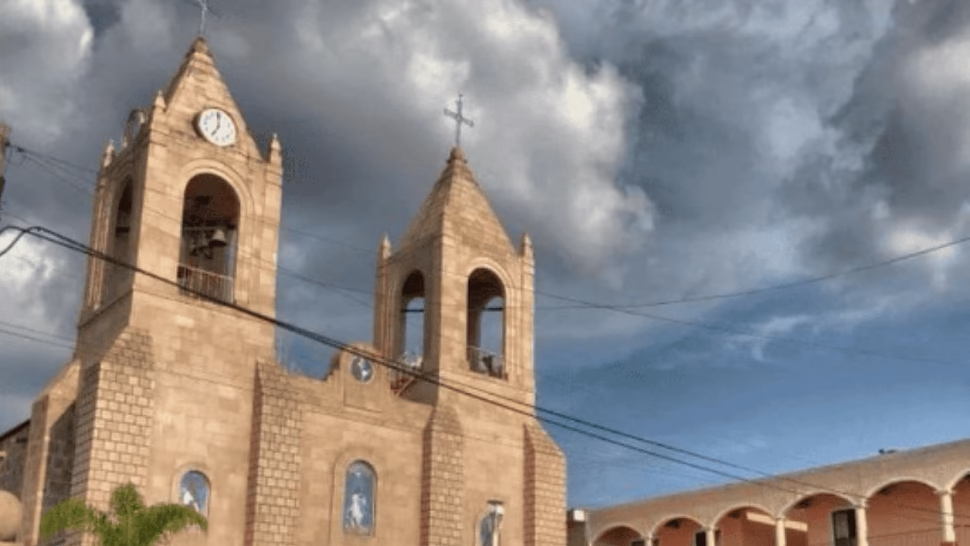
The United States Department of the Treasury identified Florencia de Benito Juárez, Zacatecas, as one of the key points of the Jalisco New Generation Cartel (CJNG) to manufacture fentanyl, cocaine and methamphetamine.

According to the agency, José Octaviano García Martínez is the current head of the plaza in the area, accompanied by Cuauhtémoc Rivera Zepeda and Uriel Hernández Morales. These last two would be in charge of the clandestine laboratories in Zacatecas and Jalisco. All three report to Audias Flores Silva—alias El Jardinero—, designated as successor to the late leader Nemesio Oseguera Cervantes, El Mencho.

Criminal presence in a small municipality

Florencia de Benito Juárez barely covers 328 square kilometers in the south of the state, in the Sierra Madre Occidental, adjacent to Jalisco. Despite its size, the municipality has been the scene of organized crime operations.

In March 2025, authorities dismantled a camp used by a criminal cell. Months later, in June, they destroyed a greenhouse used for growing marijuana. Both operations sought to neutralize illegal infrastructure.

The municipal president elected in 2024 is Fortino Cortés Ramírez, who will conclude his term in 2027.

Recent violence and federal response

On Saturday, July 18, 2025, 10 bodies were found in the municipalities of Morelos, Pánuco and Sain Alto. Of the victims, six were construction, mining and entertainment businessmen. Two others were officials of the Fresnillo city council: Fidel Alvarado de la Torre, secretary of Municipal Social Development, and firefighter Jesús Gerardo Muñetón Hernández.

Given these events, the Secretariat of National Defense deployed 100 Special Forces elements on July 22. They joined the 400 Army and National Guard troops who had already been operating since July 19. They carry out ground reconnaissance and deterrent actions in Zacatecas, Guadalupe and Fresnillo.

The conflict in the region is not new. On May 20, 2011, a clash between rival groups—known as The Florence War—left 77 people dead. The journalist Alfredo Valadez Rodríguez documented this episode in the book of the same name, published by Ediciones Proceso in 2021.

Continue reading