‘Vote per household’ proposal reignites tradwife controversy

The tradwife lifestyle returns to the discussion after a proposal that questions the individual vote.

The resurgence of the tradwife debate

The tradwife concept became a trend again on social networks after a proposal presented at a conservative event in the United States fueled the debate about gender roles and the traditional family model. What started as a lifestyle trend is now intertwined with a political and ideological discussion.

The term, short for traditional wife, gained notoriety after Erika Kirk’s statements during the Women’s Leadership Summit, organized by Turning Point USA. At the meeting, Kirk presented the proposal called “vote per household”, which proposes that the vote be exercised by the family unit instead of each member individually.

RelatedThe paradox of free speech in the Trump era

The initiative provoked immediate reactions. Some participants supported the idea of ​​replacing individual voting with a system of family representation. Among those who expressed support is content creator Savanna Faith Stone, identified with the tradwife movement.

The rise of tradwife content on TikTok has led thousands of users to discover this lifestyle through cooking, cleaning, motherhood, and home organization videos. However, interest stopped focusing only on aesthetics when recent statements prompted a broader debate.

For some users, the conversation no longer revolves only around a way of living marriage, but rather the ideas that may accompany certain discourses about family, religion, and traditional roles. The controversy also relates to the economic consequences: depending exclusively on the couple’s income can increase financial vulnerability in cases of divorce, loss of the main breadwinner or family violence.


OpenAI launches its first mechanical keyboard for programmers

Codex Micro allows you to manage AI agents from a physical device.

Codex Micro: the control center for AI agents

After months of speculation, OpenAI unveiled its first hardware device. This is the Codex Micro, a mechanical keyboard designed for programmers who work with the company’s artificial intelligence agent platform.

The device is the result of a collaboration with Work Louder. Includes color-coded keys: blue (processing instructions), orange (requires approval), red (error), and green (unread conversation). It also features customizable command keys, a joystick for navigating workflows, and a knob for adjusting time and computing power.

According to OpenAI, this keyboard is “your control center for autonomous work with agents.” It allows you to monitor agent activity in real time without having to look at your computer or mobile phone.

Availability and price

The Codex Micro is available from July 15. It is a limited edition, aimed exclusively at programmers. Its price is $230 and it is sold on the official OpenAI website.

Bloomberg reported that OpenAI is preparing five more AI devices for the general public. This release marks its foray into hardware.

Continue reading

Pets: emotional regulators with scientific support

Science confirms that dogs and cats reduce stress and strengthen mood.

Living with domestic animals has become a relevant factor for emotional regulation and neurological care. This is stated by Universum, the UNAM Science Museum, which describes dogs and cats as “an emotional regulator with legs.”

This effect is not just a perception. Physical contact and animal company trigger biological responses that reduce mental tension and improve mood. Hugging, caressing or simply observing your pet activates metabolic processes that help you cope with daily stress.

Documented benefits

Research indexed in SciELO and reports from the journal Advanced Science detail the transformations that occur in the organism:

Interaction with pets reduces stress levels. The mind reacts in a similar way to when it receives human support.

Constant company reduces the feeling of loneliness and raises general mood.

Caring for an animal facilitates interpersonal relationships by serving as a social catalyst.

Daily experience fosters empathy and reinforces communication skills.

Simple actions such as talking to the pet, pampering it or maintaining eye contact generate a measurable impact on psychological balance.

Continue reading

Nopal fertilizer accelerates crop growth

UNAM cactus fertilizer increases biomass by 20% and accelerates crop maturation.

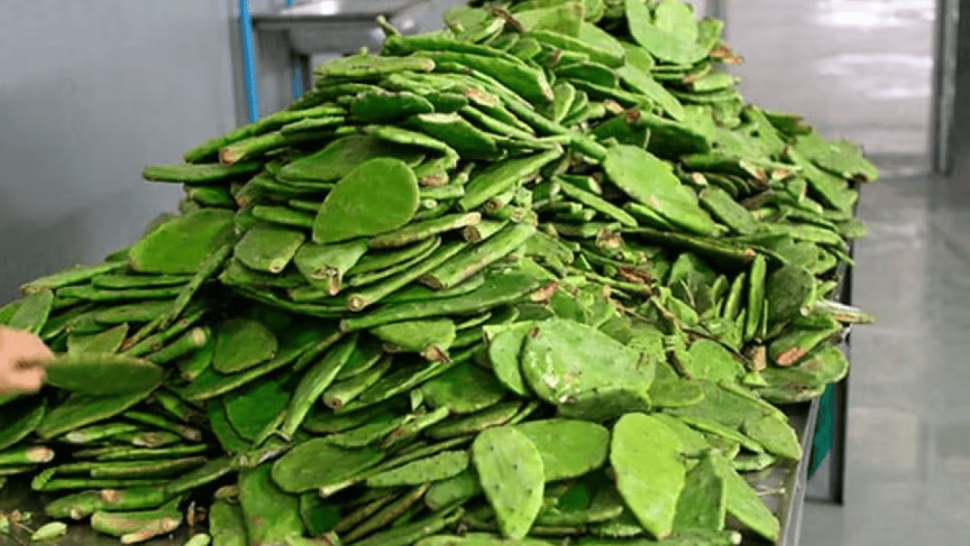
The cactus waste that is usually discarded could be transformed into a tool for sustainable agriculture. UNAM researchers developed an organic fertilizer from the thorns and edges of this cactus that increased the biomass of the crops by up to 20% and accelerated their growth.

Results in Milpa Alta

The project was led by Bruno Chávez Vergara, from the UNAM Institute of Geology. Nopal digestate, a byproduct of the anaerobic digestion of organic waste, was evaluated. The research, funded between 2018 and 2020 by the Ministry of Education, Science, Technology and Innovation of Mexico City, seeks to promote sustainable practices in volcanic soils in the south of the basin.

Between 15% and 20% of the nopal processed for consumption is discarded as thorns and edges. This material is used to generate biogas and electricity, but it also produces a liquid waste that works as organic fertilizer. The tests were carried out in agricultural areas of Milpa Alta, Xochimilco and Tláhuac, in collaboration with Sustainability in Energy and Environment (SUEMA).

Chávez Vergara explained that digestate provides mineral nutrients to plants and feeds beneficial bacteria and fungi in the soil, recovering biological functions affected by years of chemical fertilizers. Unlike synthetics, this product promotes the microbial activity necessary for soil fertility. Its liquid presentation allows better use of water and faster absorption of nutrients.

In forage oat crops in Milpa Alta, the results were immediate. Since the first agricultural cycle, a 20% increase in biomass and a reduction of up to one month in maturation time was recorded. The researcher pointed out that these benefits would be especially useful for hillside and rainfed farmers, where lack of irrigation and erosion make production difficult.

Following the results, the UNAM team plans to expand the tests to corn and carrots, in addition to determining the minimum dose necessary to make the use of this fertilizer based on cactus residue profitable.

Continue reading