Journalists declare fake news pandemic in congress

Experts analyze how lies go viral and challenge the press not to fall into the dunghill of digital misinformation.

The Truth, that Uncomfortable Visitor in the Age of Digital Manure

It seems that the fake news pandemic is the only one that has not managed to find an effective vaccine, and journalists, gathered at the 10th International Congress of the Spanish Language, have come to the fore to declare a state of emergency. At the table entitled with the subtle elegance of “Falsified news. The power of lies”, our heroes of the key agreed that we live in a world where a hoax turns around more than a coin in a washing machine. The director of the Cervantes Institute, Luis García Montero, with the solemnity of a poet who has seen too much, stated that we must flee from dogmas. What a revelation, right now, when dogmas are the highlight of the digital menu.

At the Mario Vargas Llosa Library, García Montero, who must feel like a philologist in a bar fight, assured that ideologies have the goal of convincing and creating a reality. Come on, it’s not about informing, but about building a reality show tailored to you. And in this great spectacle, the substitution of reality for virtuality grows on something that, apparently, still matters for journalism: the need to inhabit truthful information. Because, of course, reporting is not the same as communicating. It’s one thing to give data and another to drop a WhatsApp message with seventeen screaming emojis.

RelatedAttack on Gaza hospital kills five journalists amid conflict

Journalism in the Dungheap: A Survival Guide

And here comes the jewel in the crown, the phrase that should be engraved at the entrance of all newsrooms: “If one works in a dunghill or produces manure or is out of the game.” What an elegant way to describe the current crossroads. The dilemma is existential: are you part of the problem, are you the problem, or have you been marginalized for refusing to be? García Montero painted a bleak picture, but with a touch of hope: between social networks and the media in the hands of millionaires who want to communicate in favor of their own interests, journalists have it very complicated. Wow, who would have thought, that tycoons with their own agendas could be an obstacle to impartial journalism.

He stated that it is very difficult to defend informative decency in areas that little by little become hoaxes designed to discredit and turn into enemies. In other words, the battlefield is no longer the street, but the timeline of your favorite social network, where your uncle-in-law shares conspiracy theories before breakfast. We must accompany journalists in their efforts to maintain decency, he asked, and for the journalists themselves to refuse to fall into the rubble. His call was a song not to throw in the towel, because in times of uncertainty, accepting injustice is the easy way out. Throwing in the towel, according to him, invites pessimism and complicity with the rush that makes tomorrow the atrocity said today be forgotten. A rush that is the perfect accomplice to lying.

For her part, RTVE journalist, Pepa Bueno, contributed her dose of reality with a touch of nostalgia: lies have always existed, but now they have superpowers. The ability to be shared globally has turned it into a misinformation virus that spreads faster than a kitten meme. He noted that the year 2016 was a global turning point, with Brexit, the Colombian referendum and the election of Donald Trump. Three events that, together, seem like the trailer for a dystopia that no one asked for. But, in a turn that almost seems like divine intervention, he called on the media and journalists to take three actions: professional, editorial and financial transparency. Because, after all, what can go wrong when you open the books in an industry that sometimes feels like a secret club?

Juan Aurelio Arévalo Miró-Quesada, director of “El Comercio” in Peru, made the sharpest observation of the afternoon: today we have more people interested not in being informed but in being affirmed. They want the media to tell them that what they believe is true. Good journalism, on the other hand, tells you the truth, even if you don’t like it. And that, dear friends, is generating a monumental short circuit. People who consume information based on algorithms that reinforce their prejudices, and media that insist on telling what is happening, even if it hurts. People, faced with such dissonance, choose to delete the account or contact. And that, according to Arévalo, is lethal in a democracy. Because, of course, why do we want critical citizens if we can have armies of blind followers?

In short, this congress has been a reminder that the fight against disinformation is the new cold war of the 21st century, fought with keyboards and screens instead of missiles. Journalists, those beings who were once seen as beacons of truth, now navigate an ocean of digital dung, trying not to get too dirty. Meanwhile, hoaxes are rampant, and informative decency has become a luxury good. But, as García Montero said, we should not throw in the towel. Although, thinking about it, perhaps what we need is not a towel, but a hazmat suit to enter the sewers of social networks.

Ready to join the resistance? Share this analysis on your social networks and help spread a little lucidity in this sea of ​​confusion. And if you want to continue exploring more content on how to navigate this world of alternative realities, don’t hesitate to dive into our other articles. The truth may be uncomfortable, but it is always better than living in a dunghill.

IMF cuts global growth estimate due to Iran conflict

The IMF reduces its global forecast to 3% in 2026 due to the conflict in Iran, although AI partially compensates.

The International Monetary Fund adjusted downwards its projections for the world economy, affected by the energy shock derived from the conflict with Iran. However, the rise of investment in artificial intelligence and other technologies partially offsets the impact.

The organization expects the global economy to grow just 3% in 2026, compared to 3.5% the previous year and the 3.1% estimated in April. By 2027, the IMF expects a rebound to 3.4%.

Effects of the conflict in Iran

After the military actions of the United States and Israel against Iran on February 28, Tehran interrupted transit through the Strait of Hormuz, through which a fifth of the world’s crude oil and natural gas circulates. Energy prices skyrocketed, putting pressure on companies and consumers. The IMF now expects oil to rise almost 32% this year and global inflation to reach 4.7% in 2026, up from 4.1% in 2025, halting two years of anti-inflationary progress.

These forecasts assume that the strait will reopen this month and that trade will normalize by March, although the White House declared on Wednesday that the ceasefire with Iran was over.

Regional overview

“The global economy has weathered the shock better than feared,” said Petya Koeva Brooks, deputy director of the IMF’s research department. The damage was limited because countries used oil reserves and exporters outside the Persian Gulf increased production.

The United States, which produces its own energy and benefits from investment in AI, will grow 2.3% this year, up from 2.1% in 2025. Trump’s tax cuts, productivity improvements and a strong stock market sustain its economy. In contrast, the eurozone — hit by high energy prices — will grow just 0.9%, compared to 1.4% in 2025.

China will expand 4.6% this year, less than the previous 5%, but driven by public works, high-tech manufacturing and exports, despite the real estate collapse. India will continue to be the fastest growing large economy, at 6.4%, supported by strong consumption.

The IMF, a credit organization for 191 countries, seeks to promote growth and global financial stability.

Continue reading

Former captain convicted for sinking the ARA San Juan

Federal court imposed three years of suspended prison on Claudio Villamide for the 2017 tragedy.

Condemnation for the sinking of the ARA San Juan

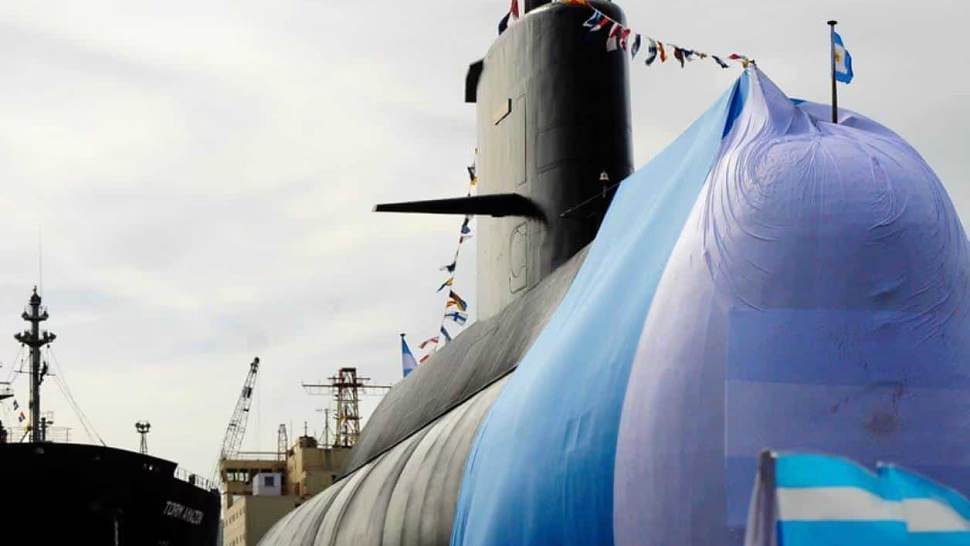
A federal court sentenced Claudio Villamide, former ship captain and former commander of the Argentine Submarine Force, to three years of suspended prison. The sentence, issued on Tuesday in Santa Cruz, found him responsible for breach of duties as a public official and negligent damage aggravated by the disappearance of the submarine ARA San Juan in 2017, which caused the death of its 44 crew members.

Villamide stated before the verdict:

“I am innocent. To this day I do not clearly understand why they have accused me of the sinking of the submarine.”

The judges imposed rules of conduct for three years: establish address and telephone number, notify changes, not commit new crimes and submit to criminal control. The ex-marine will not go to prison.

Acquitted and appeal

The court unanimously acquitted Luis Enrique López Mazzeo, Héctor Alonso and Hugo Correa, three other accused officers. Luis Tagliapietra, father of a deceased crew member and representative of the plaintiffs, announced that they will appeal the sentence.

“The sentences imposed are far from what we had requested,” he told The Associated Press. Tagliapietra had requested between seven and eight years in prison for the four sailors.

Chronology of the tragedy

The ARA San Juan disappeared on November 15, 2017 in the South Atlantic, while returning from Ushuaia to Mar del Plata. That day he reported a fault due to water entering the batteries, but he claimed to have solved it. Hours later an explosion occurred.

The judicial investigation determined that the German-made submarine had operational deficiencies reported to Villamide before setting sail on October 25. The water entered through the ventilation system, causing a short circuit and an uncontrolled descent. After exceeding 600 meters of depth, the hull imploded.

A year later, the company Ocean Infinity found the remains 600 km east of Comodoro Rivadavia, in the province of Chubut.

Continue reading

The informant who exposed the Jensens for fuel smuggling

An informant with a criminal history testifies again against oil magnate James Jensen in the Pemex robbery case.

An old acquaintance returns to court

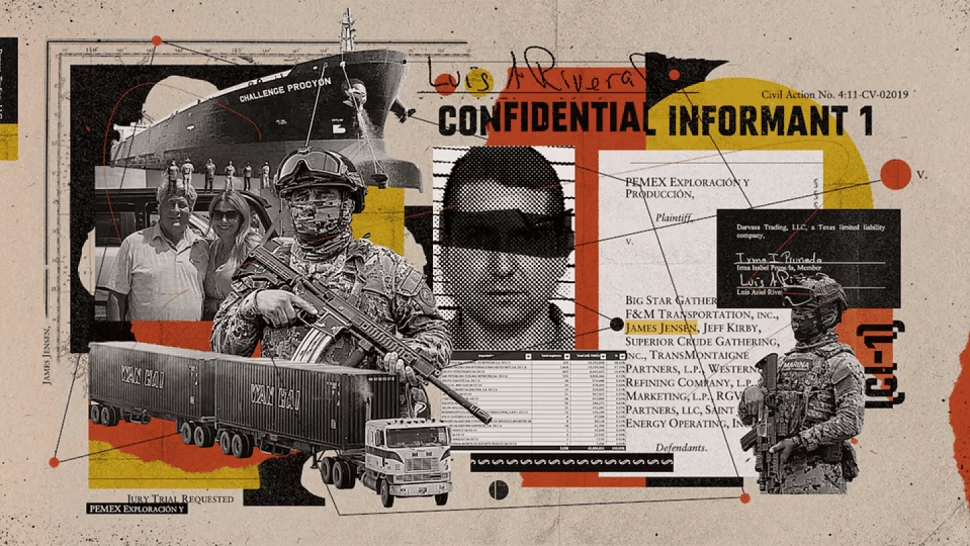
The United States Attorney’s Office bases much of its accusation against oil magnate James Jensen and his family on the testimony of a confidential informant who had already collaborated with justice more than a decade ago. This is Luis Ariel Rivera Rodríguez, a 53-year-old naturalized Mexican-American, owner of the company Luxemborg Trading LLC.

Rivera, identified as CI-1 in court documents, met secretly with prosecutors and agents from the FBI, DEA and Homeland Security in Texas since mid-2024. He recounted how the Jalisco New Generation Cartel (CJNG) participated in the theft of oil from Pemex and its smuggling into the United States.

300 million dollar business

According to the indictment, between 2018 and 2025, around 4,000 shipments of crude oil worth $300 million were trafficked. The fuel was brought into the US disguised as “petroleum distillate” or “used lubricating oil.”

Rivera stated that the CJNG controlled the roads in Mexico and collected extortions. He said he paid $2,000 per tank to operate. He also mentioned that he bribed federal, state and local officials, and that customs intermediaries falsified documents to export crude oil.

A history that repeats itself

Rivera is not new to this type of case. In 2008 he was arrested in an operation against the Gulf Cartel, which then controlled the theft of hydrocarbons in the Burgos Basin. Pemex reported losses of 300 million dollars. Rivera collaborated with the authorities and spent some years in prison until 2013.

At that time, James Jensen was already listed as a buyer of the stolen fuel, linked to companies such as Big Star Gathering LTD. However, Jensen avoided the accusations at the time.

The restaurant trap

In April 2025, Rivera arranged a meeting with James and Maxwell Jensen at a restaurant in Dallas. He had hidden microphones. He spoke about his relationship with the CJNG, mentioned leaders such as El Mencho (who died this year in a Mexican Army operation), El Tanque and Chuy 7, and recalled that President Trump had classified the cartel as a terrorist organization. That conversation supports the accusation that the Jensens knew they were dealing with organized crime.

The Jensens’ defense maintains that Rivera set a trap for them and that they were unaware of the illicit origin of the fuel. But the fact that both were involved in the same criminal plot twenty years ago complicates their version.

James Jensen, his wife Kelly Anne, and their children Maxwell and Zachary were arrested on April 23, 2025. They face charges of smuggling, money laundering, and financing a terrorist organization. The case is being litigated in the Southern District Court of Texas.

Continue reading