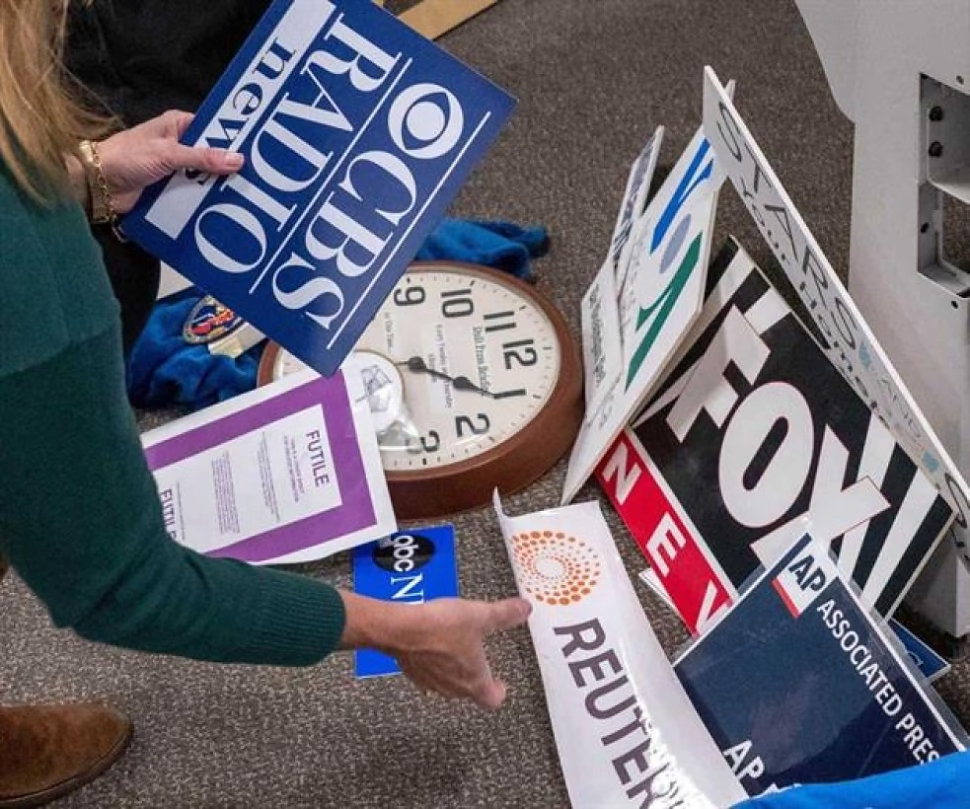
Journalists leave the Pentagon in defense of press freedom

A collective decision redefines the relationship between the media and military power. The coverage continues from the outside, with journalistic integrity as the flag.

A Historic Moment for Journalistic Integrity

Friends, sometimes life presents you with a crossroads where your character is defined not by what you accept, but by what you refuse to compromise on. Imagine the scene: a place that symbolizes the greatest military power in the world, the Pentagon. Now, visualize dozens of journalists, not being expelled, but leaving with their heads held high, choosing dignity over comfort. This is not a defeat; It is a powerful statement of principles. Last Wednesday, the press covering the United States armed forces made a collective decision that will resonate in history: turn in their access credentials and leave the building rather than submit to restrictions that stifle the true essence of journalism.

The federal government attempted to frame these new guidelines as “common sense” measures. But you know what? True common sense tells us that information is power, and that power must reside with the people. Almost unanimously, media organizations rejected the rules imposed by Defense Secretary Pete Hegseth. These rules, created by a former Fox News Channel anchor, left information professionals in a state of absolute vulnerability, and could be expelled for the simple act of trying to report any data, classified or not, that did not have the explicit approval of Hegseth himself for its disclosure. That’s not management, it’s covert censorship!

RelatedThe Pentagon in flames and the hidden battles of Trump’s second term

There was a profound beauty in the timing of his departure. Around 4 p.m., the deadline, an exodus of between 40 and 50 communicators filled the hallways. It was not a defeated group, but a united community. They carried boxes of documents, chairs, souvenirs from years of service. Reporter Nancy Youssef of The Atlantic, with a desk at the Pentagon since 2007, expressed a sentiment that perfectly captures the moment: “It’s sad, but I’m also really proud that the press corps stuck together.” As he carried a map of the Middle East to his car, he carried not just an object, but a symbol of his unwavering commitment to telling stories, no matter where.

The Response of Power and a Lesson in Courage

From the White House, former President Donald Trump openly supported these restrictions, stating that Hegseth considers the press “very disruptive to world peace” and calling it “very dishonest.” This is where we must pause and reflect. Attacking messengers is a tactic as old as it is ineffective in the long term. Transparency and accountability are not enemies of peace; They are the foundations of a healthy democracy. Even before these rules, the flow of information was already being stifled: few press conferences, restricted access and leak investigations. The environment was already challenging.

Hegseth insisted that signing the guidelines only meant that journalists “acknowledged” them, not that they agreed. What an incredible lesson this gives us! Sometimes the system will ask you to accept the unacceptable under the guise of procedure. Journalists saw this distinction for what it was: an attempt at control. Retired general Jack Keane, now an analyst on Fox News, said it with brutal clarity: “What they are really doing is wanting to spoon-feed the information to the journalist, and that would be their version. That is not journalism.” Their testimony is vital, as it comes from within the system itself. He himself recalled how new generals were taught to see reporters not as a threat but as an essential conduit to the American public. That vision seems to have been lost.

The Future: Coverage Continues Stronger

And here comes the most inspiring part of this whole situation: the show must go on. USNINews’ Heather Mongillo shared on social media her pride in having her photo on the correspondents’ wall, but also her determination: “Today, I will hand in my credential. Coverage will continue.” This is the spirit that changes the world. It’s not about the building you work in; It’s about the passion and ethics that you carry inside. These professionals are not going home; are moving their desks and redoubling their commitment to robust, independent coverage of military affairs.

The Pentagon Press Association, with its 101 members from 56 different media, stood firm. It is deeply significant that this rejection united the entire media spectrum, from traditional giants like The Associated Press and The New York Times to conservative voices like Fox and Newsmax. When ideological rivals come together for a common principle, it is because they are defending something fundamental. Some sources within the military may be intimidated, it is true, but the search for the truth will always find a way.

The immediate practical impact may be physical distance, but the message is clear: freedom of the press is non-negotiable. The truth cannot be imprisoned within four walls. This act of professional civil disobedience is a beacon of hope that reminds us that, in the face of adversity, our integrity is our most precious asset. The next big news story about the military may be reported from a coffee shop, a downtown office, or from home, but it will come to you with the same truthfulness and courage as always.

Are you inspired by this show of courage and unity?Share this story on your social networks and help spread a powerful message about the importance of defending free information.Explore more content related to transparency and citizen power on our site.


EE.UU. bombardea Irán y Teherán responde con ataques a países vecinos

Nuevos bombardeos de Washington en Irán desatan represalias contra bases de la coalición en la región.

Estados Unidos lanzó nuevos ataques aéreos contra objetivos en Irán, en una escalada que reaviva las tensiones en Oriente Medio. El presidente Donald Trump advirtió que podrían venir más acciones militares y acusó a Teherán de dilatar las negociaciones para un acuerdo.

“Pagará el precio”, señaló el mandatario estadounidense.

Respuesta iraní

RelatedTrump says he talks to Iran; Tehran denies it and tension persists

La reacción no se hizo esperar. Teherán ejecutó ataques contra objetivos en Baréin, Kuwait y Jordania, países que albergan bases estadounidenses. Según reportes oficiales, varios proyectiles fueron interceptados sin que se reportaran víctimas. Las autoridades jordanas confirmaron la neutralización de misiles dirigidos a instalaciones militares.

Detalles de la ofensiva

El Comando Central de Estados Unidos informó bombardeos contra sistemas de defensa aérea, radares y centros de control en territorio iraní. También se inutilizó un buque petrolero acusado de violar sanciones. Irán denunció daños en infraestructura civil y calificó las acciones como una violación a su soberanía.

Tensión diplomática

El canciller iraní, Abbas Araghchi, afirmó que su país se reserva el derecho a responder y reconsiderará su postura en las negociaciones. Mientras tanto, mediadores regionales como Qatar impulsan conversaciones para evitar una escalada mayor. Ambas partes aseguran buscar una salida negociada.

El conflicto se complica con las operaciones militares israelíes en la región. El primer ministro Benjamin Netanyahu mantiene una postura firme contra Irán y sus aliados, lo que, sumado a los recientes intercambios de ataques, eleva el riesgo de una expansión del conflicto.

Continue reading

Canadá propone ley para limitar cuentas de menores en redes

Canadá exige a plataformas demostrar seguridad para permitir cuentas de menores de 16 años.

Canadá presentó una ley que podría impedir que menores de 16 años tengan cuentas en redes sociales, a menos que las empresas demuestren que sus plataformas son seguras. La iniciativa se suma a un esfuerzo global por reforzar la protección infantil en el entorno digital.

Medidas clave y nuevo regulador

El gobierno creará la Comisión de Seguridad Digital de Canadá, un regulador que definirá los criterios para obtener exenciones. Marc Miller, ministro de Cultura, señaló que el proceso podría tardar hasta 18 meses.

“Estamos fallando a nuestros niños. Ya basta. Necesitamos protecciones básicas”, declaró Miller.

La ley abarca siete tipos de contenido dañino, entre ellos el que induce a autolesiones, incita a la violencia, fomenta el odio o difunde imágenes íntimas sin consentimiento. Las plataformas con contenido para adultos no podrán acogerse a exenciones.

RelatedDenmark will ban social networks for children under 15 years of age

También se regularán los chatbots de inteligencia artificial, que deberán implementar protocolos de intervención en crisis.

Impacto internacional y reacciones

Canadá sigue el camino de Australia, donde las empresas ya revocaron el acceso a unos 4.7 millones de cuentas identificadas como de menores desde que se prohibió su uso a los menores de 16 años. La medida australiana generó un intenso debate sobre privacidad, seguridad infantil y salud mental.

Otros países como Reino Unido, Francia, España, Dinamarca, Brasil, Indonesia y Corea del Sur estudian o desarrollan enfoques similares.

Lianna McDonald, directora del Centro Canadiense para la Protección Infantil, celebró la iniciativa y advirtió que la sextorsión en redes ha aumentado drásticamente. Un funcionario canadiense indicó que buscarán aprender de la experiencia australiana.

Continue reading

Exportaciones de autos chinos crecen 73% impulsadas por eléctricos

China exportó 809,000 autos en mayo; los eléctricos se duplican por el alto costo del combustible.

Las exportaciones de automóviles de pasajeros desde China alcanzaron en mayo cerca de 809,000 unidades, un incremento del 73% frente al mismo mes del año anterior, según datos de la Asociación China de Fabricantes de Automóviles (CAAM). En abril, la cifra había sido de aproximadamente 796,000 vehículos.

El encarecimiento de la gasolina y el diésel, provocado por el conflicto en Irán, aceleró el interés por los vehículos eléctricos. Las exportaciones de autos de nueva energía —eléctricos puros e híbridos enchufables— se duplicaron en mayo respecto a 2025, totalizando unas 435,000 unidades.

RelatedCanada asks to shield the T-MEC against Chinese electric cars

El auge de los eléctricos chinos

Fabricantes como BYD intensifican su expansión en América Latina, Asia y Europa, mientras la demanda interna cae. En mayo, las ventas locales de autos de pasajeros bajaron 23.4% interanual, a 1.44 millones de unidades —séptimo mes consecutivo de descenso. Los modelos de combustión interna cayeron casi 42%, cediendo terreno a los eléctricos.

Paul Gong, jefe de investigación automotriz de UBS, señaló:

“El alto precio del petróleo ciertamente se ha convertido en un mayor interés por los vehículos eléctricos”.

UBS proyecta que las exportaciones anuales de autos chinos crecerán 40% en 2026, y las de vehículos eléctricos podrían aumentar hasta 80%. Claire Yuan, analista de S&P Global Ratings, prevé un crecimiento sostenido de entre 30% y 50% en 2026.

La Agencia Internacional de la Energía reportó que uno de cada cuatro autos nuevos vendidos en el mundo en 2025 fue eléctrico, y prevé que en 2026 las ventas globales de eléctricos alcancen 23 millones de unidades, cerca del 30% del total. China es el mayor productor global de este segmento.

BYD, el mayor fabricante chino de eléctricos, vendió más de 160,000 unidades en el extranjero en mayo —80% más que un año antes. La empresa aspira a 1.5 millones de exportaciones en 2026, frente a 1.05 millones en 2025. Superó a Tesla en ventas globales de eléctricos el año pasado.

La guerra de precios en el mercado interno chino ha erosionado la rentabilidad, por lo que vender más en el exterior mejora márgenes. Yuan anticipa un repunte de ventas locales en el segundo semestre, impulsado por el lanzamiento de nuevos modelos.

Continue reading