Attack on Gaza hospital kills five journalists amid conflict

A devastating attack on a Gaza hospital silences the voices documenting the tragedy, in the deadliest conflict for the press in recent history.

The Forced Silence of the Witnesses

In a twist of fate as cruel as it is heartbreaking, the Gaza Strip was the scene of a tragedy that shakes the foundations of world journalism. It was not a simple incident; It was an explosion of horror that took the lives of five chroniclers of the truth, those brave people who, armed only with their cameras and their words, dared to narrate hell on earth. The epicenter of this catastrophe: the Nasser Hospital in Khan Yunis, a sanctuary turned into a target, a place that days before had witnessed the most moving stories of survival.

Photojournalist Mariam Dagga, 33, a tireless fighter whose lens captured the desperation of children fighting starvation, was among the victims. His work for The Associated Press and other media became a posthumous legacy, an indelible testimony to the harshness of an all-out war. The AP, heartbroken, expressed its shock and deep regret, highlighting the titanic efforts to keep its teams safe in conditions where death lurks around every corner.

RelatedIsrael bombs Gaza hospital, kills journalists

A Sequence of Horror and Devastation

Monday morning was dyed black with the roar of two missiles that hit the hospital in quick succession. Eyewitnesses describe a Dantesque scene: journalists and rescue teams were running towards the site of the first impact, moved by the instinct to document and help, when a colossal explosion on an exterior staircase enveloped them in a deadly embrace. That corner, a usual spot for communicators, became a lethal trap. The final toll, according to Zaher al-Waheidi of the Gaza Health Ministry, amounted to twenty souls lost, a bloody price for being in the wrong place at the most dire time.

From Jerusalem, Israeli Prime Minister Benjamin Netanyahu referred to the event as a “tragic mishap“, a phrase that resonates with a chilling coldness in the face of the magnitude of the loss. He assured that Israel “values ​​the work of journalists” and that its Army carries out an exhaustive investigation. Meanwhile, Israeli military sources, cited by local media, justified the attack by alleging that it was aimed at a Hamas surveillance camera on the roof of the medical complex, a statement that adds more layers of controversy to this already tangled conflict.

The Bloodiest Conflict for the Press

The figures speak for themselves and scream a terrifying truth. According to the Committee to Protect Journalists (CPJ), this confrontation has claimed the lives of 189 communications professionals in Gaza in just 22 months. A figure that completely eclipses the 18 deaths recorded in the war between Russia and Ukraine, painting a bleak picture for press freedom. Thibaut Bruttin, general director of Reporters Without Borders, does not hesitate to describe this situation as the most severe setback ever seen in the safety of reporters, directly accusing the Israeli forces of trying to silence all independent voices that dare to tell the story from the ground.

Mariam Dagga’s life was a faithful reflection of the reality she covered. Displaced multiple times, struggling to find food for herself and her family, her existence was a perfect parallel to Gazan suffering. Their 13-year-old son was evacuated at the beginning of the fight, separating them in a farewell that now seems like an omen. His Facebook posts, brief and full of tragic poetry, revealed the weight of his reality. “When you see the earth covering the most precious thing you have, only then do you realize how trivial life is,” he wrote, in a message that today sounds like an epitaph.

Along with her, other colleagues fell: Mohammed Salama from Al Jazeera, the cameraman Hussam al-Masri linked to Reuters, the independent Moaz Abu Taha and Ahmad Abu Aziz, who collaborated with Middle East Eye. Each name, a truncated story; each life, an unfinished story. The Qatari network confirmed that, with this latest attack, ten journalists associated with its network have died in Gaza, a bloodletting that seems to have no end.

The international community cries out in unison. Reporters Without Borders has demanded an emergency meeting of the UN Security Council to examine Israel’s alleged failure to comply with resolutions protecting journalists in conflict zones. Meanwhile, the Foreign Press Association launched a desperate appeal: “Too many journalists in Gaza have been killed by Israel without justification. This must be a decisive moment. We call on international leaders: Do everything possible to protect our colleagues. We cannot do it ourselves.”

In a cruel contradiction, Israel keeps entry to international media prohibited, forcing the world to depend on brave local journalists, those who are now being wiped off the map one by one. Accusations of links with armed groups rain down on these professionals, staining their work with suspicions that organizations like the AP have not been able to verify and that those affected vehemently deny.

The world watches, horrified, as this drama unfolds in which truth is the first casualty. Each explosion not only destroys buildings; It silences stories, extinguishes glances and buries the hope that the full story of this suffering reaches the eyes of the world. The question that floats in the air, heavy and ominous, is: Who will be left to tell it?

Information is power! Share this crucial story on your social networks so that the world does not ignore what is happening and explore more related content on our portal to stay informed.

Ataque israelí en hospital de Gaza deja cinco periodistas muertos

Earthquakes in Venezuela: health system on the limit and rescues decrease

The Venezuelan health system collapses after the earthquakes; diseases grow and disappear.

Health system under pressure

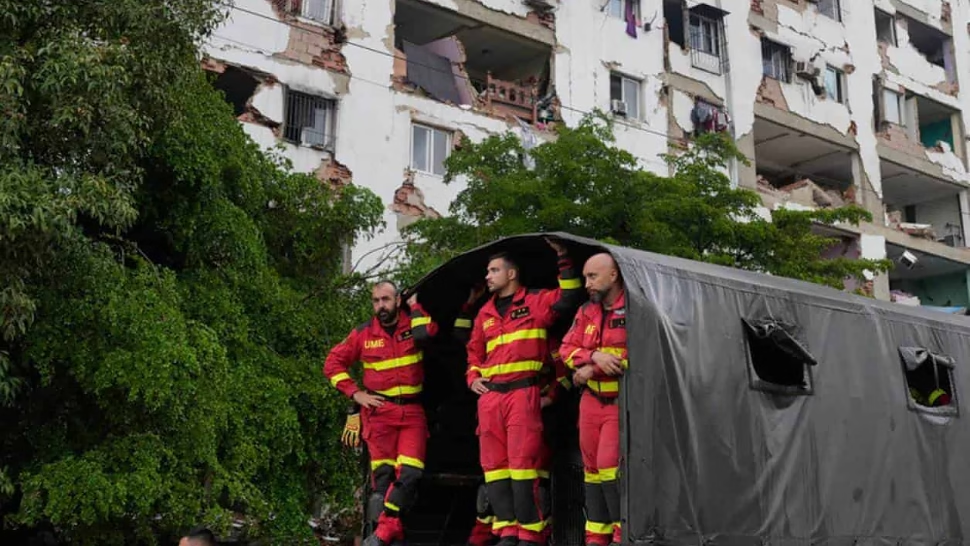
Almost a week after two powerful earthquakes, Venezuela’s fragile public health system is on the brink of collapse. The WHO reported that damaged and understaffed hospitals are facing a wave of injuries.

According to the government, the earthquakes damaged or put 38 hospitals at risk. The WHO evaluated 21 facilities: three are no longer operating, six were damaged and the rest are overflowing. “The findings reveal chaos in service provision, overcrowding and breakdown of biosafety measures,” said Christian Lindmeier, WHO spokesperson.

In addition, specialist doctors, including maternal care in La Guaira, are missing. This worsens the crisis in a country from which eight million people, many health professionals, have fled in recent years.

Humanitarian crisis and rescues

The government reports 1,943 deaths and 10,571 injuries. However, experts believe that the real figure is higher. NASA estimates that 59,000 buildings were damaged or destroyed.

The main rescue period of 48 to 72 hours has already passed. As of Tuesday, only four people were found alive by authorities. A minor rescued after six days under rubble was the exception.

UN agencies estimate 1.2 million tons of debris. Some 680,000 children require humanitarian assistance. Displaced people sleep in overcrowded cars or shelters, without access to toilets or soap, raising the risk of measles, dengue and malaria outbreaks.

In the absence of an official count of the missing, Venezuelans turn to WhatsApp groups. A non-governmental list registers at least 43,220 missing people.

“The health system, already stressed by decades of underinvestment, is now operating beyond its capacity,” Lindmeier warned. Humanitarian aid arrives late: the Red Cross and the World Food Program set up tents in La Guaira, where people line up for food, medicine and masks.

Continue reading

Merz defends the German team; Nagelsmann will remain in charge

Merz's support for the German team after its defeat sparks political criticism.

Merz’s support and the political storm

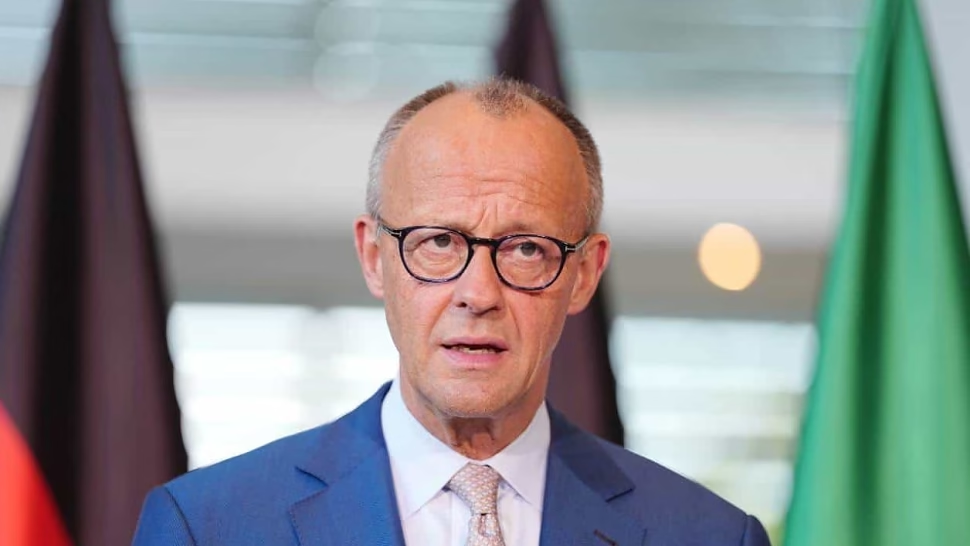
German Chancellor Friedrich Merz ignited the political and sporting debate by posting on social media his support for the national team, eliminated on penalties by Paraguay in the round of 32 of the 2026 World Cup. “Although the elimination hurts: What a game! With your commitment and team spirit, you moved our country. We are proud of you,” he wrote.

The reaction was immediate. MEP Marie-Agnes Strack-Zimmermann and opposition member Sevim Dagdelen accused him of losing touch with reality. The daily Tagesspiegel suggested that the publication was a mistake by an employee of the Federal Press Office.

The federation analyzes the performance

Bernd Neuendorf, president of the DFB, acknowledged the disappointment and held a workshop with coach Julian Nagelsmann and directors Andreas Rettig and Rudi Voeller to evaluate the team’s performance.

Despite rumors about his departure, Nagelsmann made it clear that he will not resign. “If the DFB wants me to continue, I will. And if not, they can tell me. I know how football works,” he said. Voeller backed him up: “He’s the right person in the right place.”

Klopp, meanwhile, ruled out any return. From the United States, where he works as a commentator, he said he was satisfied as Red Bull’s global football director. The German team thus begins an analysis process without immediate changes on the bench.

Continue reading

Mexican moles receive global recognition in Venezuela

Mexican rescue brigades are applauded online for their work in earthquakes in Venezuela.

Devastating earthquakes of magnitude 7.2 and 7.5 shook central Venezuela last Wednesday, June 24. Almost five days after the earthquake, which left thousands dead, the South American country remains in a state of emergency.

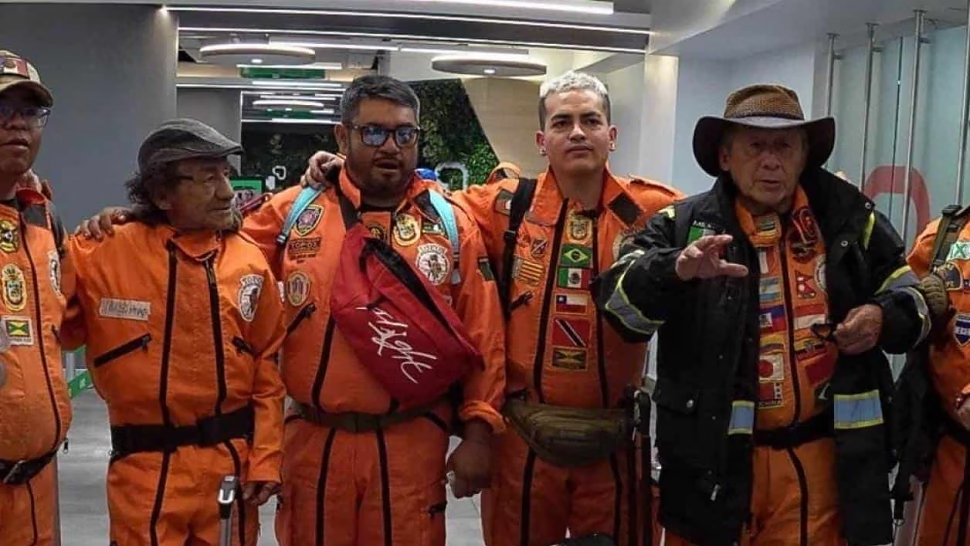
Rescuers from various nations are working tirelessly among the rubble to locate survivors. In this task, the Mexican Topos brigades have stood out for their dedication and vocation for service. His work has been recognized by millions of people around the world.

Recognition on social networks

Users of digital platforms like X have shared dozens of videos and images of the Moles’ work in Venezuela. The messages celebrate not only the rescues of people, but also animals. Some of the most replicated thank yous include:

“The Topos of Mexico are surreal! Forever great.”

“If ever, in the face of a natural disaster, you get trapped in the rubble and you hear that the Moles from Mexico have arrived, resist a little longer because you are about to be rescued, they will find you no matter what. The Mexican Moles have won heaven!”

“The Mexican Topos continue to carry out extraordinary work in Venezuela, working tirelessly among the rubble to save lives and provide hope in the midst of tragedy. Their bravery, solidarity and commitment have once again demonstrated why they are a source of pride for Mexico and an example for the world.”

The wave of publications reflects the global impact of the work of these emergency bodies. Their performance in Venezuela has reinforced the image of the Topos as a symbol of international solidarity.

Continue reading