Kentucky church shooting suspect faced prior charges

A day after wounding an officer, the suspect attacked worshipers at a temple with personal connections.

Detailed analysis of the shooting in Kentucky and its background

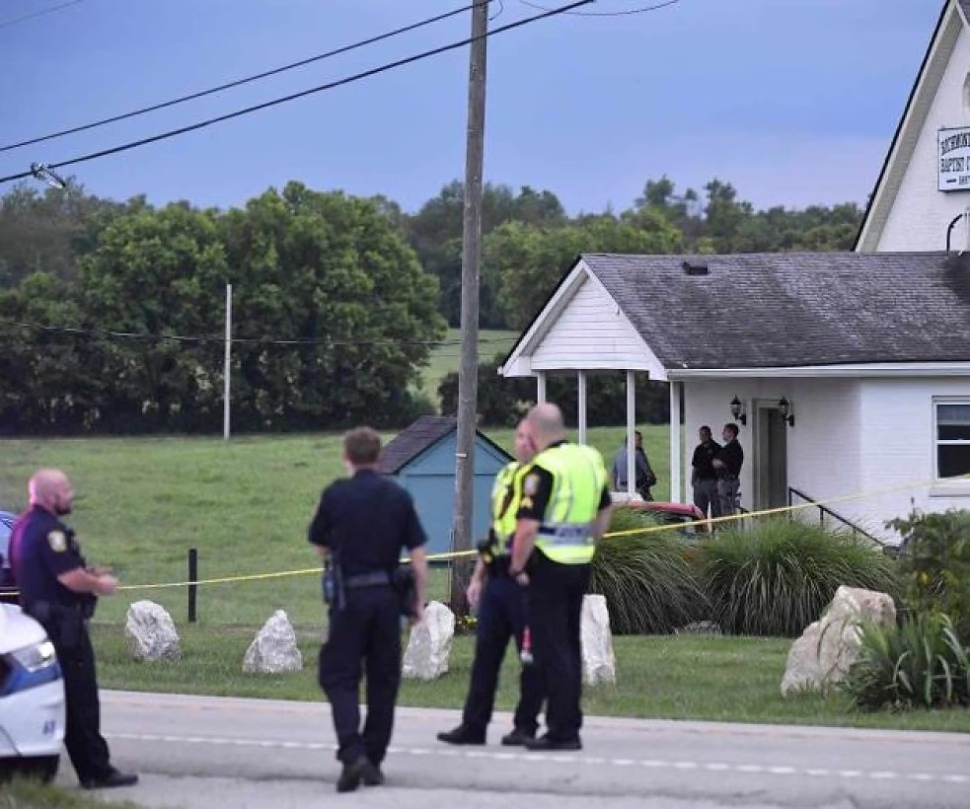
The individual involved in the Sunday shooting in a rural church in Kentucky, which left two dead and multiple injured, had a legal history linked to domestic violence. According to court records confirmed by Matt Ball, a Fayette County employee, Guy House (47 years old) had a hearing scheduled for this crime on the Monday after the attack, although the victim associated with the case did not match his ex-partner, as revealed by the Lexington Herald-Leader.

Chronology of the events and police response

The chain of events began when House shot a state agent during a vehicle stop near the Lexington airport, according to official reports. After stealing a car, the subject went to the Richmond Road Baptist Church, where he carried out the fatal attack on Beverly Gumm (72 years old) and Christina Combs (34 years old), while two men were seriously injured. Witnesses like Larissa McLaughlin described the critical moment to WLEX-TV: “I heard ‘pop, pop’ and I knew it was gunshots.”

RelatedShootings in Kentucky leave victims and mobilize authorities

Police Chief Lawrence Weathers highlighted at a press conference that license plate reading technology was key to locating the suspect, who had ties to members of the congregation. The church, located 26 km from the initial attack, is home to a small community according to coroner Gary Ginn, which intensified the emotional impact.

Judicial context and institutional reactions

Preliminary investigations suggest that the motive for the attack was related to personal conflicts, although authorities ruled out that the pending hearing involved the mother of his children. Governor Andy Beshear emphasized on social networks: “We appreciate the quick action of the security forces,”, while protocols are being analyzed to prevent similar episodes.

This case reopens the debate about access to weapons by individuals with violent histories. Data from the Violence Policy Center indicate that Kentucky has a firearm death rate 48% higher than the national average, a factor that experts link to permissive legislation.

Explore more research on armed violence and share this analysis to make its social consequences visible.

Two weeks after earthquakes in Venezuela, the emergency worsens

Thousands of Venezuelans seek medical attention after earthquakes that left more than 3,800 dead.

The health emergency worsens

Two weeks after the earthquakes that shook northern Venezuela, the humanitarian crisis intensifies. Thousands of victims go to mobile clinics and community kitchens in search of medical care and food. The UN appealed to raise $300 million and assist 1.3 million people.

The state of La Guaira, the most affected, concentrates the efforts of non-governmental organizations that now operate freely, in contrast to previous years of official restrictions. UN humanitarian aid director Tom Fletcher visited the area and warned of a rise in chronic and acute illnesses among survivors.

“They’re not just coming in with fractures anymore; they’re coming in with these other longer-term health needs,” Fletcher told The Associated Press.

Doctors in Catia La Mar report an increase in skin conditions and diarrheal diseases. There is also a lack of medications for diabetes and hypertension. Overcrowding and poor water and sanitation conditions aggravate the situation.

Irma Echarri, 67, went to a mobile unit hoping to restock her eye drops and painkillers. He was also looking for relief for a nose pain that appeared after the earthquakes of June 24.

“It hurts quite a bit,” he noted while waiting his turn.

The earthquakes left 3,889 dead, 190 buildings collapsed and 856 structures damaged, according to authorities. Some 18,000 people lost their homes and live in schools, sidewalks and parks.

Zulbey Reyes, 41, lost her job as a nanny and her house. He went to a clinic run by the Paluz organization, in alliance with the International Rescue Committee, for chest pain. The diagnosis revealed a nerve inflamed by the scream on the day of the earthquake.

The Pan American Health Organization reported that 50% of health professionals in La Guaira were directly affected: some died, others disappeared or suffered family crises.

According to the UN Office for Disaster Risk Reduction, damage to homes and infrastructure amounts to about $37 billion. So far, the United States has provided most of the aid. The response contrasts with the previous persecution of NGOs under the government of Nicolás Maduro.

Fletcher concluded: “When you have a crisis of this magnitude, people put politics aside and can focus on saving as many lives as possible.”

Continue reading

Ebola expands to new areas in Congo; There are 600 deaths

Suspected cases in Tshopo and Haut-Uele raise the Ebola alert in the Democratic Republic of the Congo.

Authorities in the Democratic Republic of the Congo warned this Thursday that the Ebola outbreak could have reached new regions. Suspected cases were detected in the provinces of Tshopo and Haut-Uele. The death toll rises to 600, while confirmed infections total 1,759.

Measures and current situation

The Ministry of Health reported two possible cases in the city of Kisangani, Tshopo province. One is linked to the Nia-Nia area, in Ituri, where the outbreak began. The other has no apparent connection with previous outbreaks, so it is already being investigated.

The government declared a health emergency on May 15, after the virus circulated for several weeks without being detected. The outbreak corresponds to the Bundibugyo variant, a rare strain of Ebola for which there are still no vaccines or approved treatments.

Given the seriousness of the situation, clinical trials began last week to evaluate possible treatments. It is hoped to find an effective alternative that contains the spread of the virus and reduces mortality.

Continue reading

Ukraine intensifies offensive against Russian oil infrastructure

kyiv attacked fuel depots and two ships in the Sea of ​​Azov.

Ukraine hits Russian oil infrastructure

kyiv intensified its drone offensive against Russian fuel depots this Thursday. The impacts hit facilities in the Tver and Stavropol regions, as well as two oil tankers in the Sea of ​​Azov. Russian authorities reported large fires.

The escalation comes a day after US President Donald Trump announced that he will grant Ukraine a license to manufacture Patriot air defense systems. Moscow claimed its air defenses shot down 73 Ukrainian drones. For its part, kyiv noted that Russia responded with 94 attack drones and two ballistic missiles against Ukrainian territory.

Russian response and dynamics of the confrontation

The Ukrainian attacks directly affect Russia’s ability to manage its energy infrastructure. Images of the fires on oil tankers circulated widely, evidencing the impact of the offensive. Russia’s response was immediate, increasing the use of drones and missiles in its counteroffensive.

This dynamic reflects the growing tension in the region. Both countries continue to exchange blows, which makes the situation of the confrontation even more complex.

Continue reading