They urge to protect day laborers in Canada after complaints

Congress urges to protect Mexican day laborers in Canada from abuse.

Congress calls for action against abuses of day laborers in Canada

The Permanent Commission of the Congress of the Union urged the Secretaries of Foreign Affairs and Labor to review the conditions of Mexican agricultural workers in Canada. The complaints indicate abuses, labor exploitation and extreme working conditions.

The point of agreement, circulated to both agencies, requests to strengthen the dissemination and promotion of the rights of those who participate in the Temporary Foreign Workers Program (PTAT).

“Various international organizations, civil society organizations and direct testimonies have shown that said program, in its current design and operation, reproduces structural conditions that violate the human and labor rights of the participants,” the document states.

Dependency and isolation

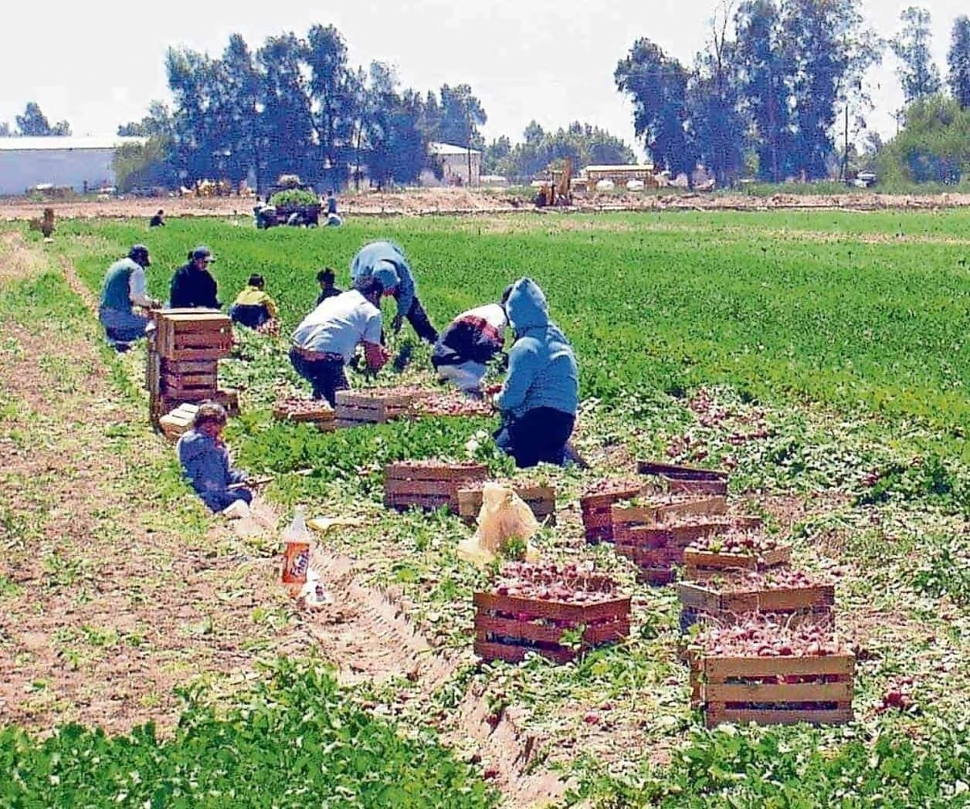
The majority work in remote rural areas, without public transportation. Access to shopping, health or communication depends on the employer. This limits their freedom of movement and makes it difficult to contact consulates or legal support, generating geographical isolation and daily dependency.

RelatedCanada matches US tariff exemptions in the T-MEC

Senators and deputies from all parties agreed: “Without binding binational mechanisms, acts of abuse continue in a context of impunity.”

Magnitude of the program

The Ministry of Foreign Affairs reported that the PTAT went from 203 workers in 1974 to more than 145,000 placed between 2019 and June 2024. The figure reflects the social impact of the program, but also the urgency of strengthening consular protection and supervision.
Mexico recovers 17 thousand archaeological pieces from abroad

The pace of repatriations exceeds that of Peña Nieto's six-year term by ten times.

Record repatriation and museum reopening

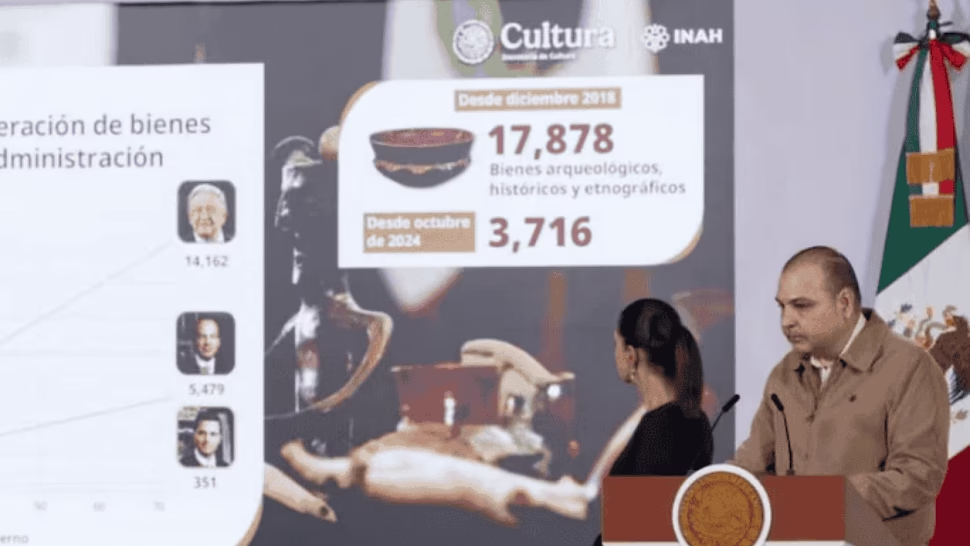
President Claudia Sheinbaum highlighted that archaeological pieces recovered abroad are being returned to their communities of origin. According to the INAH, under federal foreign policy, 17,878 cultural assets have been recovered, of which 3,716 correspond to the current administration.

The Secretary of Culture, Claudia Curiel de Icaza, pointed out that the restitution is carried out in coordination with the Ministry of Foreign Affairs through international alliances.

The director of the INAH, Joel Omar Vázquez Herrera, explained that the rate of repatriations exceeds that registered by Enrique Peña Nieto’s six-year term by ten times and that carried out under Felipe Calderón by 68 percent. From 2024 to date, the countries that have returned the most objects are the United States (3,369 pieces), followed by Italy, Canada, France and Spain.

As part of strengthening the heritage, the Museum of Teotihuacan Grandeza reopened its doors after being closed for two decades. The investment was 7 million pesos for architectural and museum restoration. It exhibits 174 pieces—80 percent never shown before—and has received more than 25,000 visitors since June.

Finally, the Undersecretary of Cultural Development, Marina Núñez Bespalova, presented the “Original Workshop” project, which will train artisans to sell their works at the Los Pinos Cultural Complex starting in November, under a fair trade tabulator designed by the communities.

Continue reading

Exhibition reveals the secrets of the Mexican ball game

A look at the ball game that united the Mexica nobility.

The field as a social space

The Templo Mayor Museum presents a temporary exhibition that reveals new data about the tlachtli, the court where the Mexica nobility played the ball game. More than a hundred archaeological and ethnographic pieces have been gathered, most recovered from Teotlachco, the “ball game of the gods”, after a century of excavations.

The archaeologists Eduardo Matos Moctezuma, Raúl Barrera Rodríguez and Lorena Vázquez Vallín were in charge of the curatorship. They pointed out that this practice acquired a nuance linked to war and sacrifice during the Late Postclassic.

The restored space is located under Guatemala Street, in the Historic Center of Mexico City. Its recovery has been a generational effort: from discoveries in the 20th century to construction supervision in 2014.

Pieces of exceptional value

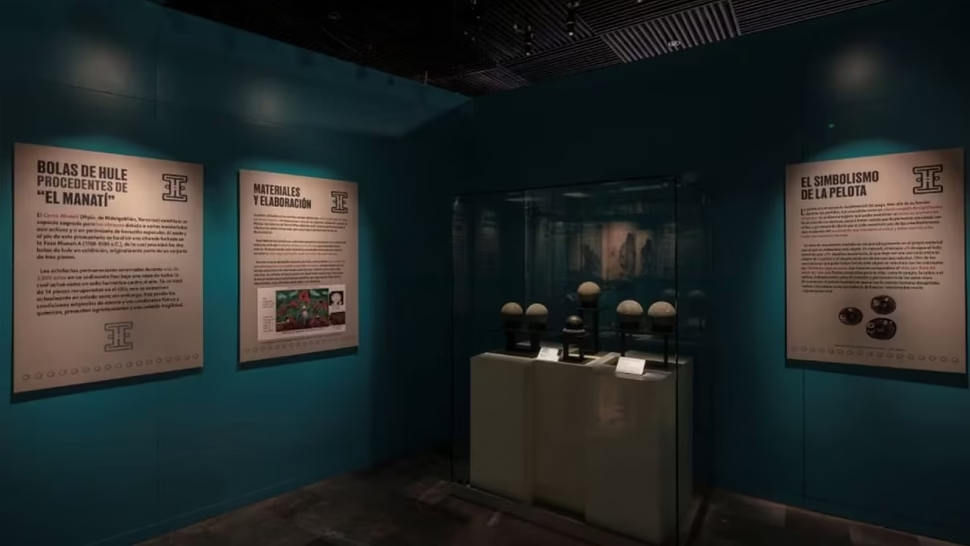
Among the most relevant objects are two rubber balls from the Olmec site El Manatí, Veracruz. They are considered the oldest in the world, 3,700 years old. They are displayed in special capsules for conservation.

The exhibition includes comparative references with Tula and examples of continuity of this tradition in Michoacán and Chihuahua. It will be open until September 2026.

Continue reading

Train derailment in Veracruz without injuries; affected roads

Freight train derailed in Veracruz without injuries; closed roads and Ferrosur maneuvers.

No injuries after derailment in the mountainous area

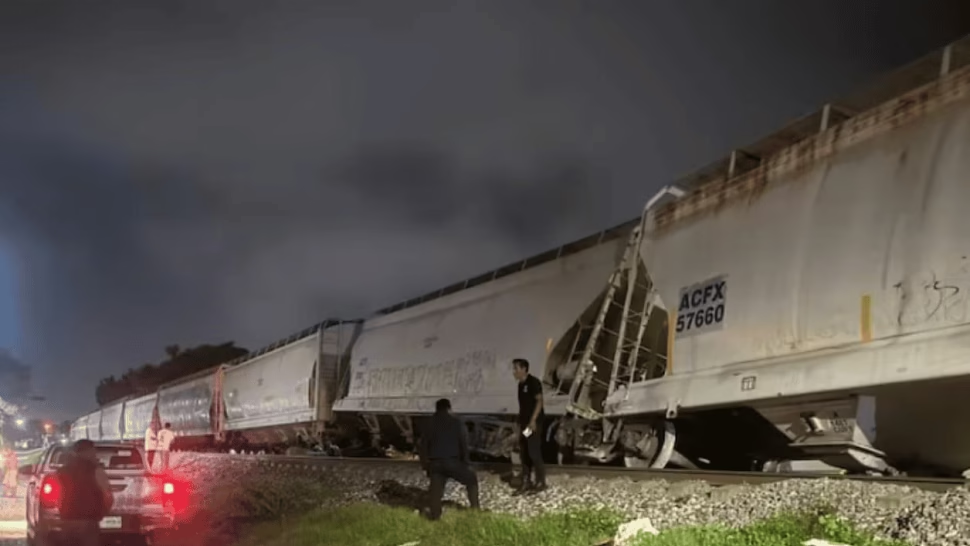
A freight train derailed in the municipality of Camerino Z. Mendoza, in the central mountainous region of Veracruz. The incident left no people injured, local authorities confirmed.

Several hoppers left the road, forcing the closure of nearby streets and avenues in the Nogales-Mendoza conurbation. Elements of the Municipal Public Security Directorate came to cordon off the area and prevent major risks.

Ferrosur works on partial reopening

Ferrosur personnel carried out maneuvers to partially reopen traffic on Miguel Hidalgo and Santos Degollado avenues. The work to remove the carriages could last up to two days, sources from the railway company reported.

Road traffic remains interrupted at strategic points, but it is expected that it will gradually return to normal in the coming hours. There are no reports of damage to homes or basic services in the area.

Continue reading