Sheinbaum receives rescuers from Venezuela and a donated dog

Sheinbaum receives rescue brigade sent to Venezuela after earthquakes; They highlight donation of a rescue dog.

This Friday, President Claudia Sheinbaum received the rescuers who traveled to Venezuela to help the population after the recent earthquakes.

“Mexico will always be in solidarity with all the people of the world, and when there is a need to support, we will be there,” he declared.

Concrete support

In the morning conference from the National Palace, Sheinbaum explained that the first stage of rescue has practically concluded. Although the search for bodies continues, the initial emergency has already been attended to.

RelatedTsunami rescue dog: from victim of abuse to hero in Venezuela

Mexico could send more assistance. Two ships with humanitarian aid – food and emergency electrical plants – are about to arrive in Venezuela.

A gift rescue dog

The president explained that Delcy Rodríguez, president in charge of Venezuela, donated a rescue dog to the Mexican brigade. This dog will be part of the search teams in Mexico.

Sheinbaum is preparing a reception ceremony at Military Air Base 1 for this afternoon, where the work of the rescue team will be recognized.
Cofepris alert: five beaches not suitable for swimming this summer

Five Mexican beaches not suitable for vacationers due to high bacterial levels.

Contaminated beaches: health risk in five destinations

The Federal Commission for the Protection against Sanitary Risks (Cofepris) reported that five beaches in the country are not suitable for receiving vacationers due to high bacterial concentrations.

The designated areas are: Tijuana Beach, in Baja California; Cuale Beach, in Puerto Vallarta/Bahía de Banderas, Jalisco; Main Beach, in Puerto Escondido, Oaxaca; and José Martí and Tumbao Beaches, in Veracruz.

“Cofepris recommends that bathers refrain from swimming activities or other direct contact recreational uses on beaches designated as unsuitable. Preserving these healthy environments and protecting collective health is a shared commitment,” the Commission said in a statement.

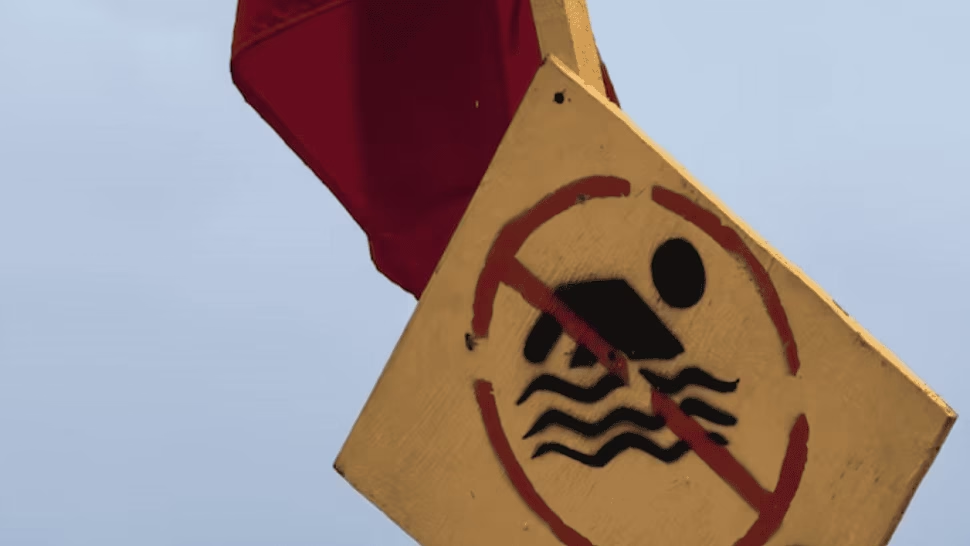
Together with the Clean Beach Committees and local authorities, prevention and intervention efforts are coordinated to implement urgent sanitation actions in these five coastal areas, in addition to placing preventive signs.

Almost all Mexican beaches are safe

In contrast, the quality of sea water on 284 beaches — 98.3% — is suitable for recreational use during the summer of 2026, Cofepris detailed.

Between June 15 and July 1, 2,279 seawater samples were collected and processed at 393 strategic verification points, distributed in 76 tourist destinations of the 17 entities with a coastline.

The authorities remember that pollution can affect the health of bathers, so they ask you to follow the recommendations to avoid problems during the holiday season.

Continue reading

Mexico recovers 17 thousand archaeological pieces from abroad

The pace of repatriations exceeds that of Peña Nieto's six-year term by ten times.

Record repatriation and museum reopening

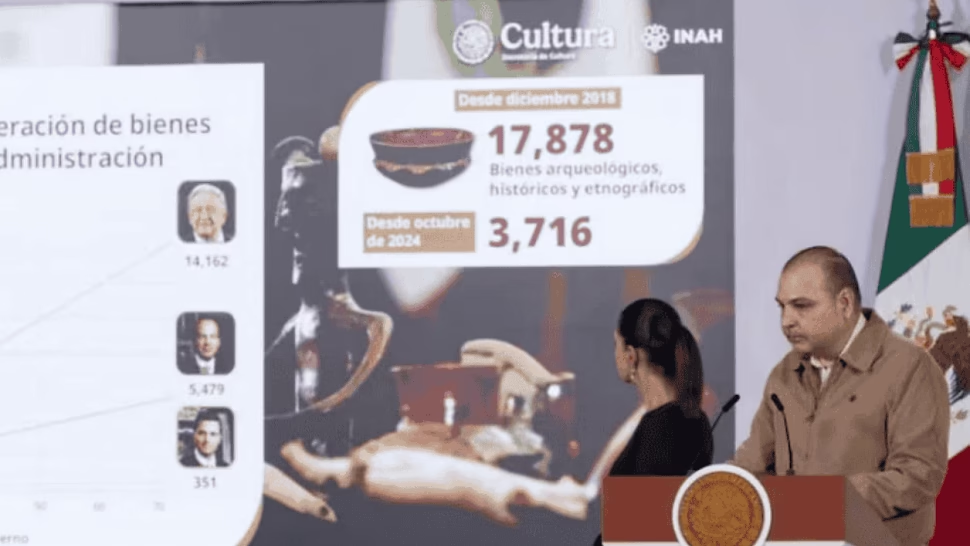
President Claudia Sheinbaum highlighted that archaeological pieces recovered abroad are being returned to their communities of origin. According to the INAH, under federal foreign policy, 17,878 cultural assets have been recovered, of which 3,716 correspond to the current administration.

The Secretary of Culture, Claudia Curiel de Icaza, pointed out that the restitution is carried out in coordination with the Ministry of Foreign Affairs through international alliances.

The director of the INAH, Joel Omar Vázquez Herrera, explained that the rate of repatriations exceeds that registered by Enrique Peña Nieto’s six-year term by ten times and that carried out under Felipe Calderón by 68 percent. From 2024 to date, the countries that have returned the most objects are the United States (3,369 pieces), followed by Italy, Canada, France and Spain.

As part of strengthening the heritage, the Museum of Teotihuacan Grandeza reopened its doors after being closed for two decades. The investment was 7 million pesos for architectural and museum restoration. It exhibits 174 pieces—80 percent never shown before—and has received more than 25,000 visitors since June.

Finally, the Undersecretary of Cultural Development, Marina Núñez Bespalova, presented the “Original Workshop” project, which will train artisans to sell their works at the Los Pinos Cultural Complex starting in November, under a fair trade tabulator designed by the communities.

Continue reading

Exhibition reveals the secrets of the Mexican ball game

A look at the ball game that united the Mexica nobility.

The field as a social space

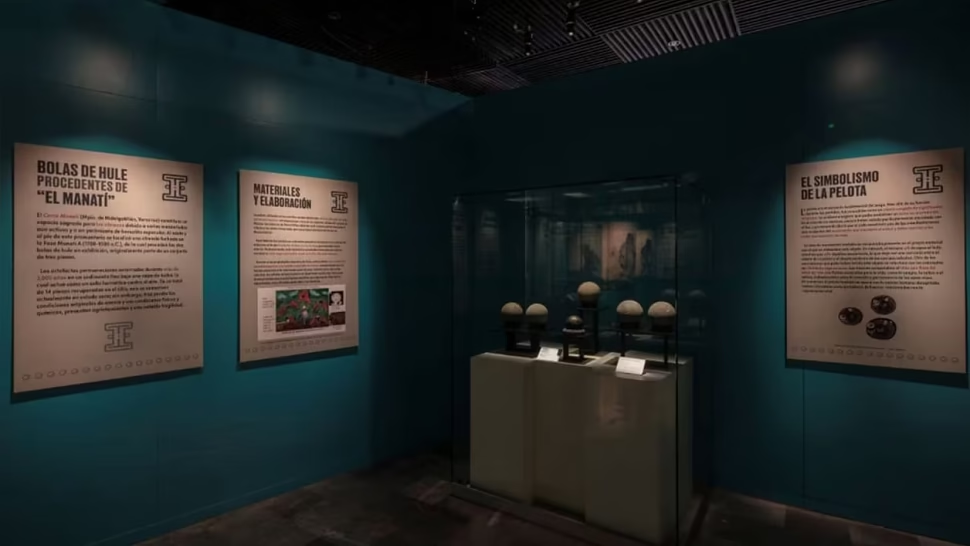
The Templo Mayor Museum presents a temporary exhibition that reveals new data about the tlachtli, the court where the Mexica nobility played the ball game. More than a hundred archaeological and ethnographic pieces have been gathered, most recovered from Teotlachco, the “ball game of the gods”, after a century of excavations.

The archaeologists Eduardo Matos Moctezuma, Raúl Barrera Rodríguez and Lorena Vázquez Vallín were in charge of the curatorship. They pointed out that this practice acquired a nuance linked to war and sacrifice during the Late Postclassic.

The restored space is located under Guatemala Street, in the Historic Center of Mexico City. Its recovery has been a generational effort: from discoveries in the 20th century to construction supervision in 2014.

Pieces of exceptional value

Among the most relevant objects are two rubber balls from the Olmec site El Manatí, Veracruz. They are considered the oldest in the world, 3,700 years old. They are displayed in special capsules for conservation.

The exhibition includes comparative references with Tula and examples of continuity of this tradition in Michoacán and Chihuahua. It will be open until September 2026.

Continue reading