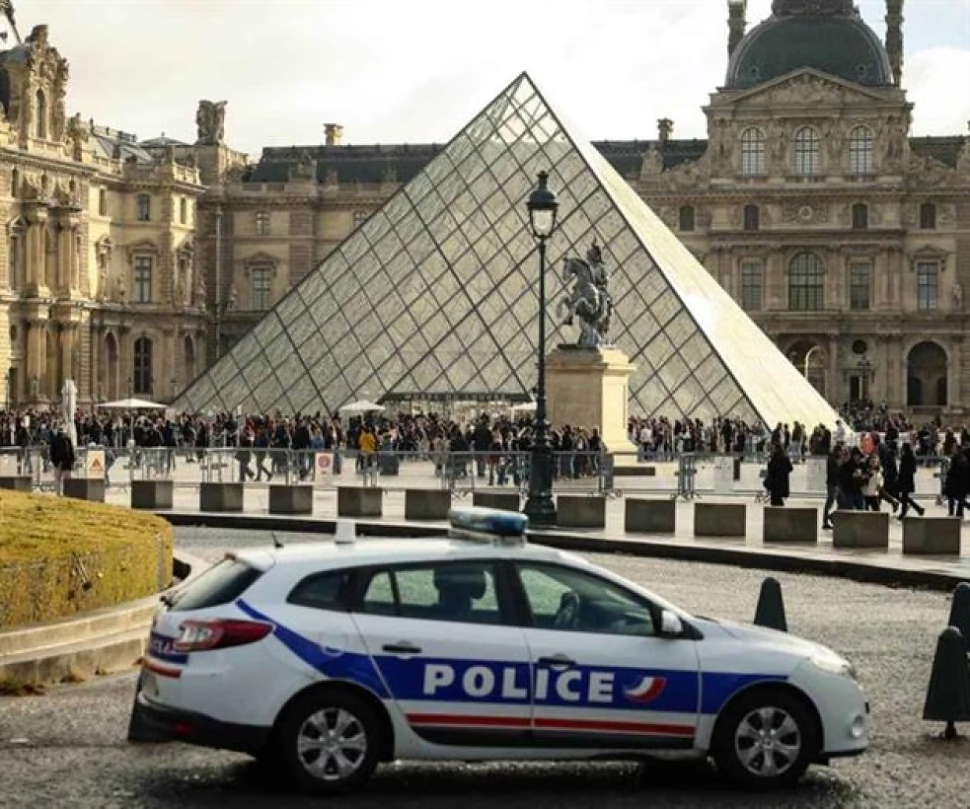
Analysis of the Fourth Detainee in the Louvre Investigation
The Paris Prosecutor’s Office has confirmed the arrest of a 39-year-old individual, allegedly identified as the fourth member of the criminal group responsible for the theft of the French crown jewels from the Louvre Museum. This development represents a significant advance in the investigation, suggesting that the main operational structure of the group has been dismantled. The subject in custody has an extensive criminal history, which includes six previous convictions, among which one for receiving stolen goods in 2010 stands out, a crime for which he received a two-month suspended prison sentence.
In the current context, preliminary charges have been brought against him for the crimes of robbery in an organized gang, a criminal offense that carries a maximum penalty of fifteen years in prison, and criminal conspiracy, susceptible to a sentence of up to a decade in prison. The criminal action, perpetrated on October 19, was characterized by its audacity and precision, resulting in the illicit appropriation of loot valued at approximately 88 million euros (102 million dollars). It is crucial to highlight that this purely economic valuation does not incorporate the incalculable historical and heritage value that these pieces represent for the French nation.
Operational Methodology and Development of the Incident
The judicial statement has not specified the specific role that the recently detained man would have played within the criminal structure. However, the investigation has established that the assault on the museum was carried out during daylight hours, using industrial tools such as grinders and a forklift, as well as subterfuge tactics that included the perpetrators dressed in workers’ clothing and high-visibility vests to blend in with the museum staff. While this individual remains in custody, three other people detained for interrogation during the same week have been released without charges being filed against them, according to prosecutor Laure Beccuau.
The investigating agents maintain their active efforts with a double primary objective: the location and recovery of the stolen jewelry and the precise determination of the role that each individual played within this organized criminal group. Likewise, it seeks to exhaustively clarify the planning and execution mechanisms of the crime. The main hypothesis of the investigation maintains that the operation was carried out by a team of four people, where two individuals broke into the ornate Apolo Gallery – the space where the jewels were exhibited –, while two other accomplices waited outside in charge of the motorcycles used for the escape.
Three men, considered the other alleged members of the robbery team, were previously arrested in October and charged with the same preliminary charges of organized gang robbery and criminal conspiracy. Physical evidence, specifically DNA traces found at the crime scene and on objects directly linked to the theft, constitutes a strong evidentiary element in the process. In parallel, a woman was arrested in October, facing preliminary charges of complicity in robbery and criminal conspiracy. It has been established that she has a long-standing romantic relationship with one of the alleged thieves, with whom she has children in common and resides in the northern suburbs of Paris, an area that also houses other suspects. His legal defense has categorically denied any participation or knowledge of the events.
Consequences and Post-Event Security Measures
The historical loot, which remains unrecovered, includes pieces of exceptional heritage value. Among them is a diamond and emerald necklace that Napoleon Bonaparte gave to the Empress Marie Louise, various jewels associated with the 19th century queens Maria Amalia and Hortensia, and the famous pearl and diamond tiara that belonged to the Empress Eugenie. This security episode has generated intense public and institutional scrutiny of the Louvre’s protection protocols. The director of the museum institution has explicitly recognized the existence of a “critical security failure” and has announced the commitment to implement new surveillance systems, including the installation of state-of-the-art cameras and more sophisticated anti-theft mechanisms.
The analysis of the timeline of the event reveals that the thieves completed the robbery in a period of less than eight minutes, from their forced entry to their escape from the museum. They used a forklift to access one of the building’s windows. The recordings from the museum’s security cameras documented how the two individuals who entered the Apollo Gallery used grinders to cut the bulletproof glass of the display cases that housed the jewelry. In a later twist, the imperial emerald crown of Napoleon III’s wife, Empress Eugenie – a piece containing more than 1,300 diamonds – was found abandoned near the museum, a sign that suggests possible complications during the group’s escape.
Has this analysis of one of the most significant art thefts of the decade been enlightening to you? Share this report on your social networks to contribute to the dissemination of a high-profile investigation and explore more specialized content on our platform on asset security and court cases of historical relevance.