Judicial reform in Mexico scares foreign investors

Experts warn that changes in the Judiciary could scare away investors. Spoiler: no one wants to play Russian roulette with their money.

When the Judiciary becomes a reality show

Ah, Mexico. The country where politics never disappoints in giving us chapters worthy of a melodrama. Yesterday the popular elections were held to elect judges and magistrates, and as expected, the business sector is more nervous than an influencer without filters. The reason? The uncertainty generated by this change could scare away Foreign Direct Investment (FDI). In other words, they are basically putting an “Abstain capitalists” sign on the national economy.

“Judicial autonomy” sounds nice, but how real is it?

Natalia Campos, from the Mexican Institute for Competitiveness (Imco), said it bluntly: the Rule of Law is key to measuring competitiveness. Translation: if judges lose autonomy, companies will start looking the other way like when you see your ex at a party. “What is worrying is the lack of technical judgment and the possibility that legal disputes become a game of chance,” he explained. Come on, no one wants to invest in a country where the rules change faster than the trends on TikTok.

RelatedNorma Piña receives an international award for her judicial defense

And in case anyone thought this was exaggerated, Campos gave the uncomfortable example: Venezuela. Yes, that place where the rules of the game are reinvented every morning. “Companies prefer not to bet where legal certainty is conspicuous by its absence,” he concluded. Basically, it’s like buying a ticket to a concert and being told when you arrive that it’s now an abstract play. No, thank you.

The market looks with a magnifying glass (and with distrust)

Gabriela Siller, from Banco Base, agreed: without Rule of Law, legal certainty disappears. But don’t worry, the impact won’t be immediate. “It will depend on how the results turn out and how the market assimilates it,” he clarified. In other words, companies could pause their investments until they see if this turns into “The Hunger Games” style chaos or something halfway functional.

And it’s not just local voices that are alarmed. The Center for Strategic and International Studies (CSIS) has already raised the alarm: this reform could weaken investor confidence and complicate even the T-MEC. Translation? Mexico could go from being the “best trading partner” to that unpredictable friend who is late for everything and never pays his part of the bill.

For this reason, CSIS will organize an analysis panel on June 6 to evaluate the impact of the reform. Spoiler: they don’t paint pretty things. Between judicial independence at risk and legal security in check, the economic future seems more uncertain than the ending of “Inception.”

Moral? If we want foreign money not to flee like a boring party, we better make sure that the Judiciary does not become a political puppet. Because, in the end, even memes have more credibility than a judicial system without autonomy.

Are you worried about Mexico’s economic future? Share this article and continue exploring more content about how political decisions affect your pocketbook. #SpoilerAlert: Never for the better.

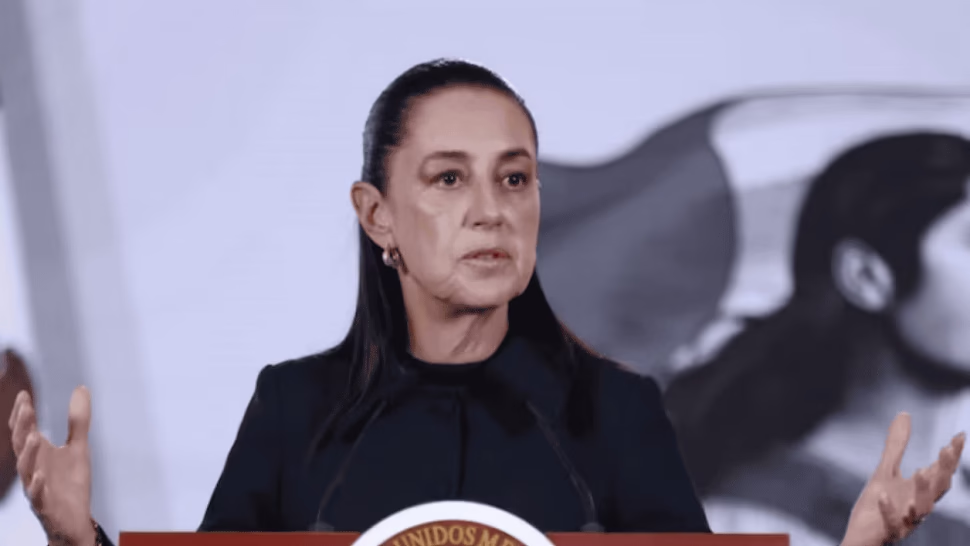
Mexico will offer more humanitarian aid to Venezuela after earthquakes

Sheinbaum will contact Delcy Rodríguez to coordinate more support for victims of earthquakes in Venezuela.

President Claudia Sheinbaum reported that this week she will communicate with the president in charge of Venezuela, Delcy Rodríguez, to offer more assistance to those affected by the earthquakes of June 24.

He explained that Foreign Minister Roberto Velasco already maintains contact with the Venezuelan president to coordinate humanitarian aid and rescue support. Among the resources sent is the “Yumare” group of the Secretariat of National Defense (Sedena).

“Roberto is in contact with the president in charge of Venezuela, and we are also going to look for her this week to see what else they need to support them. We are going to continue helping in everything we can,” Sheinbaum declared at a press conference.

Sheinbaum highlighted the work of the Mexican Army rescuers. He also recalled the ceremony on June 10, in which the Venezuelan ambassador to Mexico, Stella Marina Lugo, participated.

“The event was very emotional, because it is not only the professionalism of the rescuers of the Mexican Army, of the doctors, nurses who were there, but also the dedication and humanism with which they do their work,” said the president.

Sheinbaum stressed Mexico’s commitment to continue supporting Venezuela in this emergency. Cooperation continues to address the needs of the affected population.

Continue reading

Hyundai tests the Interoceanic Train with 3 thousand cars

The South Korean company transported 3,000 vehicles by train from Oaxaca to Veracruz; permanent contract is defined.

First mass transfer of vehicles

President Claudia Sheinbaum confirmed that Hyundai used the Interoceanic Train to move 3,000 vehicles from Salina Cruz, Oaxaca, to Coatzacoalcos, Veracruz, over the weekend.

“This weekend there was a very important transfer of Hyundai company vehicles through the Interoceanic. They arrived in Salina Cruz and left through Coatzacoalcos,” he explained at Monday’s morning conference.

Sheinbaum announced that this week it will be decided whether the collaboration becomes permanent.

Automotive context and tariffs

The president also referred to the closure of a Toyota plant in Tijuana and its relocation to Texas, a fact celebrated by Donald Trump and attributed to his tariff policy.

Sheinbaum stated that they maintain contact with the automotive industry and seek to reduce the unilateral tariff imposed by the United States. “The sale of national vehicles has increased,” he said, and announced a third meeting with the sector.

Regarding the closure of Toyota, he clarified that it is not immediate, but a process of years. “We give alternatives to workers with the Ministry of Labor, the governors and the Ministry of Economy,” he said.

Sheinbaum hopes that negotiations with the US will advance to eliminate or reduce the tariff on auto imports.

Continue reading

Finding of three bodies in the mountain area of ​​Sinaloa

Three decomposing male bodies found near Durango; Prosecutor's Office will use forensic genetics.

Finding in the mountain area of Sinaloa

Three male bodies in an advanced state of decomposition were located on a plot of land near the El Mezquite community, in the municipality of El Fuerte, very close to the border with Durango.

Elements of the Army, the National Guard and municipal police secured the place after reporting to the emergency lines. The criminalistics experts collected the corresponding evidence.

The state Attorney General’s Office ordered that the bodies be transferred to a funeral home in Los Mochis. There, forensic personnel will carry out genetic studies to determine their identities. The victims, young in appearance, have not been identified.

The agency assured that the circumstances of the death are being investigated. The identification process is key to providing answers to families and advancing the investigations.

Continue reading