Finding of three bodies in the mountain area of ​​Sinaloa

Three decomposing male bodies found near Durango; Prosecutor's Office will use forensic genetics.

Finding in the mountain area of Sinaloa

Three male bodies in an advanced state of decomposition were located on a plot of land near the El Mezquite community, in the municipality of El Fuerte, very close to the border with Durango.

Elements of the Army, the National Guard and municipal police secured the place after reporting to the emergency lines. The criminalistics experts collected the corresponding evidence.

RelatedUN demands rigorous investigation into discovery of bodies in crematorium

The state Attorney General’s Office ordered that the bodies be transferred to a funeral home in Los Mochis. There, forensic personnel will carry out genetic studies to determine their identities. The victims, young in appearance, have not been identified.

The agency assured that the circumstances of the death are being investigated. The identification process is key to providing answers to families and advancing the investigations.

Sheinbaum orders criminal complaints for migrant deaths in the US

Mexican government will file criminal complaints for 17 deaths of fellow citizens in the United States.

President Claudia Sheinbaum called on civil society, political forces and Congress to close ranks against the violation of the human rights of Mexicans in the United States.

Criminal complaints for deaths of fellow nationals

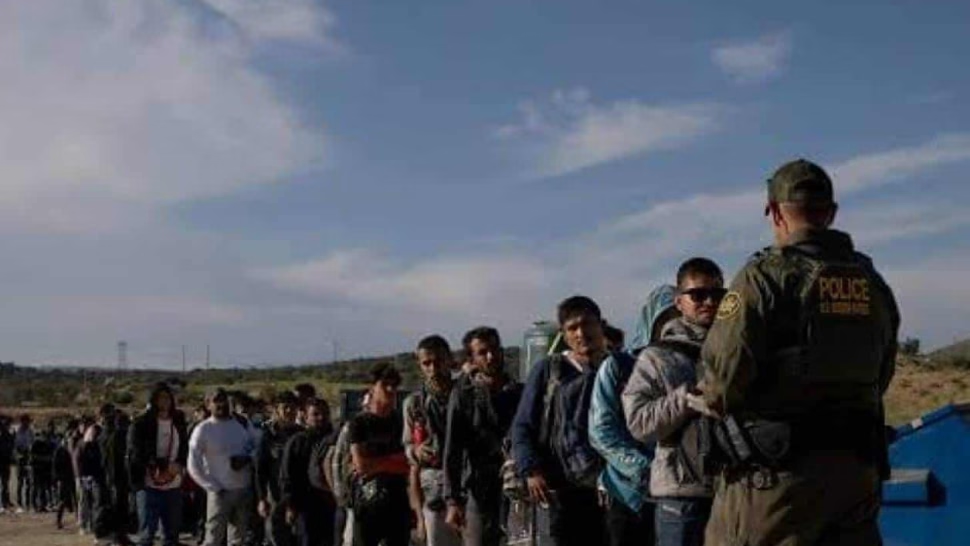
In the morning conference, the president reported that the Ministry of Foreign Affairs will formalize criminal complaints this Monday before the Department of Justice and US state prosecutors’ offices for the death of 17 compatriots. The deaths occurred in custody or in operations of the Immigration and Customs Enforcement Service (ICE).

Sheinbaum explained that Foreign Minister Roberto Velasco Álvarez contacted the US ambassador to Mexico, Ronald Johnson, to notify him of the international legal procedures in defense of the migrant community. The ambassador was receptive, according to the president, who clarified that the Mexican position does not seek a diplomatic conflict with its main commercial and security partner, but rather to establish a firm limit against abuses against individual guarantees.

Continue reading

PAZ and Somos México formalize their registration with the INE

Leaders of PAZ and Somos México protest with criticism of the INE.

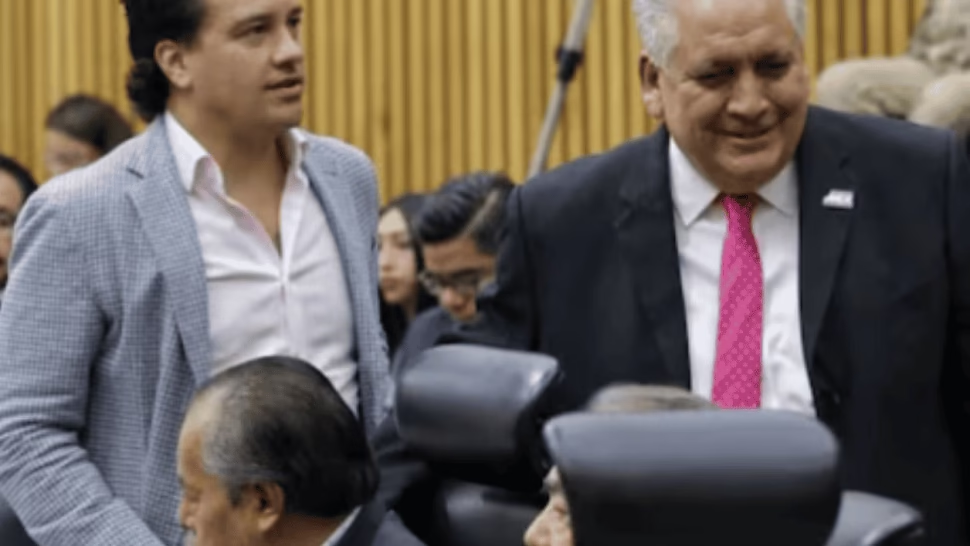
The National Electoral Institute (INE) took oath this Monday to the leaders of the new parties PAZ and Somos México, which obtained their registration as of July 1. During the ceremony, both representatives expressed disagreement with previous decisions of the electoral body.

Statements from the leaders

Hugo Éric Flores, Morenoist deputy and leader of PAZ, demanded that the General Council of the INE guarantee that every vote counts. He pointed out that in the previous election there were discrepancies in the counting of boxes, which affected the registration of the old PES.

“We still do not understand why the results of the election changed. Only two hundredths separate the old PES from the previous record. Five years ago 30 thousand boxes should have been counted and only 20 thousand boxes were counted and they left us on the edge of the record.”

Flores assured that the party never left and that today they return to stay: “We want institutions that guarantee that every vote of Mexicans is counted.”

Guadalupe Acosta Naranjo, leader of Somos México, claimed the INE’s instruction to change the name and color of the party due to an alleged coincidence with Fuerza por México, which has local registration. He stated that, although they are opposition, they will offer proposals.

“We are the opposition, yes, without a doubt, but we will be options, proposals and solutions. We will lay the foundations so that in 2030 we will recover our republic and our democracy. They ordered us to change our name, but we freely decided to be We are Mexico, we are pink tide, we are worthy, we are free and we are democrats for Mexico.”

Both parties seek to consolidate towards the 2027 election. The registration obtained represents a step in the recomposition of the national political map.

Continue reading

Former director of Pemex faces trial for family violence

The judge linked the former director of Pemex to the trial, but the victim's forgiveness opens the door to an alternative solution.

The specialized Control judge, Adriana Correa, issued an order to bring proceedings against Víctor Rodríguez Padilla, former director of Petróleos Mexicanos (Pemex), for the crime of family violence to the detriment of his wife, María Felicia Jiménez Lavie, and his minor son.

Forgiveness without legal value

The case took an unexpected turn: the defense presented a document signed by the victim in which he granted forgiveness to Rodríguez Padilla and requested not to continue with the process to seek reconciliation. However, the judge rejected the document, considering that it has no probative value, since the crime is prosecuted ex officio and the signature is not legally certified.

Imputation for vicarious violence dismissed

The judge dismissed the charge of vicarious violence. He argued that the evidence did not prove that the former official tried to abduct or retain his son. On the contrary, it was proven that he lived with the minor days after the attack against his partner.

Next steps

The defense requested the conditional suspension of the process, which would allow Rodríguez Padilla to remain free. The judge considered the request viable, but conditioned its admissibility on the victim appearing personally to ratify the pardon. For this reason, he summoned a new hearing for this Tuesday at 8:15 a.m.

In addition, he instructed the Prosecutor’s Office to interview María Felicia Jiménez to explain the legal implications of her request. The intermediate hearing, where the evidence from both parties will be analyzed, was set for October 13.

Defense questions evidence

During the hearing, the former director’s lawyers questioned the authenticity of the video of the attack—without audio—and pointed out that there are no eyewitnesses. The judge rejected those arguments: she considered the video as relevant evidence and recalled that family violence usually occurs in private.


Continue reading