Former Secretary of the Navy, accused in illegal fuel network

Witness assures that Captain Sol asked for help from Ojeda Durán to authorize illegal ship.

New testimony in the investigation into the tax evasion network within the Ministry of the Navy indicates that one of its heads sought the support of Rafael Ojeda Durán, Secretary of the Navy during López Obrador’s six-year term, to authorize a ship with smuggled fuel.

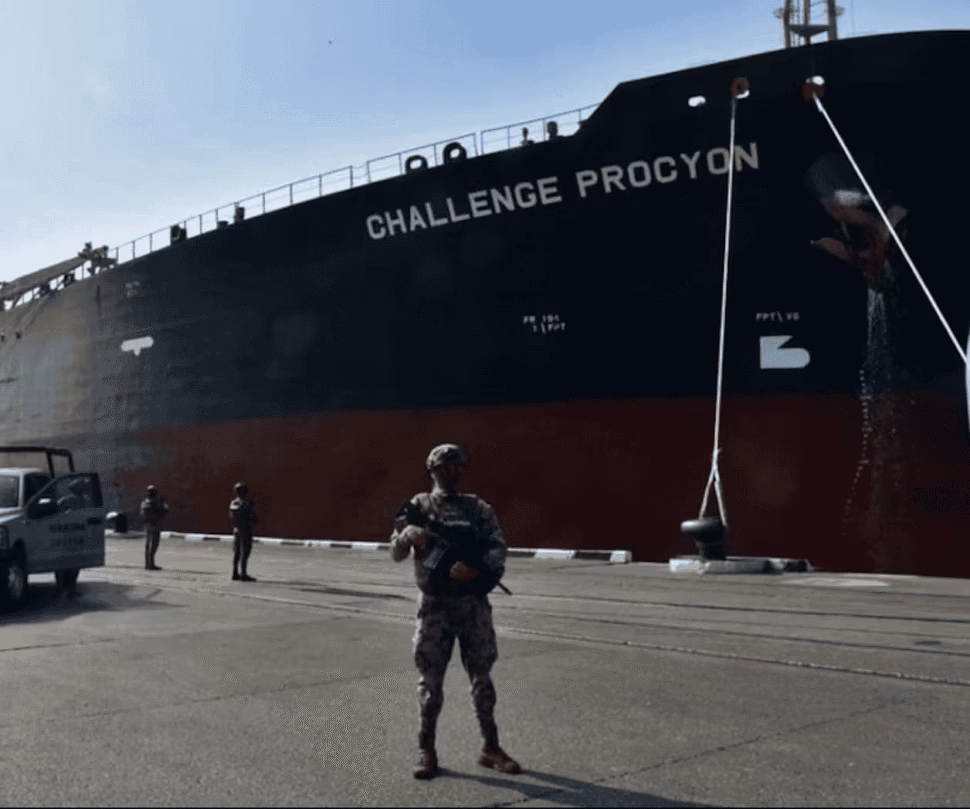
After the seizure of the Challenge Procyon ship in March 2025 in Tampico, Miguel Ángel Solano Ruiz, alias “Capitán Sol,” told a military officer from the customs in Guaymas, Sonora, that he would speak with Ojeda Durán to “control the situation” of the Torn Agnes, another vessel loaded with illegal fuel that had arrived at the border port.

RelatedNavy captain commits suicide after being accused in a huachicol network

The new testimony

The witness, identified with the initials J.C.S.P., belongs to the Navy and worked with ship captain Luis Alfredo García Arellano Villegas, then in charge of the Guaymas customs. According to their statement, to which EL PAÍS had access, this duo managed the entry of the Seaways Citron ship in October 2023, an operation that “was already agreed upon in central areas” and had authorization from the Farías Laguna brothers, nephews of Ojeda Durán.

At that time, Captain Sol indicated how to distribute a bribe of 2.5 million pesos between civil and military customs officials. The statement details that they kept the money in the weapons storage room of the premises.

The defense of Ojeda Durán’s nephews—Roberto Manuel and Fernando Farías Laguna, accused of leading the plot—asked the authorities for the former secretary to testify. The request, submitted in early June, was not granted. The lawyers argued that the new testimony suggests that Ojeda Durán not only knew the facts, but “presumably could be related.”

Another key evidence is the handwritten letter that Fernando Rubén Guerrero Alcántar, a soldier involved, gave to Ojeda Durán in June 2024. In an audio published by Aristegui Noticias, Ojeda Durán is heard offering him a kind of pact of silence: “Either we uncover all this and I don’t care who falls… or we try to close it here ourselves.” Guerrero Alcántar was deprived of his life five months later, in November 2024, and his letter did not reach the Prosecutor’s Office until July 2025.

The Government has tried to separate Ojeda Durán from the case, but the dates and facts place him at the center. The Prosecutor’s Office did not respond to questions about this new evidence; The Secretary of the Navy said that it maintains collaboration but is not the “competent authority” to report.
Zelenskyy dismisses Syrskyi amid protests in Ukraine

The change in high command responds to citizen pressure and internal criticism.

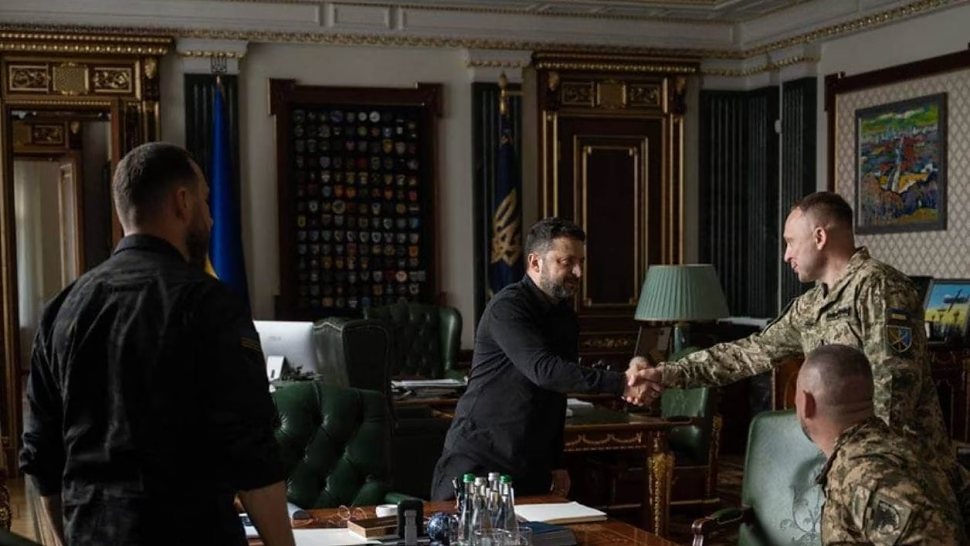
Ukrainian President Volodymyr Zelenskyy dismissed General Oleksandr Syrskyi as commander-in-chief of the armed forces, following several days of protests in kyiv and other cities demanding his ouster. In his place, he appointed Mijailo Drapatyi, according to an official statement.

“Our shared desire is one: victory over the enemy,” Zelenskyy declared.

Citizen pressure and internal changes

It was Zelenskyy’s second major turn under pressure from public opinion. The protests also demanded the reinstatement of former Defense Minister Mikhailo Fedorov, seen as a driver of military modernization. Syrskyi was criticized for representing a Soviet-style command culture.

Zelenskyy thanked Syrskyi for the defense of kyiv and the operations in Kharkiv and Kursk. He then introduced Drapatyi as the new boss.

Drapatyi wrote on Facebook:

“Serving Ukraine has always been an honor for me… I will work with responsibility, with focus and with respect for the people who defend our State today.”

Fedorov congratulated Drapatyi and called the appointment “a new hope in the struggle of free peoples for freedom and justice.” Zelenskyy offered Fedorov a position to unify the technology sector, but it was not confirmed whether he accepted.

Fedorov had publicly criticized Syrskyi, saying that he was blocking his reforms and that he should be replaced. After the impeachment, he called Syrskyi to thank him for his contributions, but noted that the country must move faster and correct mistakes.

Continue reading

New US attacks on Iran raise tensions in the Middle East

Ninth night of US strikes against military targets in Iran.

The United States launched a new air offensive against Iran early this Monday, the ninth consecutive night of bombing. Washington confirmed the death of another American soldier in Iraq, while Tehran responded by attacking Bahrain and Kuwait, key US allies in the region.

Objectives and implications

The US Central Command reported that the attacks targeted command centers, air defense, coastal surveillance, missile and drone bases, as well as Iranian communication networks. Official Iranian media reported at least one death near Tabriz, an area where there are allegedly underground bases of the Revolutionary Guard. Attacks were also recorded in other strategic provinces.

The escalation reached the Strait of Hormuz: a merchant ship caught fire after being hit by a projectile near the coast of Oman, forcing the crew to evacuate it. The Revolutionary Guard claimed to have attacked oil tankers in the area. Bahrain activated anti-missile sirens and Kuwait confirmed that its air defenses intercepted Iranian projectiles.

Oil impact and diplomacy

The price of Brent oil exceeded $90 per barrel due to the interruption of maritime traffic in the Strait of Hormuz, through which about a fifth of the world’s crude oil transited before the conflict. Washington maintains a naval blockade on Iranian ports to stop its exports.

Secretary of State Marco Rubio reiterated that the US remains open to negotiating, although he acknowledged that there are still no conditions for an agreement. Iranian authorities confirmed proposals through mediators, while former Foreign Minister Mohammad Javad Zarif insisted that only diplomacy will prevent further escalation. Since the start of the war on February 28, 17 US service members have died; According to Tehran, the recent bombings left at least 50 dead and 517 injured in Iranian territory.

Continue reading

Congo faces deadliest Ebola outbreak: 930 dead

The Bundibugyo strain has no vaccine or treatment. Insecurity aggravates the crisis.

The Ebola outbreak in the Democratic Republic of the Congo now has 930 deaths, according to the Ministry of Health. Between Friday and Saturday alone, 37 new losses were recorded, one of the highest daily figures since May 15, when the emergency began.

The challenge of a strain without a vaccine

The authorities report 2,344 confirmed cases as of Saturday. The current outbreak is caused by the Bundibugyo variant of the virus, considered the fastest growing known. Unlike other strains, there is no vaccine or approved treatment yet.

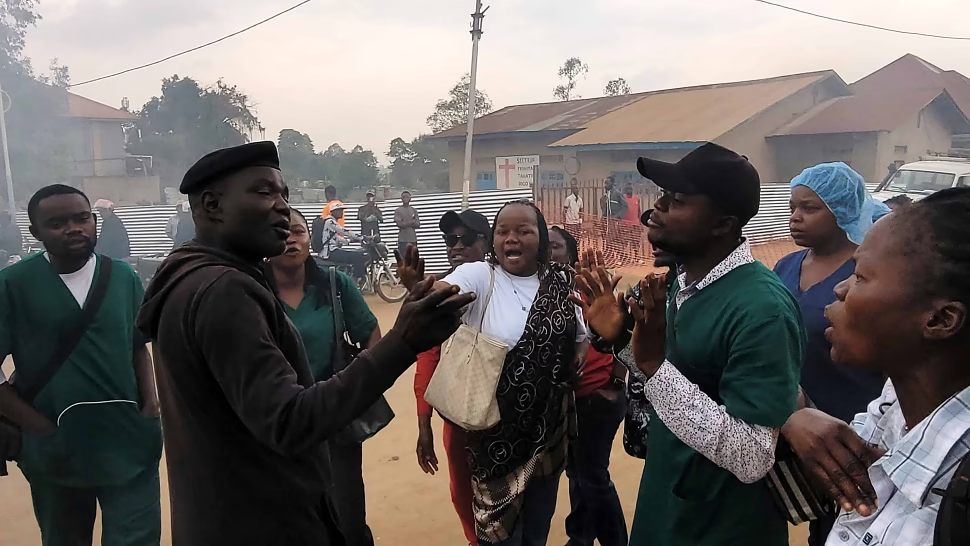
Insecurity in the province of Ituri, the most affected, complicates the response. Attacks on medical facilities—fueled by rumors and mistrust—along with lack of payment to healthcare workers are hampering the containment of the virus.

The World Health Organization (WHO) warned that 80% of new infections come from unknown transmission chains. The disease is spreading faster than teams can track. In addition, 36 health workers have died after becoming infected while providing care.

Despite the panorama, the Ministry of Health assures that it is strengthening the response. Currently 724 patients remain hospitalized or in isolation. In the last 24 hours, 22 new recoveries were reported, although authorities recognize that controlling the outbreak continues to be one of the country’s biggest health challenges.

Continue reading