The Mexican Navy under scrutiny for alleged corruption network
For years, the Mexican Navy meticulously forged a prestige based on high-impact operations, standing out for the capture of important drug trafficking leaders. This track record earned him a significant amount of trust among citizens and the recognition of international counterpart agencies, particularly the United States. However, the recent arrest of several of its members, accused of their alleged connection with a sophisticated hydrocarbon smuggling network, has plunged the military institution into a deep credibility crisis and into the eye of the hurricane of public scrutiny.
Although the investigation of the case is still in progress, the arrest of Vice Admiral Manuel Roberto Farías Laguna, who also has a family connection as a nephew-in-law of the former Secretary of the Navy, José Rafael Ojeda Durán, has shown that the corruption network reached the highest hierarchical levels of the institution. So far, the investigation has implicated fourteen individuals, including five active members of this military force, suggesting systematic infiltration.
The true magnitude of how this network of corruption permeated the structures of the Navy remains completely unclear. However, national security analysts estimate that, given the rigid vertical and hierarchical structure that characterizes the armed forces, it is very likely that the plot has originated in the high command and has spread downwards. This case calls into question the strategy of former President Andrés Manuel López Obrador (2018-2024), who delegated the administration of customs—historically the focus of powerful corruption networks—to the Navy and the Army with the express objective of eradicating these practices.
In an effort to contain the reputational damage, the Mexican president, Claudia Sheinbaum, publicly came out in defense of the institution. He assured that the corruption cases are isolated and particular events, emphasizing that the Navy collaborates fully with the Attorney General’s Office (FGR) to, in his words, “reach the ultimate consequences.”
The authorities have not yet provided an official estimate of the precise economic damage that this tax fraud represented to the public treasury. However, specialists in the energy sector, such as Gonzalo Monroy, general director of the consulting firm GMEC, have indicated that, considering the volumes of fuel stolen, the financial damage to the Mexican State could amount to millionaire amounts.
The controversial delegation of customs to SEMAR
From the beginning of its administration, the government of López Obrador raised the fight against corruption as one of the central banners of its national project. This principle was used as a fundamental argument to progressively transfer to the Army and Navy a set of functions that were traditionally carried out by civilian bodies. This vast portfolio of responsibilities included, among others, public security, the management of airports, ports, customs, a commercial airline, the distribution of medicines, road maintenance and even mega infrastructure projects.
It was in this context that in 2021, the Secretary of the Navy (SEMAR) —whose service record included legendary operations such as the capture and death in 2009 of the drug trafficker Arturo Beltrán Leyva and the arrest in 2013 of the leader of Los Zetas, Miguel Ángel Treviño— assumed the comprehensive administration of the fourteen most important seaports in the country.
From the beginning, logistics and security experts warned about the inherent risks. Ports and customs are operationally complex environments where multimillion-dollar financial flows are handled, which makes them high-risk spaces for corruption. Entrusting this task to a military institution without specific prior experience in the matter, according to analysts, constituted a monumental challenge and a calculated risk. Despite criticism, López Obrador defended his policy, arguing that the presence of sailors was crucial to intercept the entry of drugs and, paradoxically, to combat endemic corruption. “It is not militarizing, it is reinforcing surveillance in ports,” he declared at the time.
The operation that revealed the illegal plot
Mexican authorities formally announced last weekend the arrest of Farías Laguna and thirteen other people. The list of those arrested includes four active naval officers, three private sector businessmen, a retired sailor and five former customs officials, all of them allegedly linked to a network dedicated to fuel smuggling, a criminal practice known in slang as “huachicol fiscal”.
The arrests were the culmination of a months-long intelligence investigation, which led to the massive seizure of ten million liters of diesel on March 31. The fuel was located on the land of a cargo transportation company and on a tanker that had arrived weeks earlier at the port of Tampico, in the northern state of Tamaulipas, under the false declaration of transporting additives for lubricating oils.
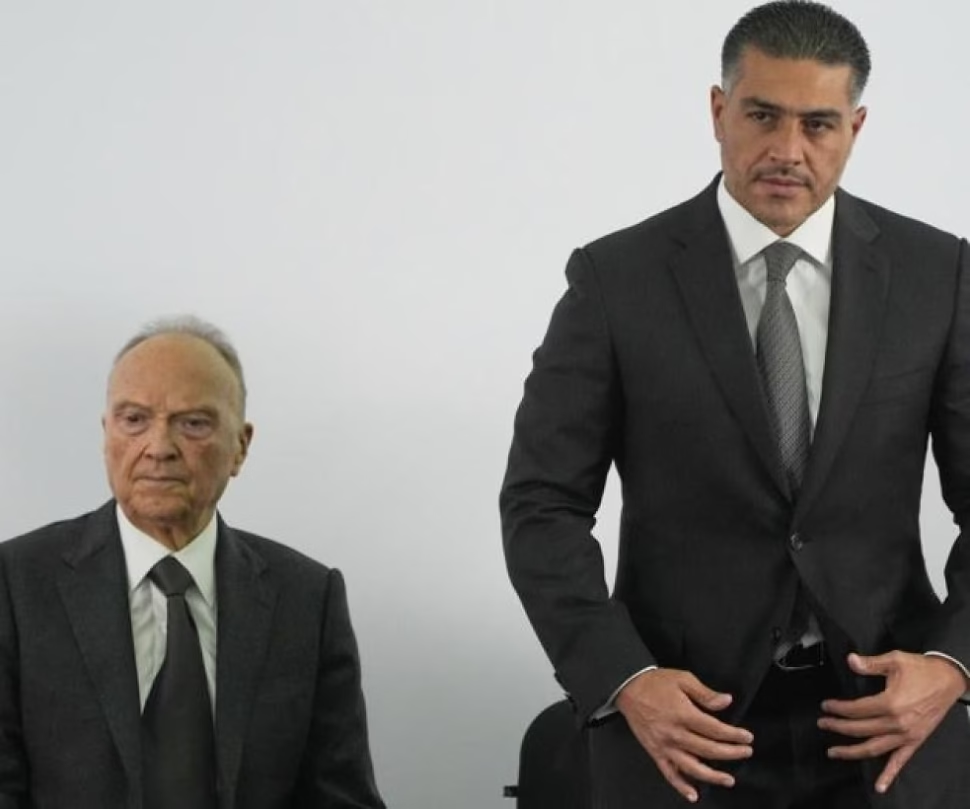
Farías Laguna, the highest-ranking officer arrested during the first eleven months of the Sheinbaum government, is identified by the FGR as the alleged mastermind of this extensive criminal network that facilitated the smuggling of millions of liters of hydrocarbons in northern Mexico. According to the statements of Attorney General Alejandro Gertz Manero, the investigations have allowed the preventive security of bank accounts totaling hundreds of millions of pesos, as well as multiple real estate properties and luxury vehicles linked to the defendants.
This scandal has been marred by tragic events. Last week, Captain Abraham Pérez Ramírez was found dead in Tamaulipas in an act reported as suicide. Although journalistic versions circulated that linked him to the smuggling case, prosecutor Gertz Manero denied this relationship, attributing the fact to a “matter of another nature.” At the same time, SEMAR reported the death of another of its members in Puerto Peñasco, Sonora, “during a routine practice exercise.” These incidents, added to the murder of Rear Admiral Fernando Guerrero last November in Manzanillo – whose case remains under investigation – add a veil of drama and complexity to the moment the institution is experiencing.
Strategic and reputational implications
The effects of this scandal transcend the merely judicial. A survey by the National Institute of Statistics and Geography (INEGI) of Mexico, released in July and prior to this case, placed the Navy as the institution with the most positive public evaluation, above the Air Force, the Army, the National Guard and all police corporations. Preserving this intangible asset of trust is, according to experts, the most urgent task.
Raúl Benítez Manaut, researcher at the National Autonomous University of Mexico and renowned security expert, highlights the critical need for the investigation to be exhaustive and transparent. He points out that if a comprehensive investigation is not carried out that “reaches all those involved, without exception or protection, the population will begin to lose confidence irreversibly.” This perception is reflected in citizen sentiment, as expressed by José Luis Campos, a 75-year-old taxi driver, who told The Associated Press: “There was respect for our forces that helped us in very difficult cases in our country, but, look, they have deceived us.”
The repercussions could also extend internationally, specifically in the crucial security relationship with the United States. Benítez Manaut suggests that this scandal could erode the trust that US agencies place in the Mexican Navy for bilateral cooperation in the combat against drug trafficking. He emphasizes that, for this reason, the institution is forced to eradicate internal corruption “with a very sharp knife” to resolve the issue at its roots and restore trust.
So far, US authorities have maintained a cautious official silence about the case, which broke out a few days before Secretary of State Marco Rubio’s visit to Mexico. At this meeting, it was agreed to establish a binational working group to supervise strategies against drug cartels, the strengthening of border security, arms trafficking, irregular migration and, significantly, the prevention of fuel theft. The express inclusion of this last point in the bilateral agenda has drawn the attention of analysts, since it did not appear as a priority in previous agreements, suggesting a shared and anticipated concern about the problem.
The transparency with which SEMAR and the Mexican government manage this institutional crisis will be decisive not only for the future of the Navy, but for the effectiveness of the national security strategy as a whole.
Does this analysis of national security seem relevant to you? Share this article on your social networks to keep your community informed and explore more specialized content in our politics and security section.