Corruption network in Marina by fiscal huachicol is dismantled

A plot of institutional corruption is exposed with key testimonies that detail the modus operandi of a million-dollar bribery network.

Mechanisms of an Institutional Corruption Network

The Attorney General of the Republic (FGR) has revealed the intricate mechanisms of a sophisticated network of institutional corruption within the Ministry of the Navy, specifically in the Tampico Customs. According to the investigations consulted, the brothers Vice Admiral Manuel Roberto Farías Laguna and Rear Admiral Fernando Farías operated through a system of intermediaries to facilitate the illegal landing of vessels loaded with fiscal huachicol.

The modus operandi consisted of the payment of million-dollar bribes to subordinates, with a fixed rate of one million seven hundred and fifty thousand pesos for each vessel that was authorized to illicitly unload within the tax precincts controlled by the institution. This operation was not spontaneous, but the result of a deliberate and systematic structure that took advantage of the chain of command and opacity in customs procedures.

RelatedNavy captain commits suicide after being accused in a huachicol network

The Protected Witness and the Quantification of Fraud

The central figure that has allowed this plot to be unraveled is the former Director of the Tampico Customs, Captain Alejandro Torres Joaquín, who is currently under the protected witness scheme collaborating with the authorities. His testimony, given before the Specialized Prosecutor’s Office for Organized Crime, provides precise and quantifiable data on the magnitude of the illicit operation.

Torres Joaquín admitted to having personally allowed the disembarkation of fourteen vessels with fuel of illicit origin between April 2024 and January 2025. The bribe payments were made with a delay of three days to one week after the vessels set sail, following a protocol designed to avoid suspicion and immediate tracking.

However, the analysis of his statement reveals a second level of diversion within the criminal network itself. Of each payment of 1.75 million pesos that he received to distribute among his eleven subordinates, Captain Torres confessed that he only distributed 330 thousand pesos among six of them, illegally appropriating one million four hundred and twenty thousand pesos for each operation. This internal embezzlement demonstrates the deep decomposition and greed that characterized the organization.

The total calculation of the illicit benefit obtained solely by Torres amounts to nineteen million seven hundred and eighty thousand pesos, derived from the fourteen vessels, while the total amount distributed among his direct collaborators was four million seven hundred and twenty thousand pesos.

Intermediaries and the Logistics Structure

The judicial investigation identifies Retired Lieutenant Commander Miguel Ángel Solano Ruiz as one of the main liaison links between the high naval commanders involved and the customs officials on the ground. According to testimony, Solano Ruiz, who is a fugitive and has an arrest warrant against him, communicated covertly using the encrypted messaging application Threema, under the alias “NK”.

The use of encryption technology and the avoidance of direct physical contact demonstrate a high degree of sophistication and criminal awareness intended to make tracking by authorities difficult. The witness reported that, although he never met Solano Ruiz personally, this individual played a crucial role in his installation in office, even facilitating the appointment of two deputy directors to consolidate his operational control over customs.

“Asking among acquaintances in the naval environment, they made reference to the fact that it is a retired Lieutenant Commander named Miguel Ángel Solano Ruiz, whom I do not have the pleasure of meeting in person and whose name does not ring a bell. I only know that he is a person who has to do with the customs system in Mexico and who has many contacts in high-level positions in the Government. From then on he does not know anything else about him,”, the witness detailed in his statement.

The investigation has led to the arrest of fourteen people, among whom are Vice Admiral Roberto Farías – nephew-in-law of the former Secretary of the Navy, Rafael Ojeda – and the six subordinates with whom Captain Torres partially shared the bribes. The list of detainees includes Captain Carlos Estudillo Villalobos, Deputy Director of Operations; Captain Sergio Varela, Deputy Director of Surveillance and Control; and Endira Xóchitl Palomo Chávez, former Head of the Department of Tax Precincts.

The list is completed by Perla Elizabeth Castro Sánchez, Head of Department and Operations; as well as Anatalia Jocelyn Gutiérrez Gutiérrez and Ismael Ricaño Matías, both merchandise verifiers. All of them are behind bars, facing charges for their alleged participation in this vast network of corruption and organized crime.

This case not only illustrates a scheme of diversion of resources and illicit enrichment, but also highlights the structural vulnerabilities that can be exploited by criminal organizations to commit tax fraud on a large scale, with the complicity of public officials in charge of national security.

Share this analysis on your social networks to keep your community informed and explore more content related to transparency and accountability in our institutions.
Renting Chapultepec Castle to FIFA does not violate the law: Culture

The official defends the rent of the historic site under the figure of payment of rights for use.

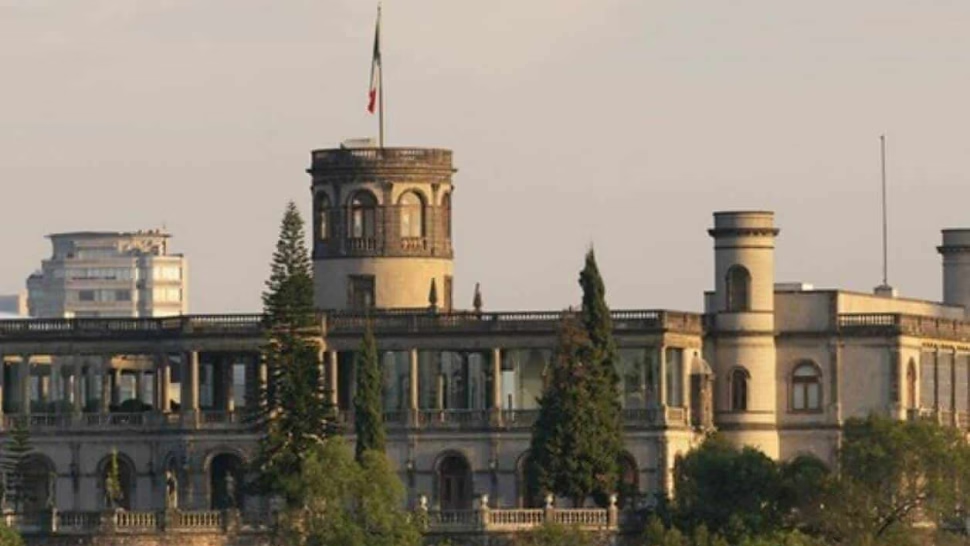
The Secretary of Culture, Claudia Curiel de Icaza, stated that the rental of Chapultepec Castle for a private FIFA event does not violate any regulations. The payment was 1 million 300 thousand pesos, under the concept of “Payment of rights for use.”

“It was an event of cultural diplomacy for us because it gave visibility to our country as a cultural host,” he declared during the morning conference on June 26.

The gala dinner, held on June 10 towards the 2026 World Cup, generated criticism on networks and led INAH investigators to prepare a formal complaint against those who authorized the use of the property.

The official version

Curiel indicated that the act complied with the law and that the director of the INAH already spoke with the protesters. “It does not proceed because there is no violation of any law, it is payment of rights for use of the space within the framework of a cultural event of cultural diplomacy,” he said.

President Claudia Sheinbaum pointed out that the complaint is of an administrative nature, not criminal. “It was not a complaint to the Prosecutor’s Office, it was administrative,” he clarified. Sheinbaum added that his participation was limited to welcoming and that he did not attend the exclusive dinner. He also recalled that FIFA paid one million pesos and that the Castle has been available for rent for a long time.

Reaction from academics

Historian Felipe Echenique and anthropologist Juan Manuel Sandoval asked the FGR to investigate those responsible for the event, considering that it transgressed national laws such as the General Law of National Assets and the Federal Law on Monuments. In the letter of complaint, cited by EL UNIVERSAL, it is argued that the violation of the rule of law was “promoted and sponsored.”

Curiel assured that they will review the complaints and that the venue’s legal department follows an internal procedure. The debate on the use of heritage spaces for private purposes remains open.

Continue reading

Network of museums and archaeological zones registers an increase of 18%

Investment of 400 million pesos and improvements in security increase visits to museums and archaeological sites.

Record attendance

The Secretary of Culture, Claudia Curiel de Icaza, reported that the country’s Network of Museums and Archaeological Zones increased its visitors by 18%. In the last two years, 57 million visits were registered, driven by an investment of 400 million pesos in infrastructure.

“It is relevant because we have strengthened the infrastructure with an investment of 400 million pesos, and many of us were accompanied to Teotihuacán with all the new signage, the new Museum of Mayan Grandeur,” he declared during the morning conference.

Security measures in Teotihuacán

The official highlighted the actions implemented in the Teotihuacán Archaeological Zone, where on April 20, a violent event occurred in the Pyramid of the Moon. Although he did not give details, he stressed that security operations have been reinforced to guarantee the visit.

The increase in visitors is also linked to the upcoming 2026 Soccer World Cup. Museums of the INAH, INBAL and the Ministry of Culture have mounted temporary exhibitions on the Mesoamerican ball game, an ancestral tradition of more than a thousand years.

“You know that the ball game is one of the most important ancestral ceremonies where the ball has been played in Mexico, in our country since Mesoamerican times for more than a thousand years,” said Curiel.

Featured exhibitions

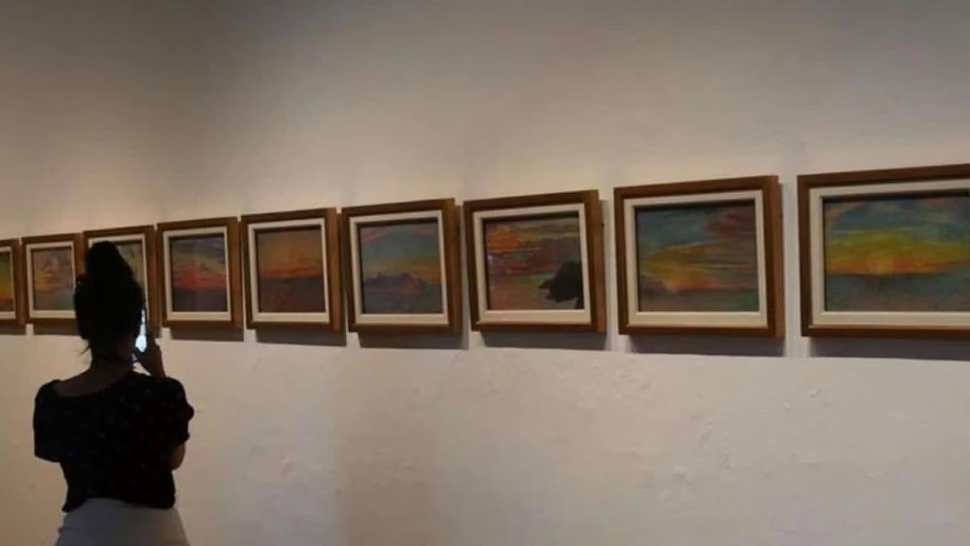
Among the exhibits he mentioned the Museo Templo Mayor about the Ball Game in Tenochtitlan, and the National Museum of Anthropology exhibits photographs by Annie Leibovitz about the 1986 World Cup. In Fine Arts, “Aztlán” is presented, Chicano art and muralism by Roberto Montenegro. In the Museum of Modern Art there are permanent collections and experiences such as Sunrises and Sunsets in archaeological zones of Tula, Xochicalco and Boca de Potrerillos.

Continue reading

Sheinbaum asks Felipe VI to apologize for abuses in the Conquest

Sheinbaum apologized to King Felipe VI for abuses during the Conquest.

Meeting at the National Palace

President Claudia Sheinbaum revealed that during her meeting with King Felipe VI she addressed the request for an official apology from the Spanish Crown for the abuses committed during the Conquest.

Sheinbaum explained that the monarch listened carefully and proposed installing a working table on indigenous peoples at the next Ibero-American Summit, scheduled for November in Madrid.

The key points of the dialogue

The president highlighted that in Mexico 28 million people recognize themselves as indigenous and 69 languages are spoken. He stressed that the recognition of pre-Hispanic civilizations is part of national identity and a fight against discrimination and racism.

“For us it is a matter of dignity,” said the head of the Executive.

Cultural agreements

During the meeting, it was agreed to send three Mexican exhibitions to Spain: one on Spanish republican refugees, another on Sor Juana Inés de la Cruz and a third on Mayan culture.

Sheinbaum described the meeting as cordial and stressed that the king is “a very simple person.” He also recalled that in 2019 the Spanish government recognized the abuses committed during the arrival of the Spanish, a gesture that facilitated the current dialogue.

After the meeting, Felipe VI traveled to Guadalajara to watch the Spain-Uruguay match at the 2026 FIFA World Cup.

Continue reading