Digital surveillance in advertising and the role of influencers

Technology and content creators collect your data in ways you can't imagine. Discover how your private life becomes a product.

It’s not paranoia, it’s advertising: Welcome to the Big Brother of consumption

Have you ever had that glitch in the Matrix feeling of searching for a specific pair of sneakers and then seeing them haunt you in every corner of the internet as if they were an Among Us meme? Well, grab your trendy drink and sit back, because it’s no coincidence. It’s not that the algorithm has psychic powers; is that there is a Big Brother of advertising that tracks you with the same dedication with which you stalk your ex’s stories. And he does it in ways that would make George Orwell blush.

Imagine this side quest from real life: you enter your usual self-service store, the one that always promises low prices, but what they don’t tell you is that the cameras on the ceiling are now the eyes of an Artificial Intelligence system. This AI doesn’t just count inventory; It scans you, analyzes your gender, and estimates your age group with the precision of a TikTok filter. Then, they kindly ask you to scan a QR code which, surprise, has already analyzed your characteristics to show you “personalized” products. Basically, it’s like a super intrusive salesperson following you around the halls whispering offers based on your looks. Comfortable? We call it terrifyingly efficient.

RelatedMeta and Alphabet’s dominance in digital advertising and emerging alternatives

Your shopping cart is a data mine (and you didn’t know it)

According to the study “Surveillance of digital consumers” by Teck Check and El Poder del Consumidor, these cameras basically “track” you through the hallways. They count what you see, what you touch (yes, even that package of cookies you later guiltily returned to the shelf), measure your length of stay, and even analyze your behavior in the checkout line. All this information is converted into data parameters to create a profile of you as a consumer. And in case you were wondering, no, this is not science fiction. These practices are implemented in 173 Walmart stores and in the majority of Sam’s Club establishments in Mexico. Our weekly trips for toilet paper and snacks will never be the same.

But the plot twist doesn’t end there. While you thought that influencers only wanted your like and comment, the reality is more complex. Through the famous affiliate programs, these content creators are also building databases of their followers. How does this level up work in collecting information? Each fan is assigned a unique identification code. When you click the link in their bio or use their discount code, the system can track exactly what you purchased. Thus, the company can determine if the influencer managed to motivate a purchase and, therefore, receives its commission. That is, your trust in your favorite influencer translates directly into sellable data and commissions. It’s not just a haul, it’s a market intelligence report with your name on it.

The dark side of recommendations and the dystopian future

The problem worsens when we consider that influencers can sell this data to companies. And worse yet, they may be promoting products that they have never tried or that, from their experience, are not even the best option. We are talking about products that can be dangerous for consumers. It is the unboxing of misinformation, where transparency is conspicuous by its absence.

And if you think this is as black mirror as it gets, wait until you see the next chapter: the use of biometric data. We’re talking about fingerprints and facial recognition to identify people and create “much smarter profiles of customer behavior for commercial purposes.” Basically, your face could be the next barcode. The central problem, and this is where things get serious, is that in Mexico there is an abysmal lag in advertising regulation. While in European countries there are strict measures to protect privacy and offer greater protection to citizens, here it seems that we are in the digital Wild West.

The organizations behind the study assure that it is urgent to “investigate how platforms and social networks operate, demand transparency and explainability, stop abusive advertising, repair damages when personal data have been exposed and establish limits on the use of sensitive information, especially in the case of girls, boys and adolescents.” In other words, we need to move from being data products to digital citizens with rights. The next time an ad seems suspiciously accurate, remember that it’s not magic, it’s corporate surveillance. And it is up to us to demand a change.

Have you found this journey through the dark side of digital advertising revealing?Share this article on your social networks so that more people discover how their data is turned into merchandise and explore more related content to learn how to protect your privacy online.


Olivia Rodrigo joins Fortnite Festival with new collaboration

Olivia Rodrigo comes to Fortnite with outfits and emotes inspired by her albums.

Singer Olivia Rodrigo lands in Fortnite

The Epic Games platform incorporates Olivia Rodrigo’s Y2K and grunge aesthetic. The collaboration includes outfits, gestures and songs from the American artist within the Fortnite Festival.

The announcement was made this Thursday through social networks. The three-time Grammy winner shared the news alongside the game’s official accounts.

Collaboration details

Two main outfits are available:

  • Olivia Rodrigo SOUR: inspired by the cheerleader outfit from the “good 4 you” video. Includes a LEGO minifigure version.
  • Olivia Rodrigo Lover Girl: based on her new musical stage with the album “You Seem Pretty Sad For A Girl So In Love”, released on June 12. Also includes LEGO minifigure.

The thematic gestures reflect the different eras of the singer. “good 4 u” incorporates broken mirror and flame effects. “maggots for brains” uses hearts and fairy dust.

Additional articles

  • Olivia Butterfly Wings Backpack.
  • Retro backpack Collection of Stickers on Fire.
  • Three improvisation tracks: “drop dead”, “maggots for brains” and “deja vu”.

The collaboration seeks to unite digital fashion, modern music and new experiences within the Fortnite Festival.

Continue reading

AI becomes a dating coach, but divides opinions

Users turn to chatbots to start romantic conversations, but doubts persist about authenticity.

The role of AI in modern romance

Marie Lansley recently arrived in San Francisco and, while looking for a partner, decided to try artificial intelligence. “I’ve tried everything,” says the 36-year-old engineer, who consults chatbots like ChatGPT and Claude to help her start conversations on dating apps. “I’m open to AI finding the love of my life, but I’m not totally convinced,” she says. “Chemistry is always going to be analog.”

More and more people are using chatbots to compose messages or interpret responses. Dating coach Carey Gaynes compares him to Cyrano de Bergerac: “You’re using a voice that’s not your own.” He worries about overdependence, although he recognizes that it can be useful.

Mason Naung, a 25-year-old student in Los Angeles, only turns to AI to break the initial ice. “If the messages go further, it would be a small warning sign,” he says. San Diego businesswoman Dani Cohen prefers an AI-written farewell message to being ghosted. “Anything that gets people to communicate in a friendly way is great,” he says.

Other voices are more critical. Clara Sullivan, a 22-year-old student, would not respond to a profile that uses AI. “It’s scary how dependent people are. It’s taken away the ability to think creatively,” he says. A Pew Research Center survey reveals that 53% of US adults believe AI will worsen creativity, and half think it will affect meaningful relationships.

Dating apps already integrate AI. Tinder has Chemistry, Hinge uses AI launchers, and Bumble plans to eliminate swipe to prioritize automated matching. Its CEO, Whitney Wolfe Herd, says that technology “should make love feel more human, not less.”

Mohammed Nizami, 23, does not use AI for dating. “We all crave authentic connection. If there’s a filter, it’s not a good way to start,” he says. Jake Clay, a content creator in New York, calls the situation a “vicious cycle” that bypasses sacred processes of life. “It’s sad to delegate something so fundamental to an AI that doesn’t understand emotions,” he laments.

Despite reservations, the merger between AI and dating seems inevitable. Efficiency gains ground, but authenticity remains the challenge.

Continue reading

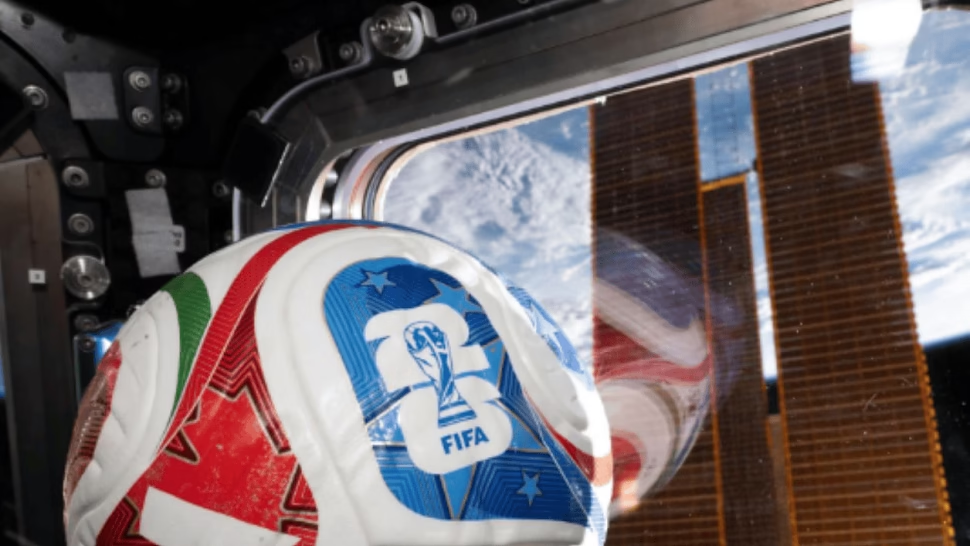
NASA takes the 2026 World Cup ball into space and plays it on the ISS

NASA sent an official 2026 World Cup ball into space and opened an exhibition in Houston.

World Cup ball arrives at the International Space Station

The fever of the 2026 World Cup permeated the atmosphere. NASA sent an official World Cup ball to the International Space Station (ISS). In a video shared on social networks, four astronauts are seen playing with the ball in microgravity. The message: “We work to inspire the next generation by showing how space exploration drives innovation in sports science.”

The agency seeks to disseminate how research on the ISS generates advances in science, technology and human health. Benefits that even reach the soccer field.

Exhibition at the FIFA Fan Fest in Houston

NASA set up an exhibit at the FIFA Fan Fest in Houston, Texas. It opened on June 11 at the start of the World Cup and will be available until July 19. Visitors can discover how space research improves life on Earth and learn about the Artemis program missions.

The exhibition explains how more than 25 years of studies on the ISS have helped understand the aerodynamics of the ball. According to a statement from the Johnson Space Center, previous research analyzed how internal mass, sensors and seam texture affect stability and rotation under real-play conditions.

Science applied to sports

As part of the project, NASA and Adidas present the “STEMonstration” demo. They compare how balls spin with different balance in microgravity. The objective: to show that space discoveries benefit athletes and fans of the most popular sport in the world.

Continue reading