Res judicata confronts ministers Esquivel and Batres

SCJN ministers clash over applying the principle of res judicata in a business tax case.

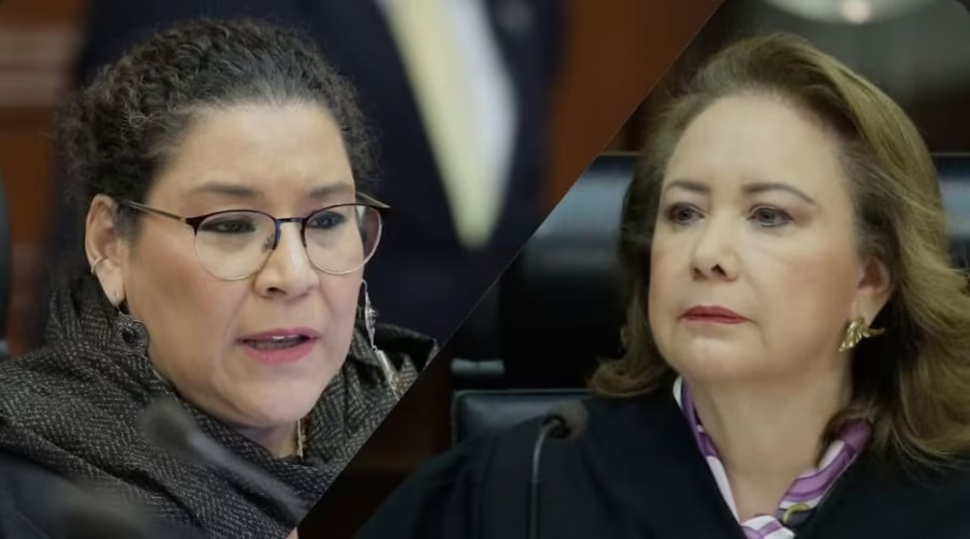
The principle of res judicata once again divided the plenary session of the Supreme Court of Justice of the Nation (SCJN). Minister Yasmín Esquivel Mossa and Lenia Batres Guadarrama presented opposing positions on the possibility of bringing back an issue related to a business tax credit.

Positions found

During last Thursday’s session, Esquivel criticized the insistence on attracting the case, after the defunct Second Chamber had already rejected the request. He maintained that there is a “firm and definitive” resolution, which is why he considered it inappropriate to discuss the issue again within the High Court.

RelatedProtests mark the arrival of Lenia Batres to Tabasco

The minister pointed out that the company involved has the right to have a previously resolved decision respected. He warned that pressing the case could be interpreted as a form of undue pressure. He recalled that judicial doctrine recognizes res judicata as “a definitive and unmodifiable truth” that cannot be reviewed.

Lenia Batres, known as the “Minister of the People”, rejected that the request implies res judicata. He argued that the SCJN regulations allow voting on the same project on different occasions and maintained that attracting an issue does not mean resolving it in substance.

The debate revived differences already expressed in November 2025, when both ministers discussed the limits of res judicata in cases of possible procedural fraud. Esquivel defended the need to provide certainty and definitive closure to judicial processes. Batres warned that a rigid application of the principle could prevent the review of fraudulent acts and affect legal certainty.
Controversy over an interview with Monsiváis reaches the Senate and the Palace

The republication of a 1999 interview unleashes accusations between the Executive and legislators.

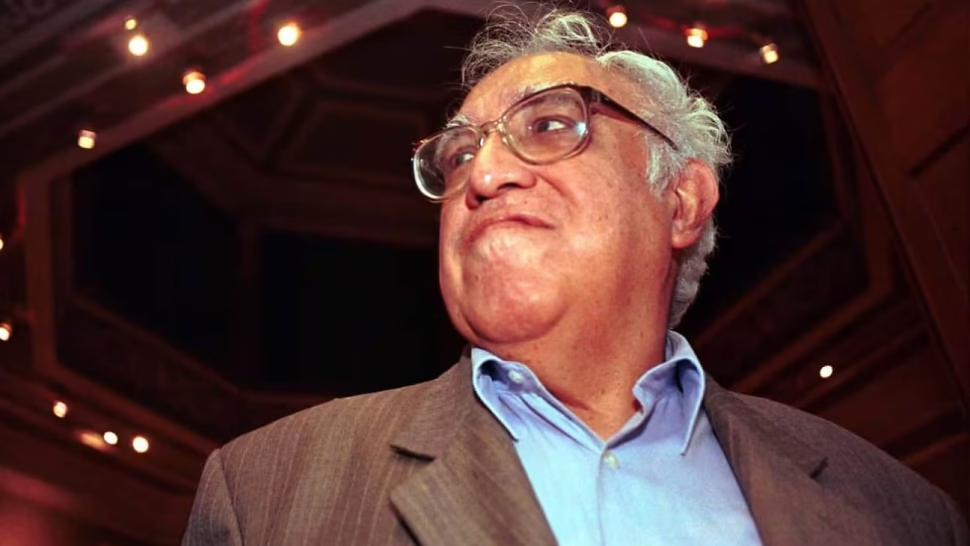
The republication of an old interview attributed to Carlos Monsiváis climbed to the center of the Mexican political debate this Wednesday. The issue was discussed both in the Senate and in President Claudia Sheinbaum’s morning conference.

The original text was written by journalist Edmundo Cázares in 1999 and recently republished by El Universal. It contains statements about the then head of Government Andrés Manuel López Obrador. Its veracity and context have been questioned, generating conflicting positions.

Sheinbaum describes the content as “grotesque”

During her conference, the president harshly criticized the publication. He described the content as “grotesque” and accused the medium of generating a controversy that distorts the tribute to the Mexican intellectual.

Reactions in the Senate

The issue also reached Congress. Senator Lilly Téllez read fragments of the text on the platform. In response, Gerardo Fernández Noroña rejected its use and maintained that it was a false publication with the intention of political attack.

The exchange reflects the polarization around the figure of López Obrador and the use of historical documents as partisan weapons.

Continue reading

PRI demands urgent action against violence in Guerrero

They denounce an incursion of armed civilians in Coyuca de Catalán; party calls for state intervention.

The national leadership of the PRI demanded that the Mexican State intervene urgently in response to the complaint by inhabitants of the Guajes de Ayala ejido, in Coyuca de Catalán, Guerrero. The residents reported the incursion of armed civilians into their community in the Sierra.

Call for safety

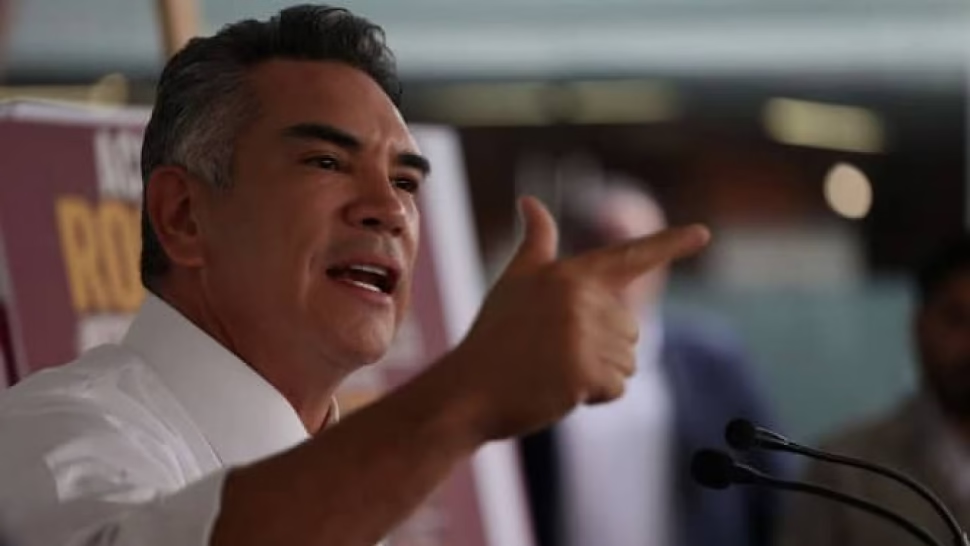
Alejandro Moreno Cárdenas, president of the party, asked the authorities to guarantee the safety of the families. He warned that these events should not be normalized due to the risk they represent for the civilian population.

The leader pointed out that in various communities in Guerrero they live under siege by armed groups. This has caused displacement, confinement of inhabitants and a constant climate of fear and uncertainty. He considered an immediate response from the State necessary.

Moreno Cárdenas also criticized the federal government for minimizing the situation of violence in the country. He affirmed that the population faces conditions of insecurity that require priority attention to restore the rule of law in the region.

Continue reading

Inflation in Mexico slows down and remains at Banxico’s goal

Inflation drops to 3.55% in the first half of June, within Banxico's target range.

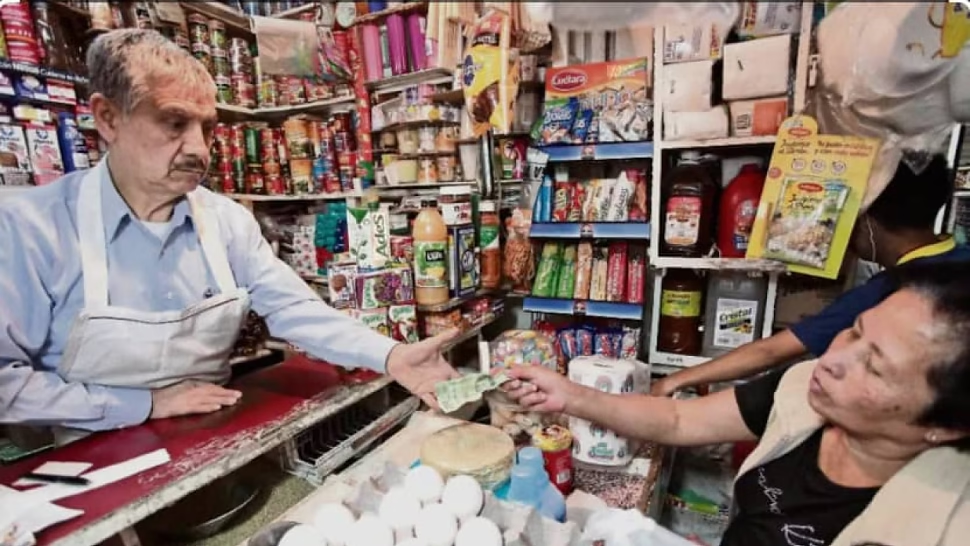
Inflation in Mexico continues to decline. According to Inegi, it stood at 3.55% annually during the first half of June. This represents a drop of 0.11 percentage points compared to the second half of May.

With three consecutive months of deceleration, the indicator remains within Banxico’s target range (3% plus/minus one point). This level is key for purchasing power.

Pressures on core inflation

However, pressures remain. Core inflation—which reflects medium and long-term trends—was at 4.12%, with a biweekly increase of 0.19 points. Within this category, merchandise rose 3.65% annually and services, 4.57%.

Non-core inflation and seasonality

In contrast, non-core inflation slowed to 1.61% annually, driven by the drop in agricultural prices. Products such as tomatoes, eggs and poblano peppers recorded significant decreases.

The report also reflected seasonal movements in tourist services, related to the summer and the Soccer World Cup. Air transportation, hotels and tour packages increased. Despite this, analysts foresee a favorable trend towards the end of the year.

Continue reading